
On Australian Mathematics Competition (AMC) exam day in China — Sunday 11 October 2026 for the ASDAN-administered region — your child sits one level-appropriate paper of 30 questions out of 135 marks, delivered online or on printed paper, in roughly 60 minutes for primary levels and 75 minutes for secondary levels, with no penalty for wrong answers. The China-region paper is provided in English and Chinese. This guide walks through the day itself so there are no surprises.
The day at a glance (China region, 2026)
| Exam day | Sunday 11 October 2026 (China region; registration closes 28 September 2026) |
| What is sat | One paper for your level — 30 questions, 25 multiple-choice + 5 integer-answer, out of 135 marks |
| Delivery | Online or printed paper (the AMT offers both formats) — your school/centre confirms which you sit |
| Time allowed | Primary levels around 60 minutes; secondary levels around 75 minutes |
| Language | Bilingual English & Chinese in the China region |
| Marking | Marks rise as questions get harder; no penalty for an incorrect answer |
| Equipment (e.g. calculators) | Set by the competition — confirm on the official site before the day |
Dates, format and the rules on equipment are set by the Australian Maths Trust and, for the China region, by ASDAN (阿思丹), and can change each year. Always confirm the live details on the official channels before exam day. For the background on levels and scoring, see what the Australian AMC is.
Online or paper: what changes, what doesn't
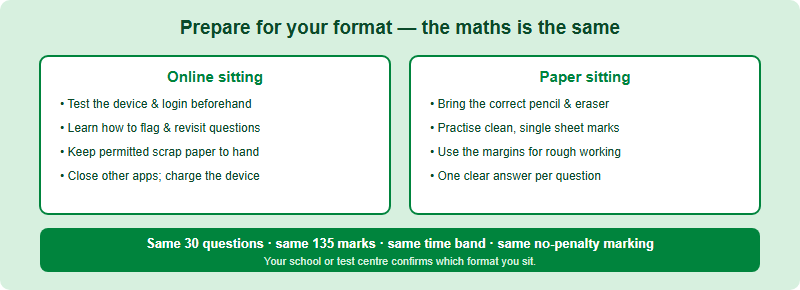
The AMT delivers the AMC in two formats — online and printed paper — and the one you sit is set by your school or test centre, not chosen on the day. The mathematics, the 30-question structure, the 135 marks and the no-penalty rule are identical across both. What differs is the mechanics:
| Aspect | Online sitting | Paper sitting |
| Answering | Enter answers on screen; check the interface lets you flag and revisit questions | Shade the answer sheet carefully; bring/confirm the correct pencil |
| Rough working | Usually on your own scrap paper beside the device — confirm what is allowed | Margins and provided space; keep working tidy |
| What to test beforehand | Device, login, and that the platform loads — do a practice run if offered | Know how to fill the sheet; one clear mark per question |
| Same for both | Same questions, same 135 marks, same time band, same no-penalty marking | |
If your child sits online, the single most useful preparation is a low-stakes dry run on the same kind of device, so the interface is familiar and exam time is spent on maths, not menus. If your child sits on paper, practise filling an answer sheet cleanly — a smudged or double-marked multiple-choice bubble can cost a mark the maths earned.
The bilingual paper, and the no-penalty mindset
A practical advantage for China-region students: the paper is offered in English and Chinese. For younger students at Pre-A and Level A, this removes a language hurdle so the test measures mathematical thinking rather than reading speed in a second language. Encourage your child to read whichever language they parse fastest, and to cross-check a tricky wording in the other language if something is ambiguous.
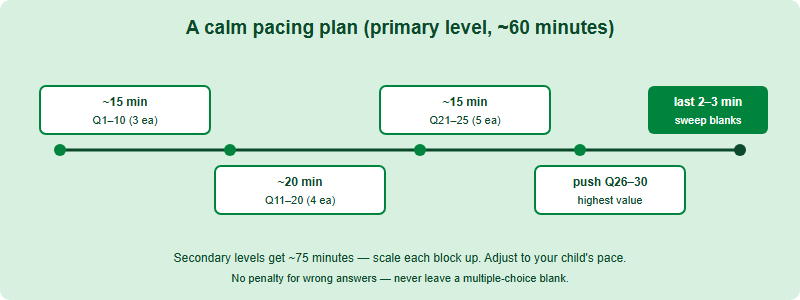
The mindset that matters most on the day flows from one rule: there is no penalty for a wrong answer. That single fact should shape behaviour in the room:
- Attempt every multiple-choice question. A blank scores zero; a reasoned guess can only help.
- Don't get stuck. If a question resists for a couple of minutes, mark a best answer, flag it, and move on — there are easier marks waiting further down.
- Protect the easy marks. A careless slip on a 3-mark warm-up question costs exactly as much as missing a hard one. Re-read what each question is actually asking.
- Save the final minutes for a sweep to fill any remaining blanks. For the full marking logic behind this, see our guide to how the AMC is scored.
A simple exam-day checklist for parents and students
Most of a calm exam day is settled the night before. From our China-region desk, a short list that covers the essentials:
- Confirm the basics: your sitting format (online or paper), the start time, and the venue or login — your school or centre is the source of truth.
- Equipment: bring what is permitted and nothing that is not. Whether calculators or other aids are allowed is set by the competition — confirm on the official site rather than assuming.
- For online sitters: charge the device, test the login, and close other apps. Keep permitted scrap paper to hand if allowed.
- For paper sitters: bring the right pencil and an eraser; practise clean, single answer-sheet marks.
- Mindset: remind your child that every question can be attempted, that the early questions are the most valuable to secure, and that one hard question is not worth losing five easy marks over.
- Afterwards: awards are decided by percentile and released later by the organiser; the raw score alone does not tell the whole story.
Remember too that this is the Australian AMC (Australian Maths Trust, since 1978), administered in China by ASDAN — a different competition from the American AMC (MAA) and the Singapore-run AMO. If you are still deciding on a level for the 11 October sitting, our foundation guide lays out all six levels from Pre-A to E.
Frequently asked questions
When is the Australian AMC exam day in China in 2026?
Sunday 11 October 2026 for the ASDAN-administered China region, with registration closing 28 September 2026. Confirm the live dates on the official channels.
Is the China-region AMC sat online or on paper?
The AMT offers both online and printed-paper formats; your school or test centre confirms which you sit. The questions and marking are the same either way.
Are calculators allowed in the Australian AMC?
Equipment rules are set by the competition and can change — confirm on the official site before exam day rather than assuming.
How long is the exam?
Around 60 minutes for primary levels and 75 minutes for secondary levels, for a 30-question paper. Confirm your level's timing on the official site.
Published by the Australian AMC editorial desk, operated by Hanlin Education for China-based international-school students. The Australian Mathematics Competition is run by the Australian Maths Trust (AMT) and administered in the China and Asia region by ASDAN (阿思丹); the American AMC (MAA) and the AMO (SIMCC) are separate competitions. Official rules, dates and equipment policies are set by the competition and change yearly — confirm current details on amt.edu.au. Any confirmed error is corrected within 7 working days.