
The Australian AMC is a 30-question, 135-mark paper made up of 25 multiple-choice and 5 integer questions, and crucially there is no penalty for a wrong answer (per amt.edu.au). That single rule changes how you should spend the last 20 minutes. This guide breaks down the integer-answer questions and the high-value “back five” (Q26–30, worth 6 to 10 marks each) so you convert effort into marks.
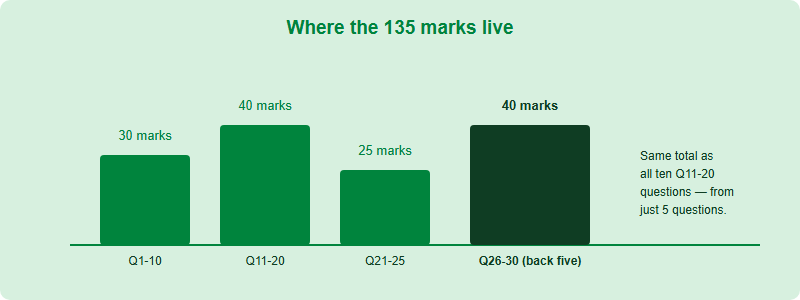
How the 135 marks are actually distributed
Before any strategy, you need the marking map. The Australian Maths Trust sets the same weighting for every level, Pre-A through E. Marks climb steeply toward the end of the paper, which is exactly why a plan for the final questions matters more than rushing the early ones.
| Question band | Marks each | Question type | Band total |
|---|---|---|---|
| Q1–10 | 3 marks | Multiple-choice | 30 |
| Q11–20 | 4 marks | Multiple-choice | 40 |
| Q21–25 | 5 marks | Multiple-choice | 25 |
| Q26 | 6 marks | Integer (0–999) | 6 |
| Q27 | 7 marks | Integer (0–999) | 7 |
| Q28 | 8 marks | Integer (0–999) | 8 |
| Q29 | 9 marks | Integer (0–999) | 9 |
| Q30 | 10 marks | Integer (0–999) | 10 |
The last five questions alone carry 40 of the 135 marks — the same total as Q11–20. A student who lands even two of the back five out-scores a student who merely finishes the first twenty. The exact maximum integer value and band cut-offs can vary by year, so treat 0–999 as the working assumption and confirm current paper rules on the official site.
What an integer question actually is — and why it is harder than MCQ
For Q1–25 you choose from five options (A–E). For Q26–30 you instead write a numeric answer onto the answer sheet. Two consequences follow directly:
- No five-way guess. On a multiple-choice question a blind guess is roughly a 1-in-5 shot. On an integer question, a blind guess across hundreds of possible values is effectively zero. You only score if your arithmetic actually lands.
- No back-solving from options. A favourite MCQ trick is to test the five answers and see which fits. Integer questions remove that ladder — you must construct the answer forward.
Because there is no penalty, you should still write something in every integer box if you can produce a defensible number. But the smarter move is to spend your time where a partial, structured attempt can reach a correct integer, rather than scattering wild guesses. If you want the foundational picture of how the whole paper is built, start with our What Is the Australian AMC guide.
A time budget that respects the mark map
Primary divisions (Pre-A, A, B) get 60 minutes; secondary divisions (C, D, E) get 75 minutes (per amt.edu.au). The instinct is to spend equal time per question. Resist it. Here is a budget tuned to where marks live, for a secondary 75-minute paper — scale proportionally for the 60-minute primary papers.
| Phase | Questions | Time | Goal |
|---|---|---|---|
| Warm-up | Q1–10 | ~15 min | Bank the 30 easy marks cleanly; no careless slips. |
| Core | Q11–20 | ~22 min | Steady accuracy; this is your largest single band (40 marks). |
| Stretch | Q21–25 | ~18 min | Attempt all; flag any you cannot crack and move on. |
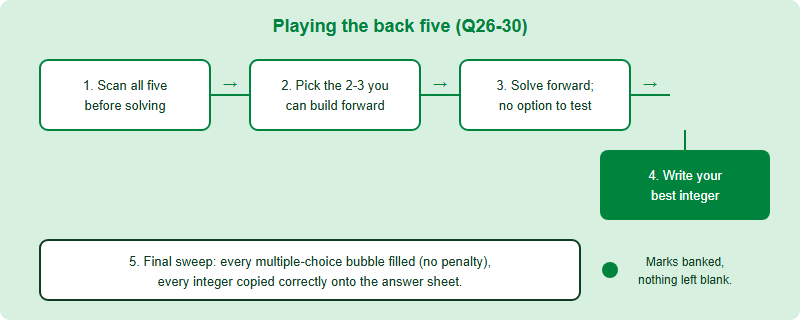
| Back five | Q26–30 | ~18 min | Pick the 2–3 integer questions you can genuinely build; write a number in every box. |
| Sweep | Whole paper | ~2 min | Fill any blank MCQ bubble (no penalty) and re-check transcription. |
The “sweep” line is the cheapest marks on the paper. Because wrong answers cost nothing, an empty multiple-choice bubble is a strictly worse choice than a guess. Leaving the room with blank A–E bubbles is the single most common avoidable error.
Four habits that turn integer questions into marks
- Restate the target. Integer questions often ask for a count, a sum, a remainder, or a final coordinate. Underline exactly what number is wanted before you compute — many lost marks are correct working that answers the wrong question.
- Bound the answer. If the working value is in the hundreds and the sheet expects a value within the allowed range, an out-of-range result is a flag to recheck. Use the range as a sanity test.
- Carry units and digits carefully. A transcription slip (writing 84 instead of 48) wastes a fully solved question. Re-read the box you wrote.
- Bank, don’t chase. Q30 is worth 10 marks but is the hardest on the paper. If Q26 and Q27 are within reach, those 13 marks are usually a better bet than a single heroic attempt at Q30. Difficulty rises with mark value by design.
For how these scores then translate into Credit, Distinction and High Distinction bands, read our companion piece on how the Australian AMC is structured and recognised, and remember that all award cut-offs are set per year level and region and confirmed on the official site.
The kinds of maths the back five tends to test
The Australian AMC draws its hardest questions from a small number of recurring problem families. You cannot predict the exact questions, but you can recognise the territory and prepare the right tools. Across past papers, the integer block typically leans on:
| Problem family | What it asks for | Tool to rehearse |
|---|---|---|
| Counting & combinatorics | How many arrangements, paths, or selections satisfy a rule. | Systematic casework; multiplication and addition principles. |
| Number theory | Remainders, divisibility, digit sums, last-digit patterns. | Modular thinking; spotting cycles in remainders. |
| Geometry with a numeric answer | A length, area, angle measure, or count of regions, as an integer. | Coordinate setups; area decomposition; the Pythagorean relation. |
| Sequences & patterns | The nth term, a running total, or when a pattern first repeats. | Find the rule, then jump ahead rather than listing every term. |
| Logic & invariants | A final state after repeated operations, or what cannot change. | Look for a quantity that stays fixed; work small cases first. |
A practical drill: take any past back-five question, and before solving, label which family it belongs to. That single habit speeds up your choice of method under time pressure, because the family points you at the tool. The exact mix varies by level — Pre-A and A lean on counting and patterns, while D and E reach into deeper number theory and geometry — so calibrate your practice to the division you are entering. For the level breakdown, our Australian AMC guide lays out Pre-A through E.
How to think through one without copying any specific question: suppose the back five asks for a count of something defined by a rule. Rather than trying to list every possibility, the efficient student splits the situation into a few non-overlapping cases, counts each with the multiplication principle, and adds the cases. The discipline — cases that do not overlap, cases that cover everything — is what converts a scary “how many” into a clean integer. That structure, not raw cleverness, is what the back five rewards most often.
Practising the integer block before exam day
Most students drill multiple-choice and never rehearse the integer format. In the final weeks, do at least a few timed runs where you treat Q26–30 as a separate mini-exam: 18 minutes, no options to lean on, answer written as a number. The goal is not to “finish the paper” — almost no one does — but to make forward construction automatic so the back five stop feeling like a wall.
One note on what is true across calendars: the China-region Australian AMC sits on 11 October 2026 with registration closing 28 September 2026 (via the ASDAN China-region pathway), while Australia’s own sitting runs in early August. The paper structure — 30 questions, 135 marks, no penalty, integer back five — is the same; only dates and logistics differ by region, so confirm your sitting's details with the official channels.
Frequently asked questions
How many integer questions are on the Australian AMC?
Five: questions 26 to 30. The first 25 are multiple-choice. Together the paper has 30 questions and a maximum of 135 marks (per amt.edu.au).
Is there a penalty for wrong answers on the AMC?
No. The Australian Maths Trust states there is no penalty for incorrect responses, so you should fill every multiple-choice bubble even when guessing.
How much is each back-five question worth?
Q26 is 6 marks, Q27 is 7, Q28 is 8, Q29 is 9 and Q30 is 10 — 40 marks in total from the final five questions. Confirm current weightings on the official site.
Should I attempt Q30 first because it is worth the most?
Usually no. Q30 is the hardest question. Securing two easier back-five integers often yields more marks than one attempt at Q30.
Published by the Australian AMC editorial desk, operated by Hanlin Education for China-based international-school students. The Australian Mathematics Competition is run by the Australian Maths Trust (AMT, since 1978), with the China region operated by ASDAN; official rules are set by the competition and change yearly — confirm current details on amt.edu.au. Corrections are made within 7 working days.