
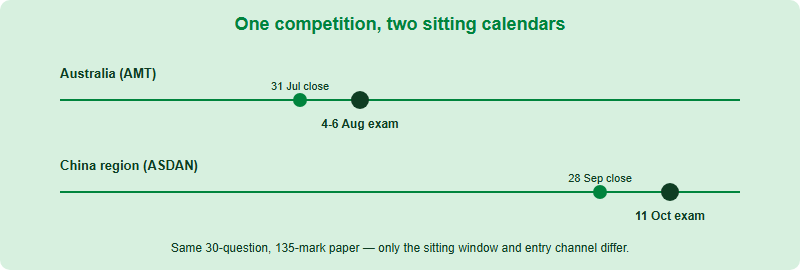
If you search “Australian AMC date” you will find two different answers, and both can be correct. Australia's own competition runs in early August 2026; the China region sits the same paper on 11 October 2026, with registration closing 28 September 2026 through the ASDAN China-region pathway. This guide explains why one competition has two calendars and how China-based students should plan around the October date.
Same paper, different sitting dates
The Australian Mathematics Competition is run by the Australian Maths Trust (AMT, since 1978). In Australia, the 2026 competition runs from Tuesday 4 to Thursday 6 August 2026, with online entry closing Friday 31 July 2026 (per amt.edu.au). The China region is operated by ASDAN, which schedules a sitting suited to the Chinese international-school calendar — for 2026 that is 11 October, registration closing 28 September. The competition content is the same Australian AMC; only the sitting window and the registration channel differ.
| Detail | Australia (AMT) | China region (ASDAN) |
|---|---|---|
| 2026 exam window | 4–6 August 2026 | 11 October 2026 |
| Registration closes | 31 July 2026 | 28 September 2026 |
| Registration channel | Australian school portal | ASDAN China-region entry |
| Paper structure | Identical: 30 questions, max 135 marks, no penalty, integer back five | |
| Levels | Identical: Pre-A to E (Grades 1–12 in China-region terms) | |
| Language | English | Bilingual (per ASDAN) |
The practical takeaway: do not put the August date in your calendar if you are sitting in China. Use 11 October 2026 and the 28 September registration deadline, and confirm both on the official channels before you commit, because dates are set each year and can change. For the full picture of how the competition is built, see our What Is the Australian AMC guide.
Why a later China date is actually an advantage
The October sitting is not a downgrade — for many China-based students it is a better fit, for three concrete reasons.
- It lands after the new school year settles. An August date collides with the summer break and the start-of-term scramble. October gives students several weeks of term routine before exam day.
- The summer becomes prep runway. Instead of cramming into July, you can use the July–August holiday as structured practice time and the September weeks as a sharpening phase, sitting fresh in mid-October.
- Registration closes when families are back. A 28 September deadline falls in term, when school maths departments and parents are organised, rather than mid-holiday.
The risk that comes with a later date is complacency: “October feels far away” in June, and then the 28 September deadline arrives faster than expected. The fix is to fix the registration date in your calendar now and treat late September as a hard wall.
A backward-planned timeline to 11 October
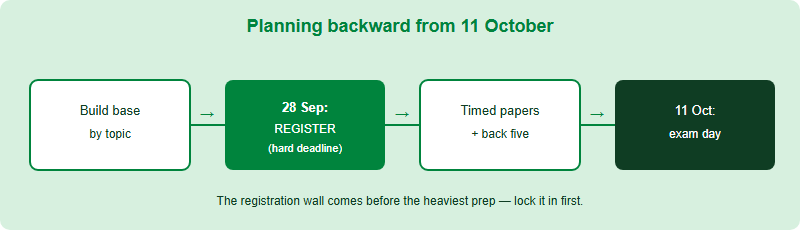
Work back from exam day. This is a sensible default skeleton for a China-based student; adjust the volume to the level you are sitting (Pre-A through E) and to how much maths background you already have.
| When | Focus | Concrete action |
|---|---|---|
| Now – mid-Sep | Build base | Choose your level; work past-paper style problems by topic; log which question bands cost you marks. |
| By 28 Sep | Register | Complete ASDAN China-region registration before the deadline. This is non-negotiable — miss it and there is no exam to prepare for. |
| Late Sep – early Oct | Timed practice | Two to three full timed papers under exam conditions (60 or 75 minutes by division); rehearse the integer back five separately. |
| Final week | Sharpen, don't cram | Light review, sleep, and a logistics check: venue, timing, what to bring. Confirm details with your school or ASDAN. |
| 11 Oct | Sit the paper | Fill every multiple-choice bubble (no penalty), construct the integer answers, sweep before time is called. |
Notice the deadline sits before the heaviest prep phase. Registering early removes the worst-case outcome — a strong, well-prepared student with nowhere to sit because the entry window closed. If you are deciding which level to enter, our overview of the Australian AMC walks through the Pre-A to E bands.
What stays identical no matter which date you sit
The two-calendar setup worries some families — “is the October paper a different, perhaps harder version?” It is not. The Australian Maths Trust defines the competition; the China region schedules a sitting of it. Everything that determines difficulty and scoring is held constant across both calendars:
- Paper length and scoring: 30 questions, maximum 135 marks, with no penalty for wrong answers — the same on both dates (per amt.edu.au).
- Question structure: 25 multiple-choice (Q1–25) plus the 5 integer questions (Q26–30, worth 6–10 marks), with the same 3/4/5-mark progression through the earlier bands.
- Levels: Pre-A to E, covering Grades 1–12 in China-region terms, with the 2026 Pre-A division for the youngest students.
- Time allowed: 60 minutes for primary divisions, 75 minutes for secondary divisions.
- Award framework: Participation through High Distinction, ranked by percentile within year level and region, plus the named honours.
So a student preparing with Australian past papers is preparing for exactly the right exam, regardless of sitting on the August or October calendar. The only things that genuinely differ are the date, the registration channel, and region-specific logistics. China-region delivery is bilingual per ASDAN, which is one reader-relevant difference worth confirming for your sitting.
Three things students get wrong about the two calendars
- Sitting the wrong date. Copying Australia's August date into a China-based plan is the classic error. Your sitting is 11 October 2026; the August window belongs to Australian schools.
- Confusing the AMC with other “AMC”-named contests. The Australian AMC (run by AMT) is not the US AMC (run by the MAA, on its own US schedule) and not AMO (run by SIMCC). Three different competitions, three different calendars and entry routes. Mixing up their dates is a common and costly mistake.
- Assuming registration is open all year. The China-region entry window closes 28 September 2026. There is no benefit to waiting, and a real risk in doing so.
If any of those three sounds familiar, the cure is the same: anchor to the official China-region schedule, register early, and verify before exam day.
Confirming your dates
Two sources matter. For the competition's structure, rules and the Australian calendar, the authority is amt.edu.au. For the China-region sitting date, registration deadline and entry process, the authority is the ASDAN China-region channel. Both are set yearly and can change, so when a date is load-bearing for your plan — especially the 28 September registration deadline — confirm it on the official site rather than relying on any third-party summary, including this one.
Frequently asked questions
When is the Australian AMC in China in 2026?
The China-region sitting is 11 October 2026, with registration closing 28 September 2026 via ASDAN. Australia's own competition runs 4–6 August. Confirm on the official channels.
Why is the China date different from Australia's?
The same AMC paper is scheduled by the China-region operator (ASDAN) to fit the Chinese international-school calendar, so the sitting falls in October rather than August.
Is the October paper easier than the August one?
No. It is the same Australian AMC: 30 questions, maximum 135 marks, no penalty, the same Pre-A to E levels. Only the date and entry channel differ.
What happens if I miss the 28 September deadline?
You would not be entered for the October sitting. Registration windows are fixed and set yearly, so treat the deadline as hard and confirm it on the official site.
Published by the Australian AMC editorial desk, operated by Hanlin Education for China-based international-school students. The Australian Mathematics Competition is run by the Australian Maths Trust (AMT, since 1978), with the China region operated by ASDAN; official rules and dates are set by the competition and change yearly — confirm current details on amt.edu.au and the ASDAN China-region channel. Corrections are made within 7 working days.