
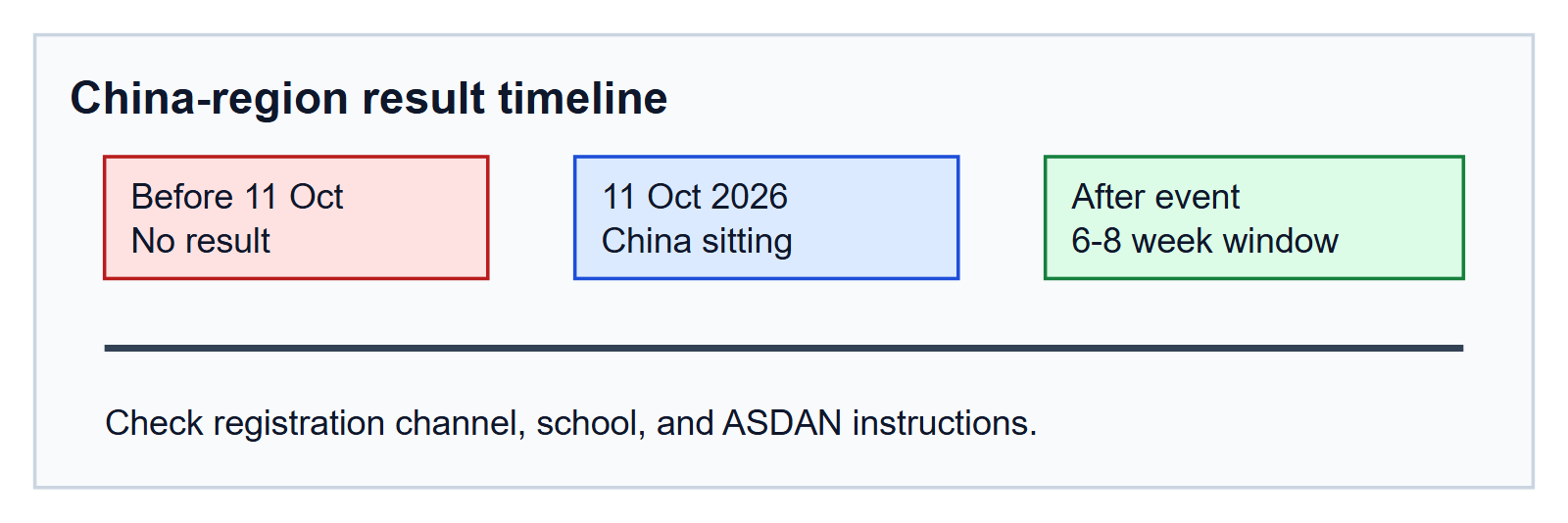
As of 23 September 2026, 2026 China-region Australian Mathematics Competition results are not available because the China sitting is on 11 October 2026. ASDAN’s Chinese organiser page says results and rankings are published within 6-8 weeks after the event. Australia/New Zealand sat 4-6 August under a separate calendar; check the registration channel, your school, and ASDAN’s instructions.
Status at a glance
| Item | Position |
|---|---|
| China-region sitting | Sunday 11 October 2026 |
| China-region results and rankings | Not available; ASDAN’s Chinese page says they are published within 6-8 weeks after the event |
| Australia/New Zealand sitting | 4-6 August 2026, a separate AMT regional schedule |
| Where China candidates should check | Channel used for registration, their school, and ASDAN’s latest instructions; no unverified portal should be assumed |
| 2026 China cutoffs | No 2026 China result or published cutoff appears on the supplied official page as of 23 September 2026 |
This is a time-stamped status page. It describes the position as of 23 September 2026 and should be re-read after the 11 October sitting, because the official result window begins only after the event. The 6-8 week statement is a processing window, not a guaranteed calendar date.
The page does not predict a release date. It exists to prevent a common mistake: treating the Australian August sitting as if it were the China sitting, or treating a previous year’s award table as if it fixed the next year’s marks. Until the China event has occurred, there is no 2026 China result to verify as of 23 September 2026.
Two calendars: China October, Australia August
The search phrase australian math competition 2026 results can mix two separate schedules. In Australia and New Zealand, the Australian Maths Trust sitting took place on 4-6 August 2026. AMT’s general process is that results and certificates are provided to registered schools or centres after award completion, and AMT notes that award cutoffs depend on year level and region and vary by year. That is an AMT general statement, not a confirmation of the exact China delivery method.
As of 23 September 2026, the China-region event is administered through ASDAN and is scheduled for Sunday 11 October 2026. Therefore, an August result, certificate, or school report from the Australia/New Zealand calendar does not represent a China-region candidate’s 2026 result. Candidates in China should wait for the channel used for registration, their school, and ASDAN’s latest instructions. For the wider schedule, see our China-region dates guide.
- Australia/New Zealand: AMT calendar, 4-6 August.
- China: ASDAN calendar, 11 October.
- Do not use one region’s result to infer the other’s release date or award cutoffs.
The practical consequence is simple. If a school in Australia receives August results, that is normal for the AMT calendar. If a China-region family has not received an October result yet, that is also normal, because the China sitting has not happened as of 23 September 2026.
China-region scoring: Pre-A versus A-E
China-region scoring is split by paper level. Pre-A contains 25 questions and has a maximum score of 100 points. Divisions A to E contain 30 questions and have a maximum score of 135 points. There is no wrong-answer penalty, so a candidate’s raw mark is simply the mark earned from correct responses. This distinction matters because a Pre-A student should not be judged against the 135-point A-E scale.
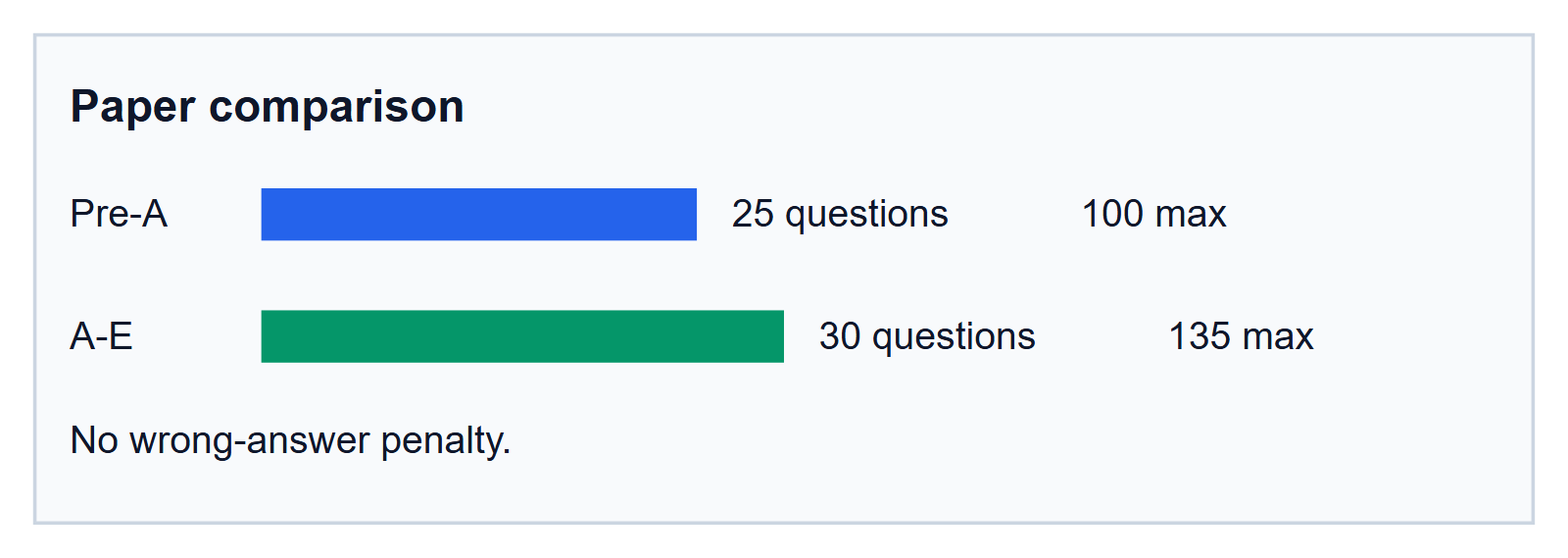
If you see the Peter O’Halloran perfect-score award discussed, read it with the correct maximum. A perfect Pre-A performance is 100 out of 100; a perfect A-E performance is 135 out of 135. Do not assume every child needs 135. The paper level, not a single universal total, determines what a perfect score means.
China awards: grade-specific bands, not one pooled cutoff
ASDAN’s Chinese official page sets out China-region award bands. Each difficulty level is awarded separately by school grade, not pooled across grades. That means candidates in different school grades are not competing for one shared cutoff; each grade has its own distribution and award calculation. The bands are:
| Award | Basis |
|---|---|
| China Prize | Top 0.3% within the relevant grade group |
| High Distinction | Top 3% for Pre-A to D; top 5% for E, within grade groups |
| Distinction | Top 20% for Pre-A to D; top 25% for E, within grade groups |
| Credit | Top 55% for Pre-A to D; top 60% for E, within grade groups |
| Proficiency | Preset mark; fluctuates yearly |
| No wrong-answer penalty | Applies to scoring |
These China-region bands should not be mixed with AMT’s general medal or Best-in-School distinctions. AMT may describe those awards in its own context, but the China national awards listed by ASDAN are the relevant bands for the China sitting. For a broader criteria explainer, see the award criteria guide.
Award language also needs care. A High Distinction in Division E is based on a different top percentage from a High Distinction in Pre-A to D. Likewise, Credit for Division E reaches a larger top slice than Credit for earlier divisions. These differences are why a single national raw-score chart would be misleading.
Because the top bands are percentile-based, the raw mark needed can move. A score that earned a Distinction in one grade or one year may not earn the same award in another grade or year. Proficiency is not a fixed percentile; it uses a preset mark that fluctuates yearly. As of 23 September 2026, there is no current 2026 China result or published cutoff on the supplied official page.
Why 2025 marks do not set 2026 cutoffs
The ASDAN page lists a 2025 performance report, not a 2026 report. A 2025 table can help you understand the shape of awards, but it cannot supply a reliable 2026 raw-mark cutoff. The reasons are structural:
- Cohort size and strength differ by grade and year.
- Paper difficulty and question order can change.
- Percentile awards depend on the distribution within each grade.
- Proficiency uses a preset benchmark that can move.
Therefore, avoid statements such as ’85 marks will guarantee High Distinction’ for 2026. The only safe statement before official publication is that the cutoff is unknown. Once results are released, the official channel or school communication should be treated as the controlling source.
Illustrative result-reading example
Illustrative example only: this is not a real result and not an actual 2026 cutoff. Use this shape when your report arrives.
| Item | Illustrative Pre-A entry | Illustrative A-E entry | What it means |
|---|---|---|---|
| Paper | Pre-A | A-E | Pre-A is out of 100; A-E is out of 135. |
| Raw score | 71/100 | 102/135 | These are made-up examples, not cutoffs. |
| Award | Blank or pending | Blank or pending | As of 23 September 2026, no 2026 China award is available. |
| Action | Wait for official channel | Wait for school or registration channel | Do not assume a portal. |
When the real report appears, check the maximum score first. A 71 in Pre-A is not comparable with a 71 in A-E, and neither number by itself reveals the award without the official grade-specific distribution.
What China-region candidates should check
Because the result process is regional, the safest checklist is narrow.
- Confirm the candidate sat through the China-region path, not the Australia/New Zealand August path. See the China-region pathway.
- Save the registration channel, school contact, or ASDAN instruction page used for enrolment.
- Treat the 6-8 week window as starting after 11 October 2026; it does not create a fixed release date.
- Do not rely on screenshots, unofficial portals, or last year’s raw cutoffs.
- Read the award line, paper level, and grade-specific context when results arrive.
If a result arrives before any official China-region communication, treat it cautiously. Regional calendars can produce genuine August results for Australia/New Zealand while China results remain unpublished. The safest rule is to match the result to the candidate’s actual sitting region, paper level, and grade before interpreting any award.
Official sources referenced: ASDAN China official Australian Mathematics Competition page, AMT Australian Mathematics Competition page, and AMT competitions FAQ.
Frequently asked questions
Are China-region Australian Mathematics Competition 2026 results available as of 23 September 2026?
No. As of 23 September 2026, the China sitting has not taken place yet; it is on 11 October 2026, and ASDAN’s Chinese page says results and rankings are published within 6-8 weeks after the event.
Do Australian August results apply to China-region candidates?
No. Australia/New Zealand sat on 4-6 August 2026 under AMT’s separate regional schedule. China-region candidates follow the 11 October 2026 ASDAN sitting and its result instructions.
What is the maximum score for Pre-A and A-E in the China region?
Pre-A has 25 questions and a maximum of 100 points. Divisions A-E have 30 questions and a maximum of 135 points. There is no wrong-answer penalty.
Can I use last year’s cutoffs to predict a 2026 award?
Not reliably. Awards are made separately by school grade, percentile bands can move with the cohort, and Proficiency uses a preset mark that fluctuates yearly, so 2026 raw-mark cutoffs cannot be inferred from 2025.