
The Australian AMC paper offered through the China region is bilingual — the questions appear in both English and Chinese. That is a genuine advantage, but only if you know how to use it. Most students who lose marks on a bilingual paper lose them to a misread word, not a missed method. This guide shows you how to read both columns strategically, build the small math vocabulary that actually matters, and keep language from stealing points that your maths has already earned.
Why a bilingual paper changes how you should read
The Australian AMC is run by the Australian Maths Trust (AMT), which has run the competition since 1978, and it is delivered in the China region by ASDAN. Per the China-region arrangement, the exam is scheduled for 11 October 2026, with registration closing 28 September 2026, and the paper is presented bilingually so that students in international schools — who may study maths in English but think in Chinese, or vice versa — are not blocked by language. (Exact per-level timing, durations and paper formatting are set by the competition each year; confirm current details on amt.edu.au and with ASDAN.)
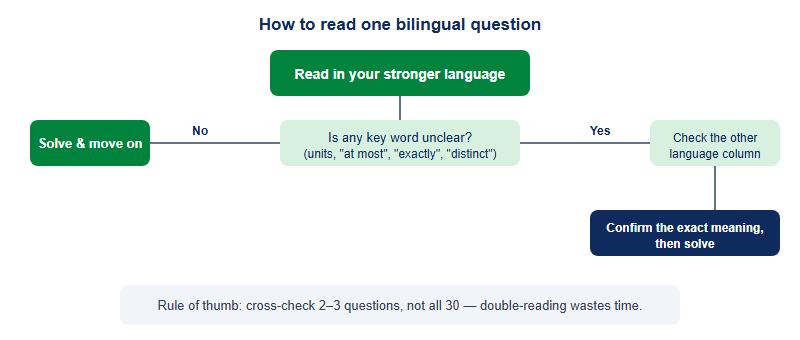
Here is the core idea most students miss: a bilingual paper is not “the English paper with a Chinese translation attached.” It is a cross-check tool. When a question is ambiguous to you in one language, the other column resolves it in seconds. The students who benefit read the language they are fastest in first, then use the second language only on the two or three questions where a single word decides the answer.
The math vocabulary that actually costs marks
In competition maths, a handful of precise words carry the whole meaning of a question. If you misread one, you can do flawless algebra and still get zero. These are the terms that most often catch students who learned maths in one language and are reading a bilingual paper. Note the pairs below and drill them until recognition is instant — this is the single highest-return language preparation you can do.
| English term | What it constrains | Common misread |
|---|---|---|
| at most / at least | An upper vs lower bound (≤ vs ≥) | Treating “at most 5” as “exactly 5” |
| exactly / precisely | A single value, no range | Reading it as “about” or “up to” |
| distinct / different | No repeats allowed | Counting a repeated value twice |
| consecutive | Following in order (n, n+1, n+2 …) | Any set of numbers |
| positive integer | Whole numbers 1, 2, 3 … (0 usually excluded) | Including 0 or fractions |
| digits vs numbers | Single symbols vs whole values | Confusing the two in counting problems |
| remainder | What is left after division | Confusing with the quotient |
| perimeter vs area | Boundary length vs surface | Solving for the wrong quantity |
A practical drill: take any set of practice questions and, before solving, underline the single word in each that would flip the answer if it were changed. On a bilingual paper you then glance at that word in both columns. Students report that this one habit removes most of their “silly” losses — and because the Australian AMC has no penalty for incorrect answers, the goal is simply to make sure the answer you commit to is the one the question actually asked for.
There is a second layer to bilingual reading that stronger students exploit: mathematical phrasing differs between languages, not just individual words. A rate problem, a “how many ways” counting question, or a probability set-up can be worded more transparently in one language than the other. When a question feels tangled, it is often not the mathematics but the sentence structure — and switching columns can un-tangle it instantly. Two situations where the second column earns its keep:
- Long word problems. Multi-sentence questions (trains meeting, ages, work-rate) carry conditions spread across clauses. If you lose track of a condition in one language, the parallel column often makes the same condition land more cleanly.
- Negations and double conditions. Phrases like “no two of which are equal” or “none of the following except” invert easily under time pressure. Reading the equivalent in your stronger language confirms whether you are counting the set or its complement.
The discipline is knowing when to switch. A student who reads everything twice runs out of time; a student who never switches misreads the two or three questions that decide their award band. Aim to be the student who switches deliberately, on exactly the questions where a word or a clause is doing heavy lifting.
A three-pass reading method for the whole paper
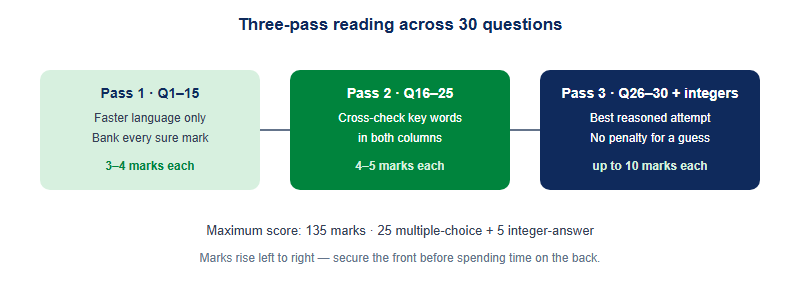
The paper has 30 questions — 25 multiple-choice and 5 integer-answer — for a maximum of 135 marks, with marks rising through the paper (Questions 1–10 worth 3 each, 11–20 worth 4, 21–25 worth 5, and 26–30 worth 6 to 10). Because the early questions are gettable and worth banking, a structured reading plan protects your score better than raw speed.
- Pass 1 — secure the front. Read Questions 1–15 in your faster language, solve what is immediate, and answer every one you are confident about. These are your reliable marks.
- Pass 2 — work the middle carefully. On Questions 16–25, slow down on wording. This is where a single term (“distinct”, “at most”) tends to decide the answer, so cross-check the second column here first.
- Pass 3 — attempt the back with nothing to lose. On the hardest questions (26–30, worth up to 10 marks each) and the 5 integer questions, put down your best reasoned answer. With no negative marking, a considered attempt can only help.
If you would like the full picture of how the levels and structure fit together before you drill the language, our overview of what the Australian AMC is and how it works for students in China lays out the six China-region levels (Pre-A to E, Grades 1–12) and the shape of the paper.
Building your bilingual prep in the weeks before 11 October
Language readiness is a training task, not a talent. A simple four-week rhythm covers it without adding to your maths workload:
- Weeks 1–2: Build a personal glossary. Every time a practice question hinges on a word, add both the English and Chinese term to a single page. Aim for 30–40 entries — that is roughly the whole competition-critical vocabulary.
- Week 3: Do timed practice reading only your faster language, and mark any question where you had to peek at the other column. Those are your language weak spots.
- Week 4: Simulate the real thing — full paper, exam timing, three-pass method — and afterwards separate your errors into “maths” and “reading.” If most are reading errors, you have found the cheapest points on your paper.
One honest caution about wording, and it applies to every competition: this article describes strategy, not the current year’s rules. Question counts, mark weightings, durations by level and the bilingual format are set by the competition and can be adjusted. Before exam day, read the official instructions for your level and confirm the specifics on the Australian AMC overview and on amt.edu.au rather than assuming this year matches last year.
A final point of clarity for families comparing contests: the Australian AMC (run by AMT in Australia, operated in the China region by ASDAN) is a different competition from the US AMC run by the Mathematical Association of America, and different again from the American Mathematics Olympiad (AMO) run by SIMCC. The names look alike; the papers, organisers and pathways are not. Prepare for the one you are actually sitting.
FAQ
Is the Australian AMC paper in the China region really bilingual?
Per the China-region arrangement, the questions are presented in both English and Chinese so students are not blocked by language. Confirm the current format for your level on the official site.
Should I read every question in both languages?
No. Read your faster language first and cross-check the other column only on the two or three questions where a single word (“at most”, “distinct”) decides the answer. Double-reading all 30 wastes time.
Do I lose marks for a wrong answer?
No. The Australian AMC has no penalty for incorrect responses, so on the hardest questions you should always commit a best reasoned answer rather than leave it blank.
What is the most useful language prep?
A 30–40 word personal glossary of the precise terms (bounds, “distinct”, “consecutive”, units) in both English and Chinese — that is roughly the entire competition-critical vocabulary.
Published by the Australian AMC editorial desk, operated by Hanlin Education for China-based international-school students. The Australian Mathematics Competition is run by the Australian Maths Trust (AMT) and operated in the China region by ASDAN; official rules are set by the competition and change yearly — confirm current dates, level structure and paper format on amt.edu.au before you rely on them. We correct any error within 7 working days.