
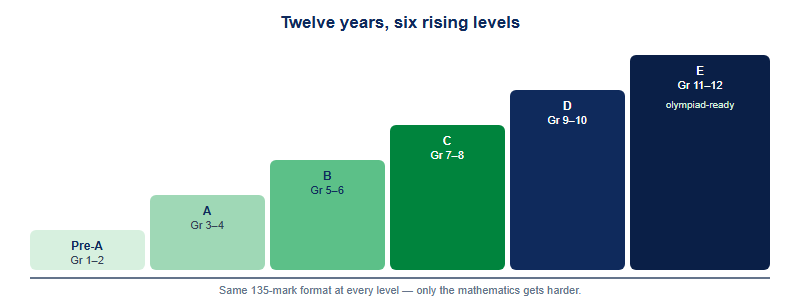
The Australian AMC is best used not as a single October exam but as a twelve-year progression that grows with a student from Grade 1 to Grade 12. Because the China region offers six levels — Pre-A through E, covering Grades 1–12 — a family can plan a decade of steadily rising challenge, with each year’s paper reinforcing the last and, for stronger students, feeding into the harder olympiad programmes the Australian Maths Trust runs after the AMC. This roadmap shows how to sequence it.
Why a long-term view beats one-year cramming
The Australian AMC, run by AMT since 1978, keeps the same paper shape at every level: 30 questions — 25 multiple-choice and 5 integer-answer — for a maximum of 135 marks, with no penalty for incorrect answers and marks rising through the paper. What changes across the six China-region levels is the difficulty and the mathematics assumed. That consistency is exactly why a multi-year plan works: a student who learns the format early — how to pace 30 questions, how to attempt the back five, how to read the wording — carries those skills upward and only has to add new mathematics each year, not relearn the exam.
Families who sit the AMC once, in isolation, usually treat it as a test. Families who plan it across years treat it as a training curriculum with a checkpoint every October. The second approach produces both stronger results and a cleaner record of growth — and it removes the last-minute panic, because the child has met the paper’s structure before. If you are new to the competition, start with our overview of what the Australian AMC is and how the six China-region levels work, then come back to build the timeline.
The six levels as a progression (China region)
Per the China-region structure operated by ASDAN, the levels map to grade bands as below. Treat each row as roughly two years of the same stage — enough time to move from “meeting the level” to “mastering it” before stepping up. The exact grade-to-level mapping and any per-level timing are set by the competition each year, so confirm current details on amt.edu.au and with ASDAN before you lock a plan.
| Level | Grade band | Stage goal | What “ready to move up” looks like |
|---|---|---|---|
| Pre-A | Grades 1–2 | Enjoy problem-solving; meet the exam format gently | Finishes the front questions calmly and wants harder problems |
| A | Grades 3–4 | Build number sense, patterns, basic geometry | Reliably banks the 3- and 4-mark questions |
| B | Grades 5–6 | Fractions, ratio, area/perimeter, simple logic | Reaches the middle band (Q16–25) with real attempts |
| C | Grades 7–8 | Algebraic thinking, counting, elementary number theory | Solves several 5-mark questions and starts the back five |
| D | Grades 9–10 | Algebra, geometry proof-style reasoning, combinatorics | Consistently attempts Q26–30 with structured reasoning |
| E | Grades 11–12 | Full contest toolkit; olympiad-adjacent problems | Scores in the upper award bands; ready for olympiad programmes |
A year-by-year rhythm that repeats
The power of a multi-year plan is that each year follows the same annual cycle, anchored to the China-region exam on 11 October 2026 (with registration closing 28 September). Once a family internalises the rhythm, it runs almost on autopilot:
- Nov–Feb (consolidate): review the paper the child just sat, identify the topics that cost marks, and fold them into normal schoolwork. No pressure, just gap-filling.
- Mar–Jun (build): introduce the new mathematics the next level assumes — a little each week, not a crash course.
- Jul–Sep (rehearse): timed past-paper practice, the three-pass reading method, and a full mock under exam conditions. Register before the 28 September deadline.
- October (perform): sit the paper on 11 October, then rest. The cycle restarts in November.
Run this loop from Pre-A upward and the child arrives at each new level already fluent in the format, needing only to absorb the year’s new content. That is a far gentler climb than meeting a harder paper cold. It also means the “prep season” (July–September) never becomes a crisis: by the third or fourth year the child knows exactly how a timed paper feels, so the pre-exam weeks are about sharpening, not surviving.
One transition deserves extra care: the jump from primary to secondary levels (Level B to C, roughly Grades 6 to 7). This is where the mathematics shifts from arithmetic-and-pattern work into genuine algebraic thinking, and where a previously comfortable student can suddenly find the middle of the paper hard. If you know the jump is coming, you can soften it — introduce basic algebra and elementary number theory during the “build” months of the Level B year, so Level C is a step up rather than a wall. Families who plan the roadmap in advance see this transition coming; families who take each year in isolation get surprised by it.
| Annual phase | Months | Focus | Watch for |
|---|---|---|---|
| Consolidate | Nov–Feb | Review last paper; fill topic gaps | Recurring gap in one strand (e.g. geometry) |
| Build | Mar–Jun | Learn the next level’s new content | The B→C algebra jump especially |
| Rehearse | Jul–Sep | Timed past papers; register by 28 Sep | Pacing and reading errors, not knowledge |
| Perform & rest | Oct | Sit on 11 Oct; then pause | Burnout — rest is part of the plan |
Where it leads: the olympiad step for stronger students
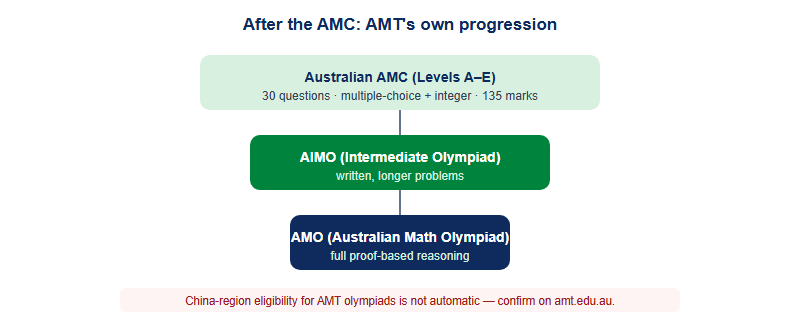
For students who reach the upper award bands at Levels D and E, the Australian AMC is a gateway, not a ceiling. AMT runs harder programmes beyond the AMC — notably the Australian Intermediate Mathematics Olympiad (AIMO) and the Australian Mathematical Olympiad (AMO) — which move from multiple-choice into full written, proof-based problem-solving. A strong AMC result is the natural on-ramp to that kind of mathematics.
Two honest cautions here. First, eligibility and access to AMT’s olympiad programmes from within the China region are set by the organisers and are not automatic — do not assume a China-region AMC result grants entry to any particular follow-on programme. Confirm the current pathway on amt.edu.au and with ASDAN before planning around it. Second, and importantly for families comparing names: AMT’s Australian Mathematical Olympiad (AMO) is a completely different competition from the American Mathematics Olympiad (AMO) run by SIMCC, and different again from the US AMC run by the Mathematical Association of America. Same three letters, three separate organisers and pathways. When you plan a progression, plan it around the specific body whose competition you are actually entering.
How to present a multi-year record honestly
A decade of AMC participation can genuinely strengthen a student’s profile — not because any single certificate opens a door, but because a rising trajectory tells a real story. On a school record or university application, the honest and effective framing is growth over time: “sat the Australian AMC each year from Level B to Level E, improving from Credit to High Distinction.” That is verifiable, specific, and far more persuasive than a one-off entry.
Keep the claims accurate. An award reflects percentile ranking within a year level and region, not admission to anything; no competition, ours included, guarantees a place at any university. Record what actually happened, cite the level and the year, and let the pattern of improvement speak. A student who can point to eight years of steady climbing has something no cram course can manufacture. If you are unsure how the award tiers themselves are defined before you set year-on-year targets, start from the level structure and scoring described in our Australian AMC overview for students in China and confirm the current bands officially.
FAQ
Can my child do the Australian AMC every year from Grade 1?
Per the China-region structure, levels run from Pre-A (Grades 1–2) up to E (Grades 11–12), so a student can participate each year. Confirm the current grade-to-level mapping on the official site.
Does the exam format change as levels get harder?
The paper keeps the same shape at every level — 30 questions, multiple-choice plus integer answers, 135 marks, no penalty for wrong answers. Only the mathematics gets harder, which is why format skills carry upward.
Does a strong AMC result get me into AMT’s olympiads automatically?
No. AMT runs AIMO and the Australian Mathematical Olympiad beyond the AMC, but eligibility from the China region is set by the organisers and is not automatic. Confirm the pathway on amt.edu.au.
Is AMT’s AMO the same as the SIMCC AMO?
No. AMT’s Australian Mathematical Olympiad is a different competition from the American Mathematics Olympiad run by SIMCC, and different again from the US AMC (MAA). Same initials, separate organisers.
Published by the Australian AMC editorial desk, operated by Hanlin Education for China-based international-school students. The Australian Mathematics Competition is run by the Australian Maths Trust (AMT) and operated in the China region by ASDAN; official rules, level structure and any olympiad progression are set by the competition and change yearly — confirm current details on amt.edu.au before you rely on them. We correct any error within 7 working days.