
Counting and logic problems are where many strong students first get stuck on the Australian AMC — not because the mathematics is advanced, but because school rarely teaches systematic counting or formal reasoning. These questions cluster in the harder middle-to-late parts of the paper, where the marks are highest. The key idea is to count without listing everything out. Here is how the multiplication principle, careful casework, and constraint-based logic let you do exactly that.
Why counting problems feel hard — and where they appear
Most school mathematics is about calculating with numbers you are given. Counting problems are different: they ask how many possibilities exist, and the honest-but-slow approach — write them all out — collapses as soon as the numbers grow. The Australian Maths Trust, which has run the AMC since 1978, knows this, which is why counting and logic questions tend to sit among the higher-value questions later in the 30-question paper.
Two facts should shape your approach. First, there is no negative marking, so even a partly-reasoned counting question is worth a committed best attempt — you lose nothing by trying. Second, these questions reward organisation over cleverness: a tidy table or a branching diagram beats a frantic list scrawled in the margin. If you are new to how the paper is laid out, our What Is the Australian AMC guide explains the structure before you dive into technique.
| Counting sub-type | The core idea | A generic example |
|---|---|---|
| Multiplication principle | Independent choices multiply | 3 mains and 2 drinks give 3 x 2 = 6 meals |
| Casework counting | Split into non-overlapping cases | Count two-digit numbers by their tens digit |
| Avoiding overcounting | Divide out repeats | 5 people shaking hands: 5 x 4 / 2 = 10 |
| Logic and deduction | Reason from the constraints | Work out who is telling the truth from clues |
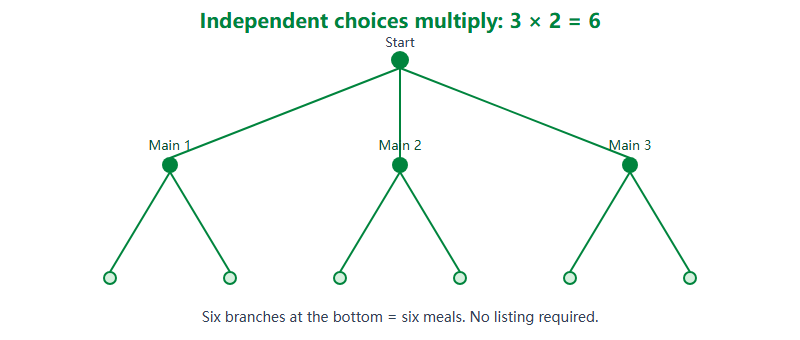
Count without listing: the multiplication principle
The single most useful counting idea is that independent choices multiply. If a canteen offers 3 main dishes and 2 drinks, and any main can go with any drink, there are 3 x 2 = 6 possible meals — and you never have to list them. Chain the idea for longer problems: a 4-digit code where each digit is 0 to 9 has 10 x 10 x 10 x 10 possibilities.
The trick is to check that the choices really are independent — that choosing one does not restrict the next. When they are not independent (say the digits must all be different), you adjust step by step: 10 choices for the first digit, then 9 for the second, then 8 for the third, and so on. Drawing the choices as a branching tree for a small version of the problem, as in the diagram above, makes it clear whether you should be multiplying and by what.
When repeats sneak in: careful counting and casework
The most common counting error is counting the same thing twice. The classic example is handshakes: if 5 people each shake hands with the other 4, that looks like 5 x 4 = 20 — but every handshake has been counted from both sides, so the real answer is 20 / 2 = 10. Whenever a problem pairs things up, or when order does not matter, ask whether you have counted each outcome once or twice, and divide out the repeats.
Casework is the safety net for everything else. When a problem has a condition that branches, split it into cases that cannot overlap, count each, and add. To count the three-digit numbers whose digits add to 4, for instance, work case by case on the first digit — a disciplined split turns one intimidating question into three or four easy ones. The rule is the same as it is everywhere on the paper: your cases must cover every possibility exactly once, with no overlaps and no gaps.
Logic and deduction: reason from what must be true
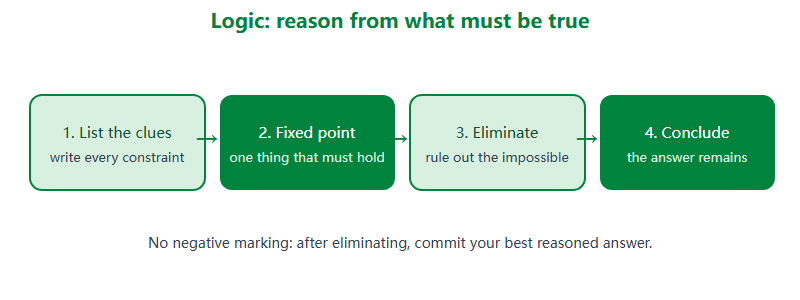
Logic questions give you a set of clues and ask what follows. The method is the same every time: list the constraints, find one thing that must be true, use it to eliminate possibilities, and repeat until only the answer remains. In a “who is telling the truth” puzzle, assume one person's statement is true and follow the consequences; if that leads to a contradiction, the assumption was wrong — which is itself useful information.
Grid and matching puzzles — which student studies which subject, in which room — are best handled with a small table where you tick and cross facts as they settle. Because there is no negative marking on the Australian AMC, even when a logic question defeats you, narrow it down and commit your best reasoned answer: a one-in-three guess after eliminating two options is far better than a blank.
A practice plan for counting and logic (China region)
These strands improve quickly with focused practice, because the techniques are few and transferable. Four habits help:
- Start with small cases. Before counting a large arrangement, count the version with 2 or 3 items to see the structure, then scale up.
- Organise on paper. Use a branching tree for multiplication problems and a table for logic grids; disorganised counting is where marks quietly leak away.
- Learn the bilingual signal words. On the China-region bilingual paper, precise words change the answer — at least (至少), at most (至多), exactly (恰好), consecutive (连续), different (不同). Read them in both languages so you never misjudge a condition.
- Review past papers by type. Group old counting questions together and practise them in a block. Confirm which materials are available through ASDAN or on amt.edu.au.
For how counting and logic sit alongside the paper's other themes, see What Is the Australian AMC, then plan your blocks of practice ahead of the 11 October 2026 exam (registration closes 28 September — confirm dates with ASDAN).
Frequently asked questions
Do I need permutation and combination formulas?
Not at the earlier levels — the multiplication principle and careful casework handle most questions. Senior levels reward more technique. Confirm the scope on amt.edu.au.
What is the fastest way to avoid overcounting?
Ask whether order matters and whether each outcome is counted once. When pairs are counted twice, divide by two, as with the handshake count.
How should I guess on a counting question I cannot finish?
Eliminate impossible options first, then commit a best answer. With no negative marking, a reasoned guess never costs marks and can score.
Are these the same problems as the US AMC or AMO?
No. The Australian AMC (AMT), US AMC (MAA), and AMO (SIMCC) are separate competitions with different papers. This guide covers the Australian AMC.
This article is published by the Australian AMC editorial desk, operated by Hanlin Education for China-based international-school students. Official rules are set by the competition and change yearly — confirm current details on amt.edu.au. Errors are corrected within 7 working days.