
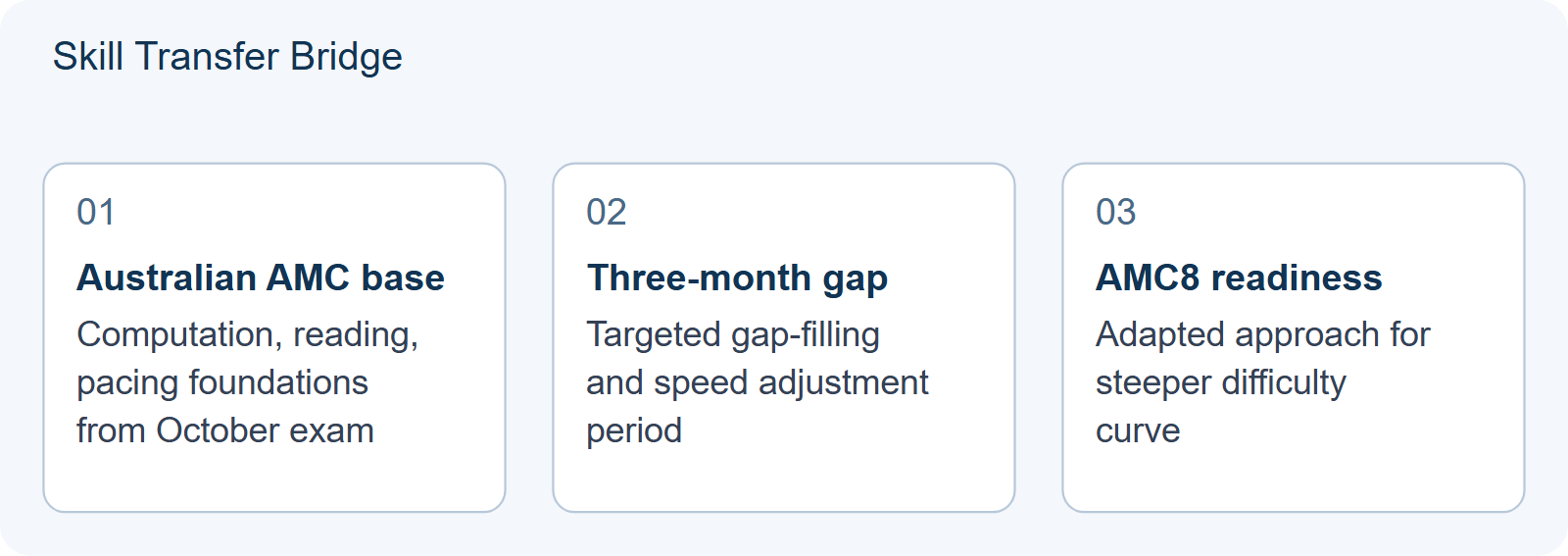
The Australian AMC and AMC8 are positioned three months apart on the competition calendar, and for younger students—particularly around grade 3—this sequence can function as a structured progression rather than two isolated events. Source notes identify this stage as a pivotal transition point in early competition mathematics, where foundational skills from Australian AMC can inform subsequent AMC8 preparation.
Structural Differences That Affect Preparation Transfer
Understanding how the two competitions differ in format helps families allocate preparation time effectively.
Timing and Question Volume
Australian AMC Level A (for grades 3–5) offers 60 minutes for 30 questions, with a scoring structure that increases by difficulty: questions 1–10 at 3 points, 11–20 at 4 points, 21–25 at 5 points, and 26–30 at 6/7/8/9/10 points respectively. Pre-A (grades 1–2) runs 50 minutes with 25 questions. AMC8 presents 25 questions in 40 minutes.
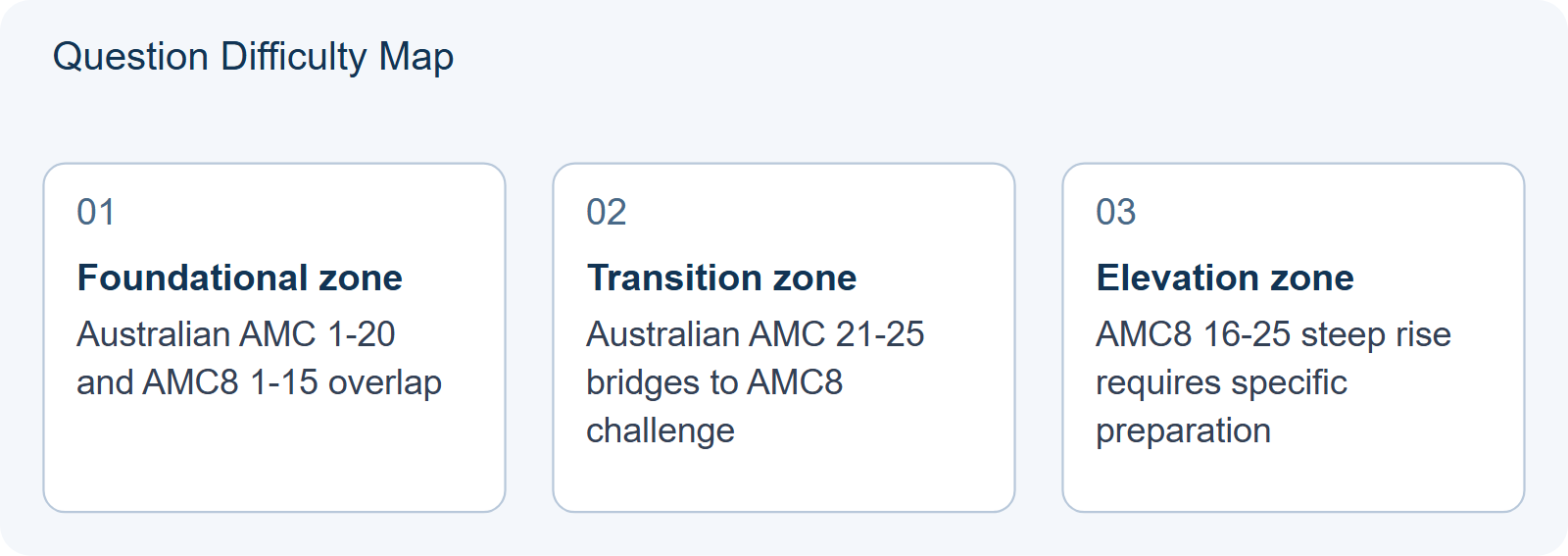
The source notes describe Australian AMC’s difficulty as having the first 20 questions foundational and the last 10 elevated, while AMC8 follows a pattern of the first 15 questions foundational with questions 16–25 rising sharply. These distinct difficulty curves mean that comfort with Australian AMC’s middle section does not automatically translate to AMC8’s later questions.
Answer Formats
For Australian AMC Levels A–E, the first 25 questions are multiple-choice and the final 5 require fill-in-the-blank answers (integers 0–999). Pre-A uses a different format with 25 questions total. AMC8 uses a multiple-choice format for all 25 questions.
Skills That Transfer Directly
Several competency areas developed through Australian AMC preparation carry forward:
- Computational fluency: The source identifies calculation and number theory as core to Australian AMC’s first 15 questions, including integer, fraction, and decimal operations alongside prime factorization, GCD, and LCM. These operations remain essential for AMC8.
- Problem-reading discipline: Australian AMC’s application-oriented problems, particularly in logic and reasoning sections, build the habit of extracting mathematical conditions from worded scenarios.
- Strategic time allocation: Experience with Australian AMC’s graduated scoring helps students recognize when to invest time versus move forward.
Gaps Requiring Targeted Attention
The source notes highlight specific areas where Australian AMC preparation alone leaves students underprepared for AMC8:
Compressed Time Pressure
AMC8’s 40-minute window for 25 questions demands faster average pace than Australian AMC Level A’s 60 minutes for 30 questions. Students accustomed to Australian AMC’s timing may need explicit practice with tighter constraints.
Steeper Late-Question Difficulty
While Australian AMC distributes its difficulty increase across the final 10 questions, AMC8’s sharp rise after question 15 means students encounter concentrated challenge earlier in the paper. This structural difference affects how students should calibrate their confidence and pacing.
Format Adaptation
Students who have practiced with Australian AMC’s fill-in-the-blank final questions have experience producing answers without option verification. AMC8’s entirely multiple-choice format requires different strategic approaches, including intelligent elimination and estimation techniques.
Month-by-Month Priority Allocation
The following framework represents suggested preparation sequencing based on the three-month gap described in source material. Individual families should adapt this to their student’s specific situation.
| Period | Focus Area | Rationale |
|---|---|---|
| October (post-Australian AMC) | Diagnostic review of Australian AMC performance; identify persistent weak spots in computation, geometry, or reasoning | Source notes emphasize gap-filling during this interval |
| November | Targeted skill building in areas where Australian AMC performance indicates readiness gaps for AMC8’s steeper difficulty curve | Bridge period before format-specific preparation |
| December–early January | AMC8-format practice with emphasis on pacing and early-section accuracy to reach later questions with adequate time | Proximity to competition date supports format familiarity |
Using Australian AMC Performance to Calibrate Expectations
The source material does not provide a direct score conversion or predictive framework between Australian AMC and AMC8 results. However, families can use Australian AMC performance as one data point among several when assessing AMC8 readiness:
- Strong performance on Australian AMC’s foundational questions suggests computational readiness for AMC8’s early section
- Comfort with Australian AMC’s elevated final 10 questions indicates some capacity for AMC8’s later difficulty, though the source notes these difficulty patterns differ
- Struggles with Australian AMC time management signal likely pressure under AMC8’s tighter constraints
This interpretive approach is suggested as educational guidance, not derived from formal equivalence tables.
When the Gap Indicates Readiness Versus Need for Reinforcement
The source specifically identifies grade 3 as a golden turning point for this competition sequence. For students at this stage, the three-month gap can serve different purposes depending on Australian AMC outcomes:
Indicators suggesting readiness for AMC8 transition: Consistent accuracy on Australian AMC questions 1–20 with time to attempt later questions; demonstrated comfort with both multiple-choice and fill-in-the-blank formats; stable performance under timed conditions.
Indicators suggesting foundational reinforcement before AMC8: Significant time pressure completing Australian AMC sections; reliance on guesswork for middle-difficulty questions; gaps in core computation or number theory identified during review.
These criteria represent suggested guidance for family discussion, not diagnostic rules.
Preparing for Consultation
If considering structured preparation support, families may find it useful to gather: Australian AMC score breakdown by question range; notes on where time was lost or gained; and specific topics where the student expressed confidence or confusion. Program selection requires separate assessment of fit with individual learning needs.
Australian AMC vs US AMC: Same Three Letters, Two Different Competitions
The Long Runway: An Eight-Week Australian AMC Plan from Mid-August to 11 October
The 2026 Early-Primary Pilot Is Not China’s Pre-A: What China Families Should Not Assume
Frequently Asked Questions
Is the three-month gap sufficient for meaningful AMC8 preparation?
Source material describes this interval as suitable for gap-filling while momentum persists. The adequacy depends on individual student foundation and the specific gaps identified from Australian AMC performance. For students around grade 3 at the described turning point, the gap can support targeted bridge work if priorities are clear.
Does Australian AMC fill-in-the-blank experience help with AMC8?
Australian AMC Levels A-E include 5 fill-in-the-blank questions requiring integer answers. This builds answer-production confidence, though AMC8 uses entirely multiple-choice questions. The strategic thinking developed—producing answers without option cues—transfers partially, but students must also develop elimination and estimation skills specific to multiple-choice formats.
Should younger students outside the grade 3 range attempt this sequence?
The source specifically identifies grade 3 as the pivotal transition point for this progression. Students significantly younger or older may have different optimal pathways. Pre-A (grades 1–2) has distinct format characteristics including fewer questions and read-aloud support, suggesting different preparation needs than the standard sequence described.