
The biggest change to the Australian Mathematics Competition (AMC) in 2026 is a brand-new entry point: a Pre-A level for Grades 1 and 2, opening the competition to children who were previously too young to sit it. The China-region paper is sat on Sunday 11 October 2026, with registration closing 28 September 2026. This guide explains what the Pre-A level is, what it means for young learners, and how it fits the six-level structure — verified facts only.
The headline 2026 change: a new Pre-A level for Grades 1–2
For most of its history, the AMC’s youngest entry point started at around Grade 3. For 2026, the Australian Maths Trust (AMT) — which has set the competition since 1978 and now reaches over a million students as Australia’s largest school maths competition — has added a Pre-A level designed for Grades 1 and 2. In the China and Asia region, the competition is administered by ASDAN (阿思丹), and this Pre-A level is part of the 2026 China-region offering.
The significance is simple but real: families with children in the first two years of primary school now have a structured, age-appropriate way for their child to try a real mathematics competition, rather than waiting two or three more years. If you are new to the competition itself, our overview of what the Australian AMC is covers its history and purpose first; this article focuses on the new level and what it changes for the youngest students. The full ladder of levels is set out in The Six Australian AMC Levels Explained: Pre-A to E.
One honest note up front: a competition is not a milestone every six- or seven-year-old needs. The value of the Pre-A level is that it exists as an option — a gentle, low-stakes first experience for a child who already enjoys puzzles and numbers. It is not a box to tick, and a strong result is not a guarantee of admission to any school or programme.
The six levels in 2026 — and where Pre-A sits
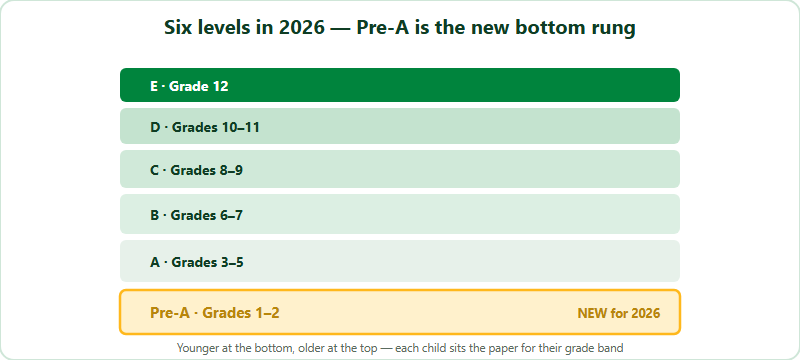
With Pre-A added, the 2026 China-region AMC now runs across six levels, each mapped to a grade band so a child sits a paper pitched at their stage. Pre-A is the new foundation of that ladder; everything above it is unchanged. The table below is the quickest way to find the right level for a given grade.
| Level | Grade band (2026 China region) | Notes |
| Pre-A | Grades 1–2 | New for 2026 — the youngest entry point |
| A | Grades 3–5 | Lower-primary level |
| B | Grades 6–7 | Upper-primary / early-middle |
| C | Grades 8–9 | Middle-school level |
| D | Grades 10–11 | Senior level |
| E | Grade 12 | Final-year level |
A useful way to picture the change: before 2026, a Grade 1 or Grade 2 child had no paper to sit and had to wait for Level A. Now there is a step below Level A built specifically for them. For the full registration walkthrough and what the October sitting involves, see 2026 Australian AMC China: Registration & the October Exam, Explained.
What the Pre-A level means for a young learner
For a six- or seven-year-old, the point of Pre-A is not the score — it is the experience of doing real, playful mathematics in a calm setting. The AMC has always been built around reasoning rather than rote recall, and that philosophy is exactly what makes a first competition worthwhile at this age: a child meets problems that ask them to think, not just to remember a procedure.
Three things make the Pre-A experience genuinely young-learner-friendly. First, the no-penalty rule: across the AMC, a wrong answer and a blank score the same — nothing is ever subtracted for trying. For a small child, that removes the fear of “getting it wrong” and makes it safe to attempt every question. Second, the AMC is offered in both English and Chinese, so a child can read the paper in the language they are most comfortable with. Third, every entrant receives a certificate, so the day ends with a tangible keepsake regardless of the result.
A note on illustration: the kinds of ideas a young child reasons about at this stage are simple and visual — for example, “If a row has 3 red blocks and 2 blue blocks, how many blocks are there in all?” or “Which shape comes next in the pattern: circle, square, circle, square, ?” These are our own made-up examples to show the flavour of early reasoning, not real past questions. The exact difficulty, number of questions and time for the Pre-A paper specifically are set by AMT and ASDAN — confirm current details on the official site.
The shared paper design — and what is set per level
It helps parents to know the structure the AMC is built on, while being clear about which details vary by level. Across the competition, the paper is built to a consistent shape, with the no-penalty rule the same for everyone. What changes with level — including the new Pre-A — is the time allowed and the pitch of the questions.
| Feature | Detail (2026 China region) |
| Paper structure | 30 questions — 25 multiple-choice + 5 integer-answer |
| Total marks | 135, rising with difficulty (no even split) |
| Wrong-answer penalty | None — a blank and a wrong answer score the same |
| Time | 45–75 minutes depending on level (younger = shorter) |
| Languages | English & Chinese |
| Awards | By national percentile: Prize, High Distinction, Distinction, Credit, Proficiency — plus a certificate for every entrant |
| Perfect paper | Eligible for the O'Halloran Award (awarded for a perfect score) |
| Pre-A specifics | Exact question count / time / difficulty for the new Pre-A level — confirm on the official site |
The honest caveat is the last row. The general AMC architecture above is reliable and officially stated. But because Pre-A is brand new, the precise paper details for Grades 1–2 are something to confirm directly with AMT and ASDAN rather than assume from the older levels — younger sittings are typically the shorter end of the 45–75-minute range, but we will not state an exact figure we have not verified for Pre-A.
The China-region October exam day — key 2026 dates
The other thing worth fixing in your calendar is when the competition happens in the China region. It is important not to confuse this with Australia’s own home schedule: in Australia the AMC is a home-country event with its own calendar, while the China and Asia region, administered by ASDAN, sits in October. For 2026, the key dates are below.
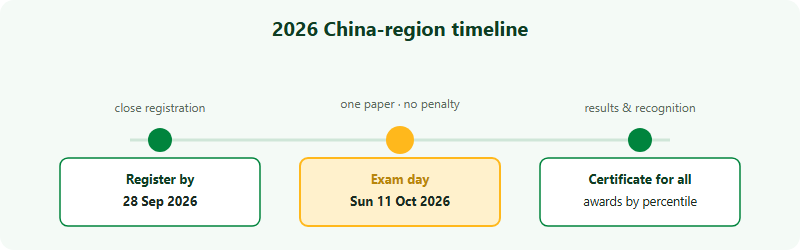
In plain terms: register by Sunday’s deadline of 28 September 2026, then the child sits the single paper on Sunday 11 October 2026. Results are recognised by national percentile against the child’s own grade band — so a Pre-A entrant is measured against other Grade 1–2 students, not against older children. The exact entry fee and the precise registration steps are set by AMT and ASDAN and can change; confirm them on the official channels before you plan around them.
Keeping three look-alike contests straight
Because the Pre-A news will draw in families who are new to competitions, one clarification matters more than usual: the “AMC” with a new Grades 1–2 level is the Australian one. Several maths contests share the letters “AMC,” and there is a separate contest called the AMO — they are run by different organisations with different papers, and the Pre-A level belongs only to the Australian AMC.
| Competition | Run by | In brief |
| Australian AMC (this site) | Australian Maths Trust (AMT); ASDAN (阿思丹) in China/Asia | Six levels Pre-A–E (Grades 1–12); China region sits 11 Oct 2026; the new Pre-A level is here |
| American AMC | MAA, USA | A different competition with its own structure and pathway — not the same as this |
| AMO | SIMCC, Singapore | A separate contest with its own paper and medal scheme |
If a page or advert mentions the MAA or SIMCC, it is not the Australian AMC, and the Pre-A level and the dates above do not belong to it. When unsure which contest a flyer refers to, check the official source for that specific competition.
Frequently asked questions
What is the new Pre-A level in the 2026 Australian AMC?
Pre-A is a new level added for 2026, designed for Grades 1–2. It is the youngest entry point, opening the competition to children who were previously too young to sit it.
What grades can join the Australian AMC in 2026?
Grades 1 through 12, across six levels: Pre-A (1–2), A (3–5), B (6–7), C (8–9), D (10–11) and E (Grade 12).
When is the 2026 China-region exam?
The China-region paper is sat on Sunday 11 October 2026, with registration closing on 28 September 2026. Confirm details on the official site.
Is the Pre-A level too hard for a young child?
It is pitched for Grades 1–2, there is no penalty for wrong answers, and every entrant gets a certificate — so it is built as a safe first experience.
This is the editorial desk for the Australian Mathematics Competition (AMC) China region. The competition is run by the Australian Maths Trust (AMT) and administered in China and Asia by ASDAN (阿思丹); this content desk is operated by Hanlin Education for students in China. Dates, fees, levels and rules — including the specifics of the new Pre-A level — are set by the AMT and ASDAN and can change each year; always confirm current details on the official channels (amt.edu.au and the ASDAN China-region channels). Confirmed errors are corrected within 7 working days.