
Twenty-five of the thirty questions on the Australian AMC are multiple choice, and the five options attached to each one are information. Most students discard that information: they read the question, cover the options with a hand, solve forwards, and only then look. Sometimes that is right. Often it is slower than the alternative. Here is how to read the options as data.
What this is, and what it is not
This is not an article about mathematics. Nothing below will help you factorise faster or spot a similar triangle. It is about the instrument — the fact that on questions 1 to 25 the answer is guaranteed to be one of five things printed in front of you, and that this guarantee is a mathematical constraint you are allowed to use.
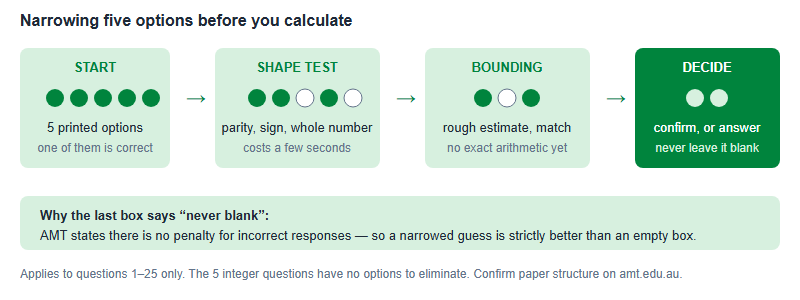
The Australian AMC paper is 30 questions for a total of 135 marks: 25 multiple-choice and 5 integer questions, with no penalty for incorrect responses. That structure matters here in two ways. First, the option-based techniques below apply to the first twenty-five questions and then stop working entirely, because the last five require you to produce a number with nothing to check it against. Second, because wrong answers cost nothing, every technique that narrows five options to two is worth marks even when it fails to reach certainty. If you want the full structural picture of the paper first, see our guide to what the Australian AMC is.
One honest caveat before the techniques. None of this substitutes for knowing the mathematics. A student who cannot set up the problem gains little from being able to test options. What these methods do is convert partial knowledge into marks — and on a thirty-question paper, partial knowledge is most of what any student has on the day.
Four ways the options are usable
1. Back-substitution — test the options instead of solving for them. When a question asks “what number satisfies this condition,” you have two routes: derive the number, or check five candidates against the condition. Checking is often faster, and it is almost always more reliable, because verifying is a simpler cognitive act than deriving. If the options are ordered by size, start with the middle one: the result usually tells you whether to go up or down, and you finish in two or three tests rather than five.
2. Elimination by shape. Before computing anything, ask what the answer must look like. Must it be even? A whole number? Larger than a quantity already stated in the question? Negative? Between two of the given values? Each such observation is cheap and frequently kills two or three options outright. Common shape tests worth having automatic:
- Parity — an even total cannot come from that combination, so those three options go.
- Magnitude — a part cannot exceed its whole; an average must sit between the smallest and largest values.
- Units and dimension — an area answer should scale like a square; if you double every length, the answer should quadruple.
- Sign and direction — a decrease cannot produce a larger number.
- Divisibility — if the count is a number of complete groups, options not divisible appropriately are out.
3. Bounding — estimate, then match. On questions with awkward arithmetic, a rough answer is often enough because the five options are usually spread apart. Round hard, get a ballpark, and see how many options survive. If exactly one does, you are finished without doing the exact calculation. This is the single most under-used technique we see, and it is the one that buys back the most time.
4. Reading the spread. The options themselves tell you what mistake the setter expects. If four options cluster and one sits far away, the outlier is often a wrong-operation trap. If two options differ by a factor of two, someone is expected to forget to halve something. If two differ only in sign or in the last digit, the question is testing care, not insight. You do not need to guess the setter's intention — but noticing that the options are close together is a signal to slow down and check, while noticing they are far apart is permission to estimate.
Forwards or backwards? A decision table
The technique is worth little if you cannot tell in five seconds which route to take. These are the signals we teach students to read off the question and options before committing.
| What you see | Route | Why |
|---|---|---|
| Options are small whole numbers, ordered | Backwards — test the middle one first | Verifying a candidate against the condition is simpler than deriving it, and ordering lets you binary-search |
| Question says “which of the following” | Backwards | The question is already telling you to test candidates |
| Options are far apart in size | Estimate, then match | A rough value separates them; exact arithmetic is wasted effort |
| Options are very close, or differ by sign or last digit | Forwards, carefully | The spread is testing care; estimation cannot separate them and a slip will land on a distractor |
| Options are algebraic expressions | Substitute a value into both question and options | Pick a simple legal number, compute the true answer, discard every expression that disagrees |
| The answer is a count of arrangements or cases | Forwards, then sanity-check against options | Counting cannot be reversed from a total, but the options bound how large the count can plausibly be |
| You are stuck with under a minute left on the question | Eliminate, then commit | Wrong answers carry no penalty; an empty box is a guaranteed zero |
Notice that “backwards” is not a fallback for weak students. On a well-set paper it is frequently the intended fast route, and strong students who refuse it on principle finish the paper more slowly than they need to.
The recovery protocol: my answer is not one of the options
This happens to everyone, and how a student handles the next thirty seconds decides whether it costs one mark or four. The panic response — recompute the whole question from the top — is almost always wrong, because you will make the same mistake again and burn two minutes doing it.
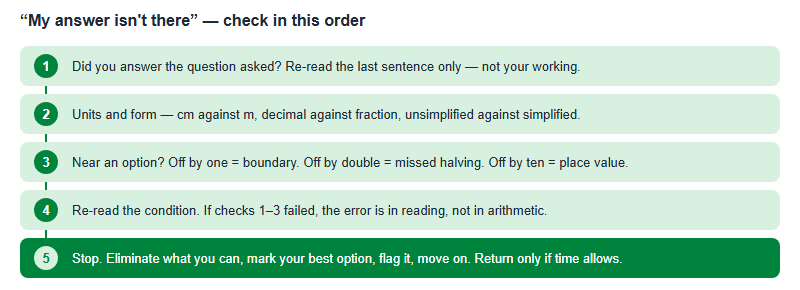
Work through the checks in this order, because they are ordered by how often they are the culprit:
- Did you answer the question that was asked? By far the most common cause. You found x; the question wanted 2x, or the perimeter rather than the side, or how many were left rather than how many were taken. Re-read the final sentence only.
- Units and form. Your answer is in centimetres and the options are in metres; or the options are fractions and you have a decimal; or the options are simplified and you have not simplified.
- Is your answer close to an option? Off by one is a boundary error in counting. Off by a factor of two is a halving you forgot. Off by ten is a place-value slip. Each of these points at a specific, findable error rather than a general one.
- Re-read the condition, not your working. If none of the above lands, the error is upstream in how you read the problem, and re-checking arithmetic will never find it.
- Stop. If four checks have not resolved it, eliminate what you can, mark your best option, flag the question, and move on. Come back only if there is time at the end.
Where the options run out — and three habits we retrain
Everything above expires at question 25. The final five questions are integer questions — a design point worth understanding in the context of how the whole paper is built. You write a number, and nothing on the page will tell you it is implausible. Students who have spent an hour leaning on options often carry that dependence into the last five without noticing, and the tell is a missing final check. On an integer question, the sanity check that the options were doing for you has to be done deliberately — re-read what was asked, confirm the units, and ask whether the size of your answer is reasonable.
The three habits we most often have to retrain, from our own China-region coaching:
- Covering the options. Students taught to “solve it properly” hide the options as a discipline. On a paper where the options are part of the question, this deletes information for no benefit. Read them first, every time, even if you then solve forwards.
- Leaving boxes empty. Because there is no penalty for incorrect responses, a blank is never the right end state. We have seen students finish with several blanks they could have narrowed to two options in ten seconds each. Check the current rule on amt.edu.au, then act on it.
- Over-verifying easy questions. Elimination is fast; verification is slow. Once one option survives a shape test and a bounding test, re-deriving the answer from scratch to feel safe is spending back all the time you just saved. The paper is thirty questions long and the clock is the real constraint.
The way to install any of this is not to read it. Take a past paper and do a single pass in which you are forbidden from calculating anything until you have written next to each of the first twenty-five questions which route you would take and why — forwards, backwards, estimate, substitute. It takes fifteen minutes, produces no score, and is the fastest way we know to make the decision automatic before 11 October.
Frequently asked questions
How many Australian AMC questions are multiple choice?
The paper is 30 questions in total: 25 multiple-choice and 5 integer questions, for a maximum of 135 marks. Confirm on amt.edu.au.
Is guessing worth it if I cannot narrow the options?
AMT states there is no penalty for incorrect responses, so a blank is never better than a guess. Narrow first where you can, then commit.
Is working backwards from the options a weaker method?
No. Verifying a candidate is often faster and more reliable than deriving one. Strong students who refuse it simply finish more slowly.
Do these techniques work on the last five questions?
No. The integer questions have no options, so elimination and back-substitution do not apply. Sanity-check those answers deliberately instead.
Published by the Australian AMC editorial desk, operated by Hanlin Education for China-based international-school students. Official rules are set by the competition and change yearly — confirm current details on amt.edu.au. Errors are corrected within 7 working days.