
On Australian Mathematics Competition (AMC) exam day in China — Sunday 11 October 2026 — your child sits a single paper pitched to their level: 30 questions (25 multiple-choice + 5 integer-answer) worth 135 marks, lasting 45 to 75 minutes by level, with no penalty for a wrong answer. It is offered in English and Chinese and run locally by ASDAN (阿思丹). This guide walks through what actually happens in the room, and how to prepare calmly for it.
The shape of the day: one paper, one level, no surprises
There is reassuringly little drama to AMC exam day, and knowing the shape of it in advance removes most of the nerves. Each student sits one paper matched to their own level — a Grade 4 child and a Grade 11 student are in different papers, never the same one — in a supervised sitting organised by ASDAN as the China-region administrator. There is no oral component, no group round, and no second paper to qualify for: the AMC is a single written contest, sat once, on one national date. For the wider picture of how the competition is structured, our overview of what the Australian AMC is covers the levels and awards first; this page is specifically about the sitting itself.
A point worth getting straight before the day, because it trips up families reading overseas sources: the AMC's home schedule in Australia runs in August across five divisions for Years 3–12, but the China region runs in October with six levels covering Grades 1–12, administered by ASDAN. If a date or division count you have seen does not match 11 October 2026 and six levels, you are most likely looking at the Australian home schedule rather than the sitting your child will actually take here. The single most useful preparation, then, is simply to confirm which level your child is entered in and treat that level's paper as the only one that matters.
| On the day — at a glance (2026 China region) | Detail |
| Date | Sunday 11 October 2026 (single national date) |
| Paper | 30 questions — 25 multiple-choice + 5 integer-answer |
| Total marks | 135 marks |
| Time | 45–75 minutes, depending on level (shorter for younger levels) |
| Marking | No penalty for a wrong answer — a blank and a wrong answer score the same |
| Language | English & Chinese |
| Run by | ASDAN (阿思丹), to the Australian Maths Trust (AMT) standard |
| Venue, start time, what to bring | Set by ASDAN — confirm on the official site |
Inside the paper: 30 questions that climb in difficulty
The paper has a deliberate architecture, and understanding it changes how a student should move through it. All 30 questions are arranged so that difficulty rises from start to finish, and the marks rise with it — the early questions are worth fewer marks and are designed to be approachable, while the final questions are the hardest and carry the most. The first 25 are multiple-choice; the last 5 are integer-answer, where the student works out a whole number rather than picking from options. Across every level the total is the same 135 marks, even though the actual questions are pitched differently for each grade band.
For students used to school tests where every question is worth one mark, this is the key mental shift: the AMC is not a race to finish, it is a hunt for marks. Because the opening questions are both easier and graded gently, the highest-value habit is to secure those first and bank the marks, rather than getting stuck on a hard problem early and running out of time before reaching ones you could have answered. The illustrative examples below show the kind of reasoning each section asks for — these are our own examples, not real past problems, which the AMT does not permit reproducing.
| Section | Questions | What it feels like (illustrative — not a real past paper) |
| Early multiple-choice | roughly Q1–10 | Single-step reasoning, e.g. "A ribbon 30 cm long is cut into 6 equal pieces — how long is each piece?" |
| Middle multiple-choice | roughly Q11–20 | Two or three linked steps, e.g. patterns, simple logic, area or fraction puzzles needing a short chain of ideas |
| Hard multiple-choice | roughly Q21–25 | Multi-step problem-solving where the route is not obvious and you must find the method yourself |
| Integer-answer | Q26–30 | The toughest items — you compute an exact whole number, with no options to check against |
The no-penalty rule, and why it changes everything in the last 10 minutes
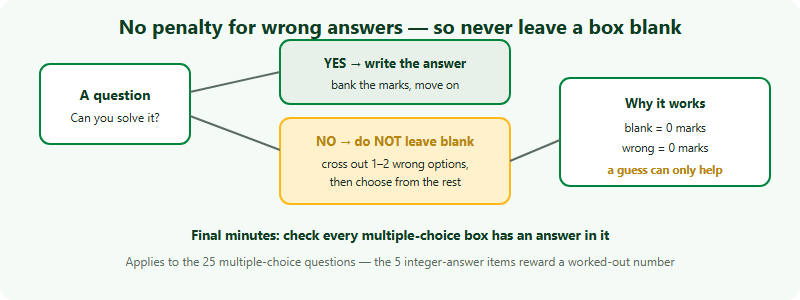
The single most important thing to understand about scoring is that there is no penalty for a wrong answer. A blank and an incorrect answer earn exactly the same: zero. This is not a minor footnote — it is a strategy. It means that leaving any multiple-choice question blank is never the right move: if a student cannot solve a question, an answer they have reasoned toward, or even a considered guess among the remaining options, can only help and can never hurt. The breakeven is unmistakable: across five options, a pure guess wins on average; a guess that first eliminates one or two wrong options does better still.
The practical drill that flows from this rule: in the final few minutes of the sitting, a student should make sure every multiple-choice box has something in it. There is no defensive reason to hold back. The diagram below turns that into a simple decision a child can remember under exam pressure. (Note the contrast with how some other contests work: it is precisely because the AMC has no negative marking that "always answer" is correct here — advice that would be wrong in a contest that deducts marks. For how the AMC sits against other maths contests on rules like this, see how the Australian AMC compares to other maths contests.)
Pacing the clock: a calm time budget by level
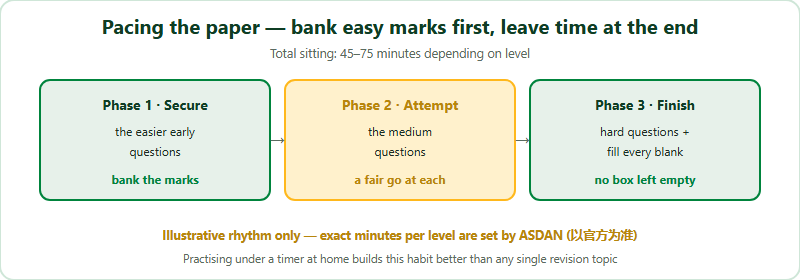
Because the sitting runs 45 to 75 minutes depending on level — the younger levels get the shorter papers, the senior levels the longer ones — the most common practical worry is time. The honest answer is that the AMC is designed so that no student is expected to perfectly finish every question; the harder items are meant to separate the field. What helps is to budget the clock backwards from the easy marks: spend the early part of the paper securing the approachable questions, give the middle band a fair attempt, and reserve a clear window at the end for the hard questions and for filling in any blanks.
The table below is an illustrative way to think about pacing, not an official rule — the exact minutes per level are set by ASDAN and should be confirmed on the official channels. The point is the principle: a child who knows roughly how long they can linger on a single question is far less likely to lose ten minutes stuck on one problem and miss easier marks further down. Practising under a timer at home, with this rhythm, is worth more than any single piece of content revision.
Sitting it in English or Chinese
A practical relief for families in China: the paper is available in both English and Chinese, so a student is not disadvantaged by the language of the questions. This matters most at the younger levels, where a Grade 1–2 child sitting the new Pre-A level may read far more comfortably in Chinese, and at the senior levels, where an international-school student may prefer the English wording they study in. The mathematics is identical in either version — only the language of presentation differs — so the choice is purely about which a child reads fastest and most accurately under time.
It is worth deciding the preferred language before the day rather than in the room, and confirming with ASDAN how the language is selected at registration or on the paper itself, as the exact arrangement is theirs to set. For families still completing entry, the practical steps are covered in our Australian AMC registration walkthrough; this exam-day guide assumes the student is already entered and now preparing to sit.
A calm pre-exam checklist for parents and students
Most of what makes exam day go smoothly is logistics settled in advance, not last-minute cramming. The AMC is a low-pressure contest by design — every entrant receives a certificate, the no-penalty rule removes the fear of losing marks, and awards are scaled by national percentile within each grade band rather than against a fixed bar — so the healthiest framing for a child is curiosity, not stakes. The short list below covers the things that genuinely help, while honestly flagging the details only ASDAN can confirm.
- Confirm the basics with ASDAN: the exact start time, venue, what to bring (pencils, eraser, whether any calculator policy applies) and the language arrangement are all set by ASDAN — confirm them on the official channels rather than assuming.
- Practise under a timer: a few timed runs at the right level build the pacing rhythm above, so the clock feels familiar rather than threatening on the day.
- Rehearse the no-penalty habit: teach the child to never leave a multiple-choice box blank, and to spend the final minutes filling any gaps with a reasoned guess.
- Match the level, not the ambition: the student should be entered at the level for their current grade; awards compare them to their own grade band, so the correct level is the fair one.
- Keep the stakes in proportion: a strong AMC result is a genuine, nationally-benchmarked signal of mathematical ability and something to be proud of — but it is not, and we do not claim it to be, a guarantee of admission to any school or programme.
- Sleep and breakfast beat cramming: on a Sunday-morning sitting, a rested, fed child reasoning clearly will out-perform a tired one who revised late.
Keep three look-alike contests straight
One last check before the day, because shared initials cause real confusion. Everything on this page — the October date, six levels, the 30-question / 135-mark paper, the no-penalty rule — describes the Australian AMC, set by the Australian Maths Trust and administered in China by ASDAN. It is not the American AMC (a different contest run by the MAA in the United States), and it is not the AMO (a separate contest run by SIMCC in Singapore). If an exam-day instruction you have seen mentions the MAA, AIME or SIMCC, it belongs to a different competition and the details here do not apply to it.
| Competition | Run by | Exam-day shorthand |
| Australian AMC (this site) | Australian Maths Trust (AMT); ASDAN (阿思丹) in China/Asia | Oct sitting in China, six levels Grades 1–12, 30 questions / 135 marks, no penalty |
| American AMC | MAA, USA | A different paper, dates and pathway (e.g. toward AIME) — not this one |
| AMO | SIMCC, Singapore | A separate contest with its own schedule and medal scheme |
Frequently asked questions
How long is the Australian AMC paper, and how many questions?
Every level sits 30 questions (25 multiple-choice + 5 integer-answer) worth 135 marks, lasting 45–75 minutes depending on level — younger levels get the shorter sittings.
Is there a penalty for a wrong answer on exam day?
No. A blank and a wrong answer both score zero, so a reasoned guess can only help. Never leave a multiple-choice box empty.
Can my child sit the paper in Chinese?
Yes — the paper is offered in both English and Chinese, and the maths is identical in either version. Confirm how the language is selected with ASDAN.
What should we bring and what time does it start?
The start time, venue and what to bring are set by ASDAN for the China region — confirm the current details on the official site.
This is the editorial desk for the Australian Mathematics Competition (AMC) China region. The competition is run by the Australian Maths Trust (AMT) and administered in China and Asia by ASDAN (阿思丹); this content desk is operated by Hanlin Education for students in China. Dates, fees, levels and rules are set by the AMT and ASDAN and can change each year — always confirm current details on the official channels (amt.edu.au and the ASDAN China-region channels). Confirmed errors are corrected within 7 working days.