
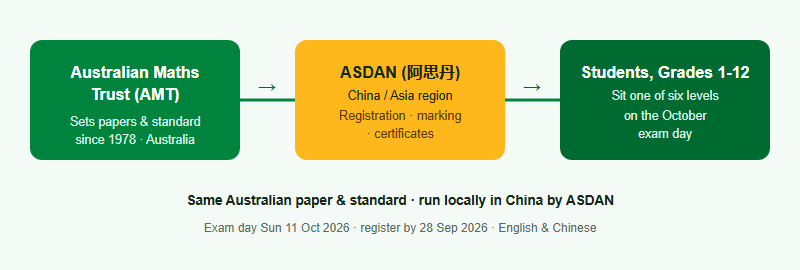
The Australian Mathematics Competition (AMC) is a school maths competition founded by the Australian Maths Trust (AMT) in 1978. For students in China and the wider Asia region it is administered by ASDAN (阿思丹), who run registration, the exam and certificates locally. For 2026 the China-region exam has six levels covering Grades 1-12 (including a new Pre-A level for the youngest students), and is sat on one national exam day in October. This guide explains what the AMC is, how its levels work, and how it differs from the American AMC and the AMO.
Quick facts (2026 China region)
| What it is | A school maths competition — one paper per level, problems that climb in difficulty, rewarding clear reasoning over speed |
| Organiser | Founded & set by the Australian Maths Trust (AMT), Australia, since 1978 |
| China / Asia region | Administered by ASDAN (阿思丹) — registration, invigilation, marking and certificates |
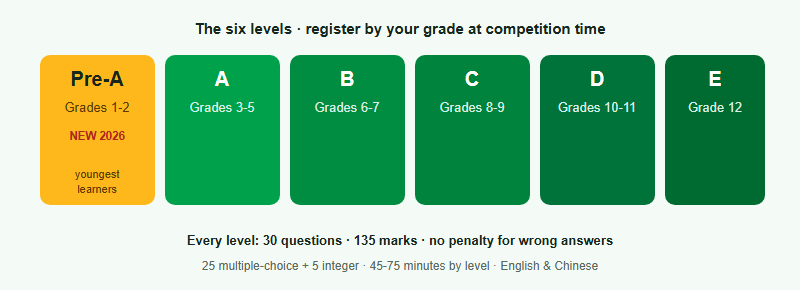
| Levels | Six: Pre-A to E, covering Grades 1-12 (Pre-A is new for 2026) |
| Exam day (China) | Sunday 11 October 2026 · register by 28 September 2026 |
| Paper | 30 questions (25 multiple-choice + 5 integer) · 135 marks · no penalty for wrong answers · 45-75 min by level · English & Chinese |
| Awards | By national percentile — Prize, High Distinction, Distinction, Credit, Proficiency, plus a Certificate for every entrant |
Dates, fees and registration details are set by ASDAN for the China region and by the AMT overall, and can change — always confirm the current specifics on the official channels before you enter.
Who runs it: the AMT and ASDAN
The competition itself — the problems, the standard and the marking scheme — comes from the Australian Maths Trust, a national not-for-profit that has run the AMC since 1978. It is “Australia’s longest-running, largest and most well-known maths competition for school students,” and one of the largest of its kind in the world. What makes the AMC distinctive is its design philosophy: a single paper for every grade band, built from fresh problems each year, where marks rise as questions get harder and there is no penalty for a wrong answer — so every student can attempt every question.
For students in China and Asia, the AMC is run by ASDAN (阿思丹), which handles registration, sitting the paper, marking to the same global standard, and issuing certificates. The papers and academic standards stay those of the Australian Maths Trust; ASDAN is the regional administrator. You can read more on the site’s China region page and the competition overview.
The six levels: Pre-A to E (Grades 1-12)
The AMC offers a paper pitched to each grade band, so a Grade 2 student and a Grade 11 student sit different, age-appropriate papers. You register according to your grade at the time of the competition. For 2026 the China region runs six levels, with the headline change being a brand-new Pre-A level for Grades 1-2 — opening the AMC to younger learners than before.
Format and scoring: 30 questions, 135 marks, no penalty
Every level sits a 30-question paper — 25 multiple-choice and 5 integer-answer questions — out of a total of 135 marks. The questions climb in difficulty, and the marks rise with them: early questions are worth fewer marks, the hardest worth the most. Crucially, there is no penalty for an incorrect answer, so the right strategy is to attempt every question and make your best reasoned attempt on the hard ones. Time allowed runs from about 45 minutes for the youngest level up to 75 minutes for the senior secondary levels.
Australian AMC vs American AMC vs AMO — don’t confuse them
This is the single most common mix-up for families, because three different competitions share similar names. They are not the same, and a result in one does not transfer to another.
| Competition | Who runs it | Who it’s for |
| Australian AMC (this site) | Australian Maths Trust (Australia); ASDAN in China | Grades 1-12 (six levels, Pre-A to E) |
| American AMC (AMC 8/10/12) | Mathematical Association of America (USA) | Mainly secondary; the path toward AIME and USAMO |
| AMO (American Mathematics Olympiad) | SIMCC (Singapore) | Grades 2-12; a separate Singapore-run contest |
In short: the Australian AMC is its own competition, run by the Australian Maths Trust, and in China it spans Grades 1-12. We’ll cover the differences in depth in a dedicated comparison; for now, just know that “AMC” on this site always means the Australian Mathematics Competition.
Awards: recognition by percentile
Every entrant receives a certificate, and national awards are given by percentile, so the bar adjusts to each level and year. The top tier nationally earns a Prize, followed by High Distinction, Distinction, Credit and Proficiency bands. A perfect score can earn the Peter O’Halloran Award. Because awards are percentile-based, they reflect how a student performed against others at the same level — not a fixed cut-off — so thresholds shift slightly from year to year. For the exact recent cut-off scores, check the official results pages.
Who should consider the AMC?
The AMC suits a wide range of students precisely because it offers a paper for every grade from 1 to 12. For younger learners — especially with the new Pre-A level — it is a gentle, encouraging introduction to competition maths that rewards thinking over memorisation. For older students, the harder questions at Levels C-E offer a genuine challenge and a recognisable line on an academic record. The no-penalty format keeps it low-pressure: there is no downside to trying. If you are weighing it against other contests for a younger child, our comparison guides (vs the American AMC, vs Math Kangaroo) are a good next step.
Frequently asked questions
When is the 2026 Australian AMC in China?
The China-region exam day is Sunday 11 October 2026, with registration closing 28 September 2026. Always confirm the live dates on the official ASDAN channels before entering.
What grades can take part?
In China for 2026 the AMC runs six levels covering Grades 1-12: Pre-A (Grades 1-2, new for 2026), A (3-5), B (6-7), C (8-9), D (10-11) and E (Grade 12). You register by your grade at competition time.
Is the Australian AMC the same as the American AMC?
No. The Australian AMC is run by the Australian Maths Trust and, in China, spans Grades 1-12. The American AMC (AMC 8/10/12) is run by the MAA in the USA, and AMO is a separate Singapore-run contest. They are different competitions.
How is the paper scored?
Each level has 30 questions (25 multiple-choice, 5 integer) out of 135 marks, with marks rising as questions get harder and no penalty for a wrong answer.
This is the editorial desk for the Australian Mathematics Competition (AMC) China region. The competition is run by the Australian Maths Trust (AMT) and administered in China and Asia by ASDAN (阿思丹); this content desk is operated by Hanlin Education for students in China. Dates, fees, levels and rules are set by the AMT and ASDAN and can change each year — always confirm current details on the official channels (amt.edu.au and the ASDAN China-region pages). Confirmed errors are corrected within 7 working days.