
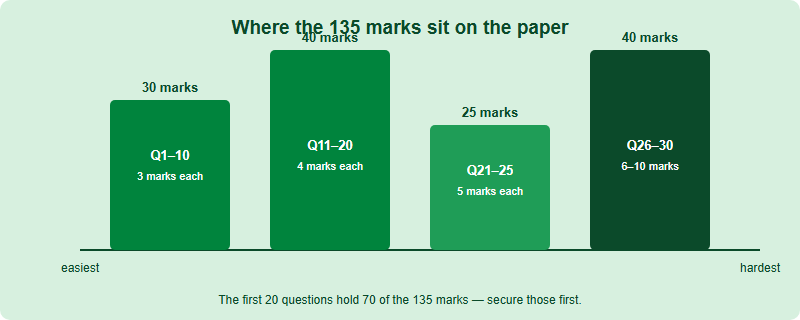
The Australian Mathematics Competition (AMC) is marked out of 135 marks across 30 questions, and the marks are not equal: the first ten questions are worth 3 marks each, the next ten 4 marks each, then 5 marks each, and the final five questions are worth 6, 7, 8, 9 and 10 marks. There is no penalty for a wrong answer. Understanding that weighting — set by the Australian Maths Trust (AMT) since 1978 — is the difference between a scattered attempt and a score that reflects what you actually know.
The exact mark allocation (per the AMT)
Every AMC paper, at every level, follows the same structure: 30 questions made up of 25 multiple-choice and 5 integer-answer questions, totalling 135 marks. The questions are ordered roughly by difficulty, and the marks rise in four bands. This is the official scheme published by the Australian Maths Trust:
| Questions | Marks each | Band total | Typical difficulty |
| 1–10 | 3 marks | 30 marks | Warm-up — most students should attempt all ten |
| 11–20 | 4 marks | 40 marks | Core curriculum, a step up |
| 21–25 | 5 marks | 25 marks | Harder multiple-choice; real problem-solving |
| 26 | 6 marks | 40 marks | The integer-answer “back six” — the hardest, highest-value questions |
| 27 | 7 marks | ||
| 28 | 8 marks | ||
| 29 | 9 marks | ||
| 30 | 10 marks | ||
| Total | 135 marks | ||
Notice the shape of it. The first 20 questions carry 70 marks — more than half the paper — and they are the most accessible. The last five questions alone carry 40 marks, the same as questions 11–20 combined, but they are designed to separate the very strongest students. That distribution is deliberate: it lets a Grade 4 student and a Grade 11 student both find a level of challenge on the same-shaped paper, while keeping a long tail of difficulty at the top. If you want the wider picture of how the levels and paper fit together, see our overview of what the Australian AMC is.
No penalty changes everything: never leave a multiple-choice blank
The AMC’s most important rule for strategy is the one that is easiest to forget under pressure: there is no penalty for an incorrect answer. You are not docked marks for a wrong guess, and you do not lose anything for attempting a hard question. This is the opposite of some other contests, where wrong answers are penalised — so a habit imported from those contests will cost you marks here.
The practical consequences are clear:
- Every multiple-choice question should have an answer marked — even a pure guess on a question you cannot solve has a positive expected value, because a blank scores zero and a guess scores zero or more.
- Eliminate before you guess. If you can rule out two of the five options using estimation, units, or parity, your guess on the remaining three is far stronger than a blind one.
- The 5 integer-answer questions (26–30) are different. There are no options to guess between, so a random number is very unlikely to land — but there is still no penalty, so writing your best reasoned value never hurts.
- Budget your last two minutes to make sure no multiple-choice answer is left empty. Sweep the page before time is called.
First-party note from our China-region desk: in practice the single most common avoidable loss we see is students leaving the final multiple-choice questions blank because they “ran out of time to solve them.” Marking a considered guess on those costs nothing and occasionally gains 5 marks each.
A mark-efficient game plan: solve in order of value, not order of number
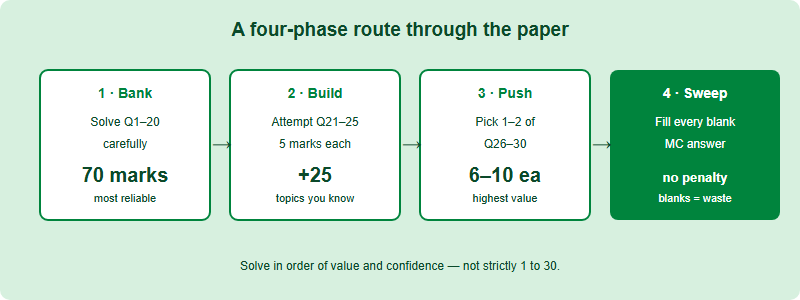
Because the marks climb, the best route through the paper is not strictly 1, 2, 3… to 30. It is to bank the high-probability marks first, then spend remaining time on the highest-value questions you can still reach. A workable plan for most students at Levels A–C looks like this:
| Phase | What to do | Why |
| 1 · First pass | Answer Q1–20 carefully but briskly | That is 70 marks and the most reliable. Accuracy here matters more than speed. |
| 2 · Second pass | Attempt Q21–25 (5 marks each) | Genuine problem-solving; pick the ones whose topic you know best. |
| 3 · Targeted push | Choose 1–2 of Q26–30 that look most approachable | The back six are worth 6–10 marks; one solved is worth more than two careless errors fixed earlier. |
| 4 · Final sweep | Fill every blank multiple-choice; recheck transcription | No-penalty rule means blanks are pure waste. |
Two cautions. First, do not over-invest in a single hard question early — a 10-mark question you cannot finish is worth the same as one you never started, and the time could have secured several 3- and 4-mark questions. Second, accuracy on the easy band is undervalued: a silly slip on a 3-mark warm-up question is, in mark terms, identical to missing a 3-mark question you found hard. For younger students at Pre-A and Level A, simply completing the first two bands carefully is often the whole game.
What the score is not: percentile awards and the China-region clock
Your raw mark out of 135 is only half the story. AMC awards are decided by percentile, not by a fixed score, so the cut-off for, say, a Distinction shifts year to year and depends on how others at your level performed. The AMT publishes a tiered set of awards — Participation, Proficiency, Credit, Distinction, High Distinction and a top Prize — plus medals and the Peter O'Halloran Award for a perfect 135. Chasing a raw number in isolation can mislead; what matters is your performance relative to your year level. For the exact recent thresholds and the full award list, confirm on the official site — these are set by the competition and change each year.
Two practical reminders specific to the China region, administered by ASDAN (阿思丹):
- Time on the clock differs by level. Primary-level papers run around 60 minutes and secondary-level papers around 75 minutes, so your pacing maths changes with your level. Plan how long you can spend per band before exam day.
- The paper is bilingual (English and Chinese), which helps younger students, but the mathematics and the marking are the AMT's global standard. The 2026 China exam day and registration deadline (and any rules on equipment such as calculators) are set regionally — confirm current details on the official ASDAN channels and amt.edu.au before you sit.
If you are still deciding which level to enter, or how the Australian AMC differs from the American AMC and the Singapore-run AMO, our foundation guide walks through all six levels and the key distinctions.
Frequently asked questions
Is the Australian AMC marked out of 100 or 135?
Out of 135. The 30 questions are weighted: Q1–10 are 3 marks, Q11–20 are 4, Q21–25 are 5, and Q26–30 are 6, 7, 8, 9 and 10 marks respectively.
Is there negative marking on the AMC?
No. There is no penalty for a wrong answer, so you should mark an answer for every multiple-choice question, even your best guess.
How many questions are multiple-choice?
Twenty-five are multiple-choice and five are integer-answer (questions 26–30). Confirm the current format on the official site before each year's sitting.
Does a higher raw score guarantee a higher award?
Not directly — awards are percentile-based, so cut-offs depend on your year level and the year. Check the official results pages for current thresholds.
Published by the Australian AMC editorial desk, operated by Hanlin Education for China-based international-school students. The Australian Mathematics Competition is run by the Australian Maths Trust (AMT) and administered in the China and Asia region by ASDAN (阿思丹); the American AMC (MAA) and the AMO (SIMCC) are separate competitions. Official rules are set by the competition and change yearly — confirm current details on amt.edu.au. Any confirmed error is corrected within 7 working days.