
The Australian Mathematics Competition rewards clear thinking far more than a memorised formula sheet. Its hardest questions cannot be answered by recall alone — they ask you to try something, adjust, and reason your way through. Five techniques do most of the heavy lifting: working backwards, splitting a problem into cases, shrinking it to small numbers, estimating to eliminate, and checking your work. Here is how each one works, and when to reach for it.
Why technique beats memorisation on the Australian AMC
The Australian Mathematics Competition is run by the Australian Maths Trust (AMT, in Australia since 1978) and is sat in the China region through ASDAN, with the 2026 exam on 11 October and registration closing on 28 September. Each paper has 30 questions and a maximum of 135 marks, with no negative marking. That last detail matters more than most students realise: because a wrong answer never subtracts from your score, you are free to experiment — test an idea, try a number, follow a hunch — with nothing to lose.
The paper is also built deliberately as a difficulty ramp. The early questions reward accuracy and speed; the later questions reward strategy. If the only thing you can do is reproduce a method your teacher showed you, you will stall at exactly the point where the taught methods run out. A small toolbox of techniques means you always have a next move. If you are new to the competition, start with our overview of What Is the Australian AMC and then come back to build the toolbox below.
| Technique | The signal that it fits | The one-line idea |
|---|---|---|
| Work backwards | A multiple-choice question with five options | Test the options instead of solving forwards |
| Casework | Several possibilities, or a condition with branches | Split into clean cases, solve each, then combine |
| Small cases | A big or awkward number in the problem | Try n = 1, 2, 3 and spot the pattern |
| Estimate and eliminate | Messy numbers or a “roughly how much” feel | Get a ballpark and rule out impossible answers |
| Check your work | Any answer you are about to commit | Re-read the question and test the answer back |
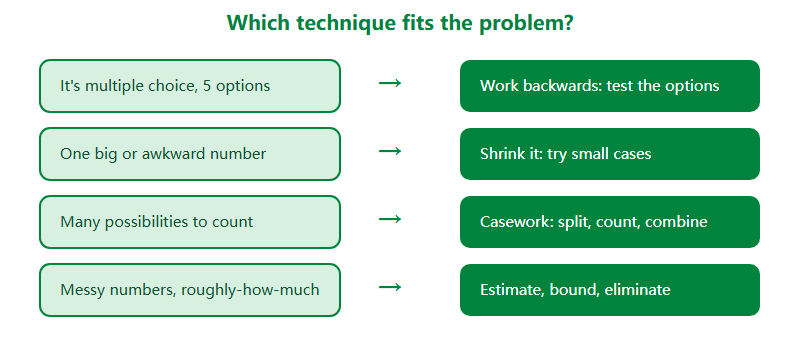
Technique 1: Work backwards using the multiple-choice options
In the standard format, Questions 1 to 25 are multiple choice, each with five options — which means the correct answer is already sitting in front of you. On many problems it is faster to test the options than to solve from scratch. Suppose a question says a number, doubled and then increased by 5, gives 27. Instead of writing an equation, try the choices: a value of 11 gives 2 x 11 + 5 = 27, so 11 is the answer. Working backwards is especially powerful when the forward method uses algebra you have not met yet — a Grade 4 student can back-solve a problem that “should” need equations.
Two cautions make it reliable. First, if the options are ordered by size, start with the middle one: you can usually tell whether to go higher or lower, which halves the work. Second, test against the exact condition in the question, not a paraphrase in your head — the AMC likes options that are “almost right” for a student who misread. (Confirm the current China-region question format with ASDAN or on amt.edu.au, since details can change year to year.)
Technique 2: Split the problem into clean cases
When a problem has several possibilities, resist the urge to solve it all at once. Break it into a small number of non-overlapping cases, handle each separately, then add up. To count the two-digit numbers whose two digits differ by exactly 3, organise by the tens digit: 1 pairs with 4, 2 pairs with 5, and so on, remembering the reverses like 41 and 52. Worked case by case, you never lose track and you never double-count.
Casework is the backbone of the counting questions that cluster later in the paper, and it also tames geometry problems that branch into “the point is either inside or outside the shape.” The whole skill is choosing cases that cannot happen together and that leave no gaps. If two of your cases can both be true at once, you will overcount; if a possibility fits none of your cases, you will miss marks. A quick check — do my cases cover everything, exactly once? — keeps casework honest.
Technique 3: Shrink the problem to small cases
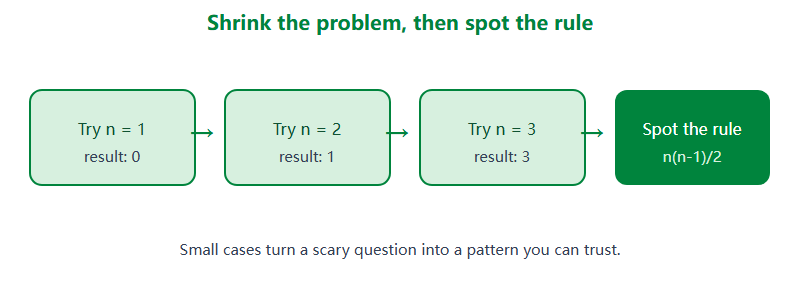
If a question throws a large number at you — “how many line segments connect 20 points?” — do not attack 20 directly. Try 2 points (1 segment), 3 points (3 segments), 4 points (6 segments). A pattern appears: the counts are 1, 3, 6, 10, and each new point adds one more segment than the last did. From there the rule n(n-1)/2 falls out, and you apply it to 20 with confidence. Shrinking works because competition problems are almost always built on a pattern, and patterns show themselves at small sizes.
The habit that makes this reliable is writing the small cases in a neat table or list rather than in your head. Lined up in a column, the numbers 1, 3, 6, 10 practically shout their rule; scattered in the margin, they hide it.
Techniques 4 and 5: Estimate to eliminate, then check
Not every question needs an exact method. If a shaded region is clearly a little less than half of a square of area 100, an answer near 45 is believable and an answer of 500 is impossible — estimation alone can eliminate three or four options. Get into the habit of asking “roughly how big should the answer be?” before you compute; it catches decimal-point slips and the wrong-units traps the AMC plants on measurement questions.
Technique five costs about ten seconds and saves the most marks: check. Re-read the question (did it ask for the perimeter or the area? the number of students or the number of handshakes?), substitute your answer back into the condition, and confirm the size makes sense. Because there is no negative marking, you should never leave a multiple-choice answer blank — a blank can only score zero, while a reasoned guess can score. But in your final minutes, spend the time checking questions you did answer rather than staring at one you cannot crack. For the bigger picture of how these skills fit the 30-question paper, see What Is the Australian AMC.
A note for China-region students: the paper is bilingual, so a technique is only as good as your reading of the question. Slow down on the words that carry the logic — at least, at most, exactly, different, consecutive — and confirm you have understood the condition in both English and Chinese before you deploy any technique.
Frequently asked questions
Do I need advanced formulas to do well on the Australian AMC?
No. Many hard questions yield to working backwards, casework, and small cases — techniques a younger student can use before meeting algebra. Confirm topic scope on amt.edu.au.
Should I guess if I run out of time?
Yes. There is no negative marking, so a blank multiple-choice answer only scores zero. Always record a best attempt for every question.
Which questions are multiple choice?
In the standard format, Questions 1–25 are multiple choice and 26–30 are integer-answer. Confirm the current China-region format with ASDAN or on amt.edu.au.
How is the Australian AMC different from the US AMC?
Different organisers and papers: the Australian AMC is run by AMT, the US AMC by the MAA, and AMO by SIMCC. This guide covers the Australian AMC only.
This article is published by the Australian AMC editorial desk, operated by Hanlin Education for China-based international-school students. Official rules are set by the competition and change yearly — confirm current details on amt.edu.au. Errors are corrected within 7 working days.