
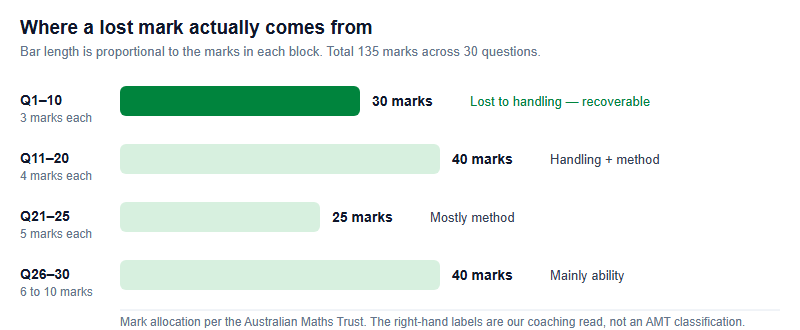
Questions 1 to 10 of the Australian AMC are worth 3 marks each — 30 marks of the paper’s 135. Almost nobody loses them because the mathematics was too hard. They go to reading too fast, recording the wrong letter, and spending four minutes on a question that deserved ninety seconds. This is a protocol for protecting the cheapest marks on the paper.
Thirty marks that difficulty does not decide
The Australian Maths Trust publishes the same structure for every AMC paper: 30 questions, 25 multiple-choice and 5 integer-answer, for a maximum of 135 marks. The marks rise in four bands — questions 1–10 are worth 3 marks each, 11–20 are worth 4, 21–25 are worth 5, and 26 to 30 rise from 6 marks to 10. There is no penalty for an incorrect answer.
Read that distribution twice, because it is not shaped the way students behave. The first twenty questions carry 70 marks — more than half the paper — and they are the most accessible questions on it. Yet the first block is the one students treat as a formality on the way to the interesting problems at the back.
Here is what makes the first ten different from every other part of the paper. A mark you do not get on question 28 is usually an ability outcome: on that day, that method was not available to you. A mark you do not get on question 4 is almost always a handling outcome: you had the mathematics, and something in the process between reading and recording went wrong. Ability takes months to move. Handling can be fixed in a fortnight.
This matters more than it sounds. In the cohorts our coaches work with, students who finish just under a band boundary very rarely got there by failing the back five — nearly all of them gave marks away in the first twenty questions, and a meaningful share of those losses sat in questions 1 to 10. That is our own coaching observation rather than a statistic published by AMT, and individual results vary. But it is consistent enough that we now start diagnosis at the front of the paper rather than the back. If you are still getting oriented to how the paper and the six levels fit together, our overview of what the Australian AMC is sets out the structure.
What the first block actually asks
Questions in the opening block are not a random sample of easy problems. Across past papers they fall into a small number of recognisable shapes, and each shape has its own characteristic way of going wrong. Knowing the shape tells you which five-second check to run before you move on.
| Shape | What it is testing | How it is actually lost | The five-second check |
|---|---|---|---|
| Direct computation | Accurate arithmetic under mild time pressure | A slip in one operation, usually a sign or a carry | Is the size of the answer sensible? |
| Read-the-figure | Extracting a value from a diagram or a table | Reading the wrong row, edge or axis | Point at the thing you read. Is it the thing asked for? |
| One-step word problem | Translating one sentence into one operation | Answering the first half of the sentence, not the last clause | Reread the final clause only. |
| Small pattern or count | Spotting a rule from three or four terms | Continuing the pattern one step too few or too many | Recount the boundary case. |
| Unit or measure | Handling minutes, metres, cents or percentages | Correct number, wrong unit | Say the unit out loud in your head. |
Notice that four of those five failure modes have nothing to do with mathematics. They are failures of attention at a specific, predictable moment. That is exactly why they respond to a protocol rather than to more practice.
The time budget, and why the first block should be fast
AMT publishes 60 minutes for the primary divisions of the AMC and 75 minutes for the secondary divisions, both sitting the same 30 questions made up of 25 multiple-choice and 5 integer-answer questions. In the China region the youngest entrants sit the separate Pre-A paper; confirm its timing and format with ASDAN. One important caution before you rehearse to a clock: AMT’s Australian division names and the six China-region levels are banded differently, so confirm the exact duration for your level with ASDAN rather than assuming which of those figures applies to your seat.
Work the arithmetic either way. Sixty minutes across 30 questions is an average of two minutes per question; 75 minutes is an average of two and a half. But the marks are not flat, so an average is the wrong target. Spending two minutes on a 3-mark question while a 10-mark question waits at the back is a trade you would never make deliberately — and yet under pressure it is the default.
Our coaching guidance is to aim to finish questions 1 to 10 in roughly a quarter of the total time, leaving three-quarters of the clock for the 105 marks that remain. On a 60-minute paper that is about 15 minutes, or 90 seconds a question. On 75 minutes it is closer to 18 or 19 minutes. These are our targets for rehearsal, not rules set by the competition.
| Block | Marks each | Block total | Share of the 135 | Our suggested share of the clock |
|---|---|---|---|---|
| Questions 1–10 | 3 | 30 | 22% | About 25% — and ideally less |
| Questions 11–20 | 4 | 40 | 30% | About 30% |
| Questions 21–25 | 5 | 25 | 19% | About 20% |
| Questions 26–30 | 6, 7, 8, 9, 10 | 40 | 30% | Whatever remains — plus the verification pass |
The column that matters is the last one. If the first block eats 40% of your clock, the paper is already lost in a way no amount of talent at question 27 will repair.
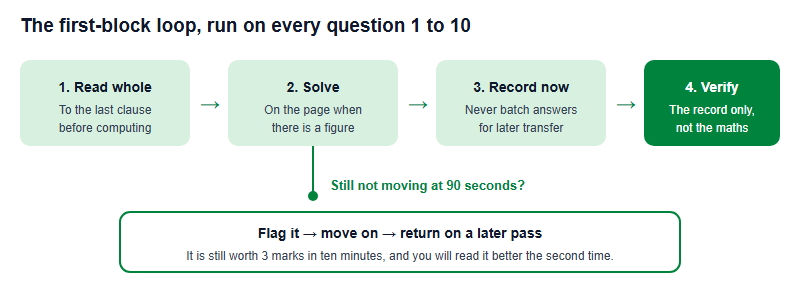
The protocol: read whole, solve, record, verify
Four steps, in a fixed order, applied to every question in the first block without exception. The point of a fixed order is that it removes decisions, and decisions are what cost time when you are nervous.
- Read to the last clause before you compute anything. The final clause is where the actual requirement usually hides: how many more, the difference, in cents, not counting the first. Students who begin calculating from the first sentence are solving a question the paper did not ask.
- Solve on the page, not in your head, whenever there is a figure. If the paper in front of you is printed, the diagram is a working surface: mark the equal sides, write the value beside the vertex you deduced it at. If your seat is delivered on screen, that working has to go somewhere else — check with your coordinator what you may write on.
- Record immediately. Do not batch answers to transfer later. Batching is where transcription drift begins, and it always begins on the easy questions, because those are the ones you feel safe deferring.
- Verify the record, not the mathematics. A three-second glance that answers one question only: is the letter I have written the letter I chose? You are not re-solving. Re-solving is the trap in the next section.
Two rules sit on top of the four steps. The first is the ninety-second rule: if you are not visibly moving on a first-block question at ninety seconds, flag it and go. It will still be worth 3 marks when you come back, and you will read it better on the second pass than you will by staring at it now. The second is that no multiple-choice question in the first block may be left blank. Because the AMC applies no penalty for a wrong answer, an unrecorded answer is strictly worse than a considered one — there is no scenario in which a blank multiple-choice box is the better outcome.
The three first-block losses we actually see
These are not the general errors that show up anywhere on a paper. They are specific to the opening block, and each has a fix that costs nothing to install.
Over-checking. A student who is anxious about accuracy re-solves questions 2, 3 and 5 from scratch, gains nothing, and arrives at question 24 with four minutes left. The re-solve feels productive because it is easy. It is the single most expensive habit in the first fifteen minutes. The fix is the distinction built into step four: on the first pass you verify the record, never the mathematics. Re-solving belongs in a final pass, if the clock allows one.
Transcription drift. The student solves questions 6 through 9, holds four answers in their head to write down together, gets interrupted by a thought about question 10, and writes three of them in the wrong rows. Every mark in the block is intact and three of them are gone. The fix is step three, applied without exception: record before you read the next question.
The last clause. The question describes a situation, and the student computes the quantity the situation is obviously about — then discovers, or fails to discover, that the paper asked for the difference between it and something else, or for the answer in different units. This is the single most common first-block loss we see in mock papers, and it is why step one is a reading instruction rather than a mathematical one.
With the China-region sitting on 11 October 2026 and registration closing on 28 September 2026, there is time to install all three fixes. The drill we recommend is deliberately small: twice a week, do ten first-block questions against a fifteen-minute clock, mark them immediately, and log each lost mark by which of the three losses caused it. Two weeks of that will tell you more about your likely score than another full past paper will. Full papers still matter for stamina and for the back end — the first-block drill sits alongside them, not instead of them. For how the levels differ in what those first ten questions look like, see our guide to how the Australian AMC is organised.
Frequently asked questions
How many marks are questions 1 to 10 worth?
Three marks each, 30 in total. Questions 11 to 20 are worth 4 each, 21 to 25 are worth 5, and 26 to 30 rise from 6 to 10.
Should I ever leave a first-block question blank?
No. The AMC applies no penalty for a wrong answer, so an unrecorded multiple-choice question is always worse than a considered guess.
How long should the first ten questions take?
Our coaching guidance is roughly a quarter of your total time. Confirm the exact paper duration for your level with ASDAN before rehearsing.
Is it worth practising only the first ten questions?
As a weekly timed drill, yes: ten questions in fifteen minutes, marked at once. It supplements full past papers rather than replacing them.
Published by the Australian AMC editorial desk, operated by Hanlin Education for China-based international-school students. The Australian Mathematics Competition is run by the Australian Maths Trust and administered in the China region by ASDAN. Official rules are set by the competition and change from year to year — confirm current details on amt.edu.au and with ASDAN. Errors are corrected within 7 working days of being reported.