
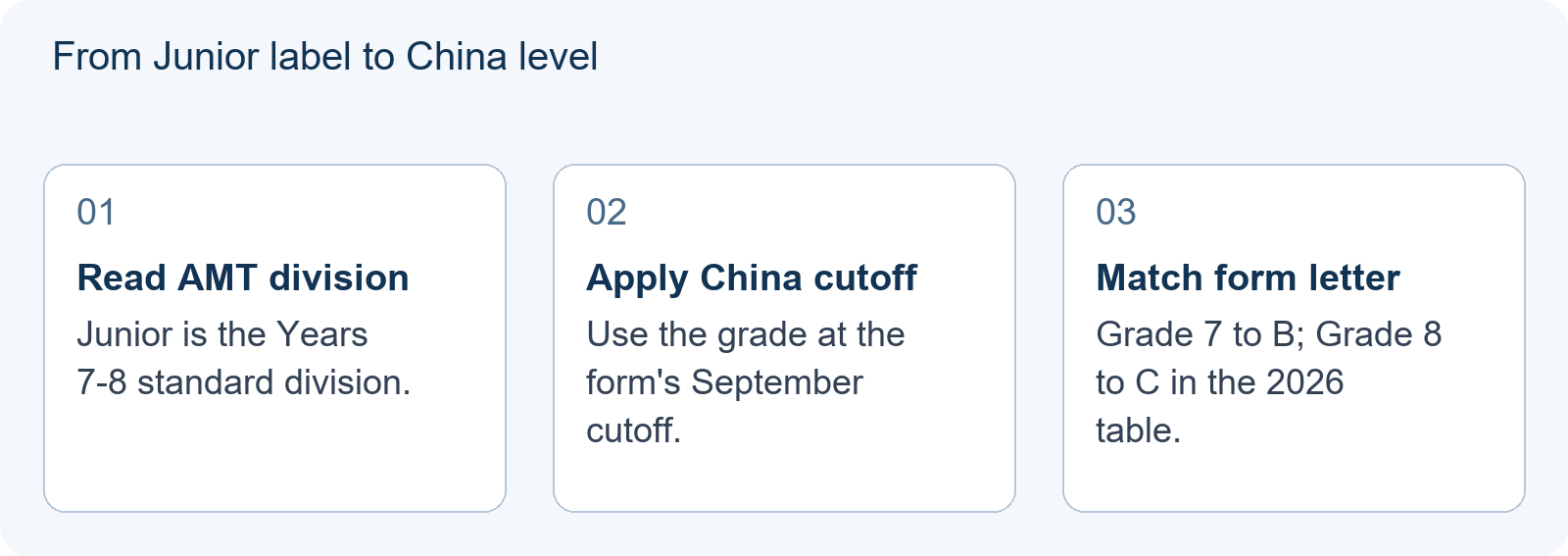
Australian AMC Junior is the Australian Maths Trust division for Years 7-8, not a China-region level letter. In the 2026 China-region table published by Hanlin Courses on 16 June 2026, after the September cutoff Grade 7 falls in Level B and Grade 8 in Level C. Check the grade at the form’s cutoff and the letter printed on the form.
Why the word Junior and the letter B or C can both be correct
The AMT Australian Mathematics Competition page lists standard divisions as Middle Primary Years 3-4, Upper Primary Years 5-6, Junior Years 7-8, Intermediate Years 9-10 and Senior Years 11-12. That is a division list. A China-region registration form may instead use Pre-A to E. The two systems answer different questions: AMT’s division names describe the standard year band of the competition; the China-region letter describes the entry on that region’s form.
The 2026 Australian AMC Mathematics Competition Full Guide (Grades 1-12), published by Hanlin Courses on 16 June 2026, reports a China-region table with six levels, Pre-A to E. That table is not the same document as AMT’s standard division list. It uses a September grade cutoff. After that cutoff, Level B covers Grades 6-7 and Level C covers Grades 8-9. This is why the single word Junior can sit across two China letters rather than matching one automatically.
AMT writes ‘years’; the China table writes ‘grades’. On the China form, use the grade number the form asks for. The comparison below uses the grade row that the form itself supplies; it does not assume that an Australian school-year label can be pasted into a Chinese grade field without checking.
| Naming system | Label | Band in the relevant source | What the label names |
|---|---|---|---|
| AMT standard divisions | Junior | Years 7-8 | AMT division band |
| 2026 China-region table | Level B | Grades 6-7 after the September cutoff | China entry level |
| 2026 China-region table | Level C | Grades 8-9 after the September cutoff | China entry level |
For related school-system mapping, see Which Level, Really? Mapping IB, British and Chinese School Years onto the Australian AMC Levels (2026). The present question is narrower: why the specific AMT division name Junior spans Level B and Level C on the China form.
The 2026 China table in one view
The Hanlin Courses guide reports the following China-region bands and timings for the 2026 cycle. The duration column belongs to that reported China table; it is not being inferred from AMT’s standard division list.
| China level | Grade after September 2026 cutoff | Reported duration | Relation to AMT Junior Years 7-8 |
|---|---|---|---|
| Pre-A | Grades 1-2 | 45 minutes | Outside Junior |
| A | Grades 3-5 | 60 minutes | Outside Junior |
| B | Grades 6-7 | 60 minutes | Includes Grade 7 |
| C | Grades 8-9 | 75 minutes | Includes Grade 8 |
| D | Grades 10-11 | 75 minutes | Outside Junior |
| E | Grade 12 | 75 minutes | Outside Junior |
The same guide reports that the 2026 China-region registration deadline was 28 September and the sitting date was 11 October. By the publication date, both dates are past; they are historical details for reading a 2026 form, not an open call to register.
Why a one-to-one mapping fails
A simple set comparison explains the overlap. AMT’s Junior band is Years 7-8. In the 2026 China table after the September cutoff, Level B is Grades 6-7, and Level C is Grades 8-9. Level B intersects Junior at the Year 7 / Grade 7 boundary; Level C intersects Junior at the Year 8 / Grade 8 boundary. But Level B also contains Grade 6, which is outside Junior, and Level C also contains Grade 9, which is outside Junior.
So Junior is neither equal to Level B nor equal to Level C. It is a wider AMT division name that the China table splits at a different point. A family that tries to translate Junior into one letter is forcing a partition that the sources do not support. The correct move is to use the grade at the form’s cutoff, then read the level letter that the form assigns to that grade.
Why the cutoff matters more than the division word
The 2026 China table gives both before-September and after-September grade rows. Before the September cutoff, the guide places Grades 5-6 in Level B and Grades 6-7 in Level C, with Grade 6 appearing in both rows. After the cutoff, it places Grades 6-7 in Level B and Grades 8-9 in Level C. The grade label attached to one student changes when the school year rolls over, and the table is written to be read against the stated cutoff.
This is the practical trap. A Grade 7 student in July 2026 is in Level C before the September cutoff. After the rollover, that student is in Grade 8 and still in Level C. A Grade 6 student in July can appear in the reported B row and also in the C row before the cutoff; that before-cutoff overlap is exactly why the form’s own row and channel confirmation matter. After the rollover, the same student is Grade 7, which falls in B after the cutoff. Comparing a July grade with an October row can produce correct-looking reasoning for the wrong reason.
For the year-move question, see The Year You Move Up: What Changes When You Cross into a New Australian AMC Level (2026).
Worked contrast: two students in the same AMT division
Teaching illustration, not an official contest case. Student A is in Grade 7 on 1 October 2026, after the September cutoff. Student B is in Grade 8 on the same date. Both fall inside AMT’s Junior division of Years 7-8. On the 2026 China-region table, A’s row is Level B and B’s row is Level C. The guide reports Level B at 10:00-11:00 for 60 minutes and Level C at 14:00-15:15 for 75 minutes. Both are A-E papers with 30 questions and 135 marks in that reported table.
If A’s family writes only Junior on a registration enquiry, the channel still does not know whether the intended entry is B or C. The grade at the cutoff does. A is Grade 7 after the cutoff, so the reported China band is B. B is Grade 8 after the cutoff, so the reported China band is C. The AMT division word is true for both students, but it is not the registration key.
A second contrast shows why the timing gap is not just cosmetic. The reported Level B paper gives 60 minutes for the same 30-question, 135-mark total; Level C gives 75 minutes. A blunt average is 2 minutes per question for B and 2.5 minutes for C, but that average is only a sanity check. The mark schedule already differs by question band, so equal time per question is not a plan. The useful conclusion is narrower: the letter changes the sitting conditions, not merely the label on a confirmation email.
A grade-first worksheet before submitting
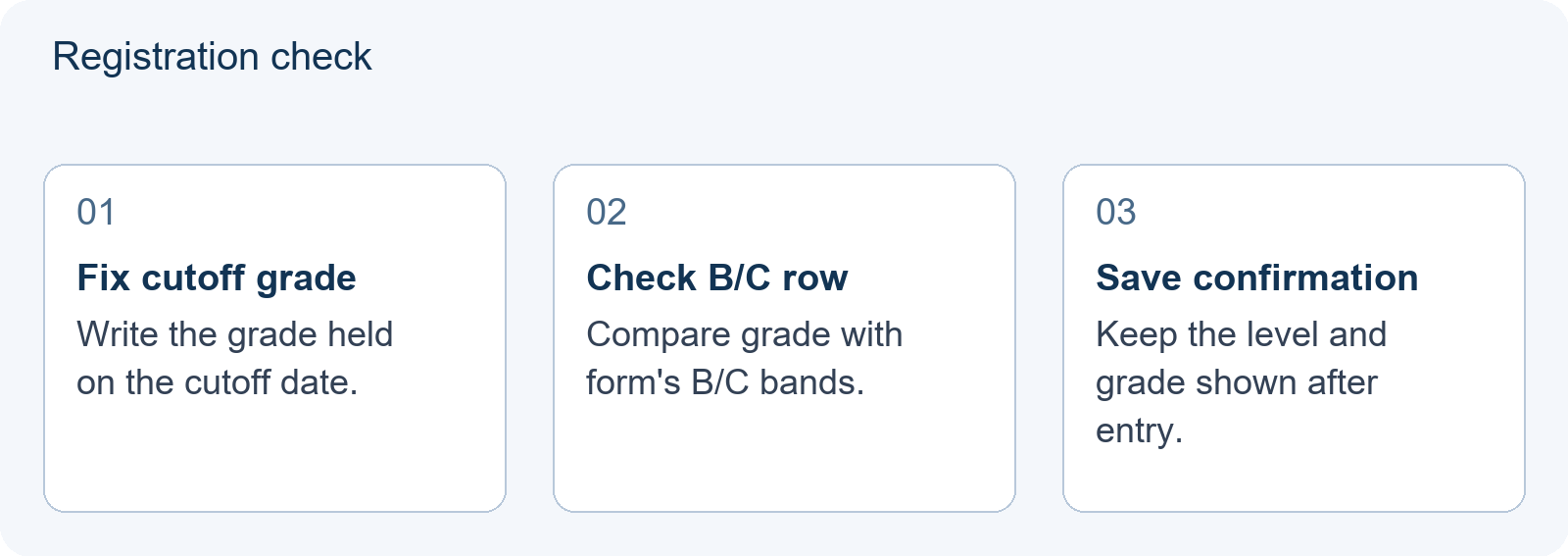
The registration diagnostic is short. First, write the student’s grade on the cutoff date named by the form, not the grade in a different month. Second, find the level letter that the form prints for that grade; do not translate from AMT’s Junior band by memory. Third, ask the school or registration channel whether the entry has already been locked. Fourth, keep the confirmation that shows the grade, the level letter and the date. Fifth, if the form says Junior only, ask which China letter and which cutoff the form is using.
| Question to answer | What to record | Why it matters |
|---|---|---|
| Which cutoff does the form use? | The date printed on the registration form or notice | The same grade word can land in a different row after a school-year rollover. |
| What grade is the student on that date? | The grade number, not an Australian ‘Year’ label alone | The China table is written in grade rows. |
| Which letter does the form print? | Level B, Level C or another letter exactly as shown | The form’s letter is the entry field, not the AMT division word. |
| Has the entry been locked? | Written confirmation from the school or channel | Clarifies how a correction would be handled after submission. |
The grade-error risk is covered in more detail in Australian AMC Entry Check: The Grade Error That Hides Inside the Right Level Letter (2026). The point is not that one letter is better. The point is that the form’s letter and the student’s cutoff grade must agree. Once they do, further comparison between Junior and B/C stops adding decision value.
Junior is not a label borrowed from another competition
The shared letters can mislead. Australian AMC Junior is an AMT division for Years 7-8. A form for a different competition has its own rules and its own labels. Do not carry another competition’s grade rule into an Australian AMC China-region form, and do not assume that the word Junior belongs to a different system. Use the Australian source and the China form in front of you.
Preparing a course-fit or resource question
A preparation conversation works better when the family brings the decision facts, not a guessed level. Useful items are the grade at the cutoff, the level letter printed on the form, a recent timed attempt or two, and the immediate goal: confidence with unfamiliar problems, a specific paper’s pacing, or review of a topic block. A useful question is: My child is Grade 7 at the 2026 cutoff; the form says Level B; here is a recent 60-minute attempt; which topics should we review before a future cycle? That is a preparation-fit question. It does not ask the article to promise a seat, a fee, a cutoff or an award.
If the family is unsure between B and C, the first request should be a registration check, not a course purchase. Ask the channel to confirm the grade row and the letter. Only after that should preparation be planned around the paper’s duration, mark ladder and question mix.
What to keep, and when comparison stops
Keep the confirmation showing the student’s grade at the cutoff and the China level letter. If those two facts agree with the form, stop comparing Junior with B or C. The division word remains useful for understanding AMT’s standard band, but it is not the field that decides the China-region entry. For a later cycle, start again from the current form and its cutoff; do not reuse a 2026 letter by habit.
Frequently Asked Questions
Is Australian AMC Junior the same as Level B?
No. Junior is the Australian Maths Trust standard division for Years 7-8. A China-region form may use Pre-A to E. In the 2026 China-region table published by Hanlin Courses on 16 June 2026, after the September cutoff Level B covers Grades 6-7 and Level C covers Grades 8-9, so a Grade 8 student is in Level C under that table, subject to the form and confirmation.
My child is in Year 7. Should we choose Level B or Level C?
If the form treats Year 7 as the grade held after its September cutoff, the reported 2026 band is Level B. If the form uses a different cutoff or the school year has not rolled over, check the grade at that stated cutoff rather than choosing by the word Junior. Ask the registration channel to confirm the letter.
Is this the same as American AMC 8, 10 or 12?
No. This article is about the AMT Australian Mathematics Competition and its Junior division. A form for another competition has its own labels and rules. Do not transfer another competition’s grade rule to an Australian AMC China-region form; use the Australian source and the form in front of you.