
The Australian Maths Trust publishes its rules on permitted aids in its competition handbook for coordinators and supervisors, and they surprise most families in both directions. Printed language dictionaries and readers are permitted in all competitions. Calculators are not a blanket yes or a blanket no — they depend on the division. Here is what is actually written down, and what you still need to confirm for a China-region seat on 11 October.
The rules exist, and almost nobody reads them
“Can she bring a calculator?” is one of the most common questions we get in the fortnight before the sitting, and until now the honest answer on this site has been to check with the competition. That was the right answer, but it was incomplete: AMT does publish the rules, in the handbook it issues to the coordinators and supervisors who run its competitions, and the relevant section is short enough to quote.
Two cautions before the detail, because both matter more than the rules themselves.
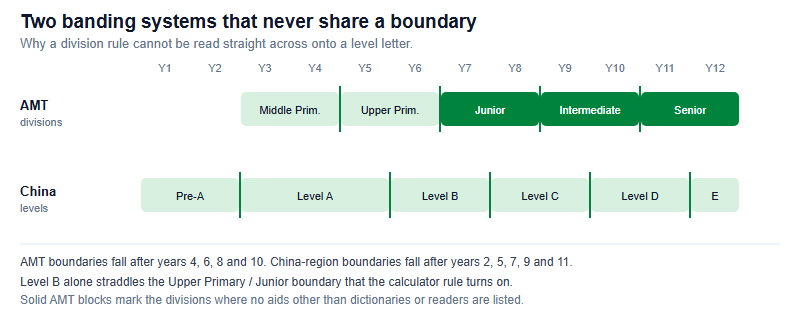
First, the aids rules attach to divisions, and AMT’s Australian division names are not the six China-region levels. AMT lists its AMC divisions as Middle Primary for Australian years 3–4, Upper Primary for years 5–6, Junior for years 7–8, Intermediate for years 9–10 and Senior for years 11–12. The China region uses Pre-A for years 1–2, A for years 3–5, B for years 6–7, C for years 8–9, D for years 10–11 and E for year 12. Those are different bandings, so you cannot read a division rule straight across onto a level letter.
Second, the China region is administered by ASDAN. AMT sets the competition rules; ASDAN runs the sitting here. Anything below that depends on which division rule applies to your seat is a question for ASDAN, and asking it takes one message. If you want the level structure itself, our overview of how the Australian AMC works sets out the six bands.
Dictionaries and readers: the provision built for a cohort like ours
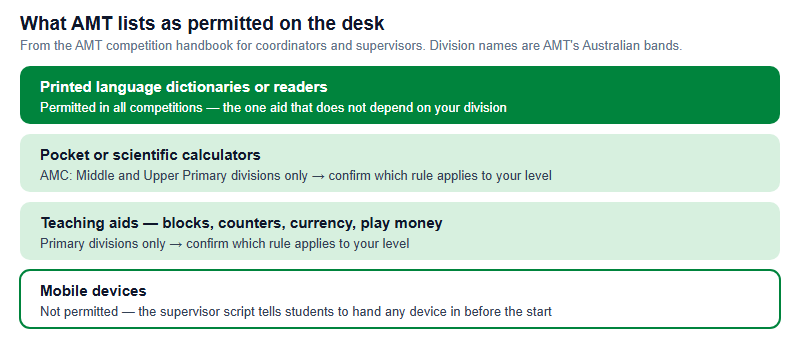
The single most useful line in the handbook, for students sitting an English-language paper in China, is the one in the supervisor’s script read aloud before the start: “Printed language dictionaries or readers are permitted in all competitions.” The rules section says the same thing from the other direction — for the Junior, Intermediate and Senior divisions, “no aids are allowed other than language dictionaries or readers.”
Read that carefully, because two words are doing a lot of work. Printed. The provision is for a physical dictionary, consistent with the rule that no mobile device may be with you during the competition. And language dictionary — a tool for translating a word, not a formula reference.
Whether a given seat in the China region interprets and applies this the same way is an ASDAN question, and a worthwhile one to ask well before 11 October rather than at the door. But the direction of the rule is encouraging, and it is a provision very few of the families we work with know exists.
Separately, and not to be confused with it, the China-region Pre-A paper for years 1 and 2 is deliberately picture-led with minimal text and comes with a read-aloud facility, so that children whose reading is still developing can compete on the mathematics. That is a design decision about the youngest paper, not a watered-down version of it, and it answers the question parents most often ask about entering a year 1 child. It is a different provision from the dictionaries-and-readers rule above, and the two should not be treated as one.
Calculators: the rule that depends on your division
Here is the sentence families actually want: “Pocket or scientific calculators are allowed only in the Middle and Upper Primary divisions of AMC and KSF.” The supervisor’s script says it again in the same terms — for the AMC, Middle and Upper Primary divisions only.
Middle and Upper Primary are AMT’s divisions for Australian years 3 to 6. And this is precisely where you must stop and refuse to do the obvious arithmetic, because the two banding systems do not line up. AMT’s internal division boundaries fall after years 4, 6, 8 and 10. The China-region level boundaries fall after years 2, 5, 7, 9 and 11. Apart from the top of the ladder, they never land in the same place.
The consequence is concrete. China-region Level A covers years 3 to 5, which sits inside AMT’s primary year range. But Level B covers years 6 and 7 — year 6 falls in the year range AMT calls Upper Primary, and year 7 falls in the range it calls Junior. A single China-region level straddles the exact boundary the calculator rule turns on. There is no honest way to resolve that from published documents; it is an administrative question, and the only correct answer is to ask ASDAN which rule applies to your level and your seat.
The rules that do not depend on your level
Several of the conditions in the supervisor’s script apply to every student in every division, and they are worth knowing simply so that nothing on the day is a surprise.
| Rule | What AMT publishes | Scope | What to confirm with ASDAN |
|---|---|---|---|
| Printed dictionaries and readers | Permitted in all competitions | Every division | How it is applied at your seat |
| Calculators | AMC: Middle and Upper Primary divisions only | Division-dependent | Which rule applies to your level |
| Teaching aids (blocks, counters, currency, play money) | Primary divisions only | Division-dependent | Which rule applies to your level |
| Other aids at the senior end | No aids other than language dictionaries or readers for Junior, Intermediate and Senior | Those divisions | Which rule applies to your level |
| Mobile devices | Cannot be with you during the competition | Every division | Nothing — leave it out |
| Staying seated | Remain seated until the competition finishes; a supervisor accompanies you if you must leave the room | Every division | Nothing |
| Borrowing equipment | Not without a supervisor’s permission | Every division | Nothing — bring spares |
| Sittings per student | No student may sit the competition more than once, or sit more than one division | Every division | Any genuine edge case |
Two of those deserve a sentence of practical translation. “Not without a supervisor’s permission” means a snapped pencil is a small negotiation in the middle of a timed paper — bring two of everything so you never have to have it. And the mobile-device rule means that if you have quietly been relying on a phone as your clock, you need another plan; ask your coordinator how time will be displayed or announced in your room.
What this changes about how you prepare
Rules about the desk sound administrative, but three of them have direct consequences for the next few weeks of work — and with the sitting on 11 October 2026 and registration closing on 28 September, there is still time to act on all three.
- Rehearse under the constraint you will actually face. This is the whole point. A student who practises with a calculator and then sits a paper without one has trained a method they cannot execute; a student who practises without one, and is then permitted one, has lost nothing at all. Until you have ASDAN’s answer for your level, prepare without. It is the only asymmetry in the question.
- Treat arithmetic fluency as part of the syllabus, not a warm-up. If the calculation has to happen in your head or on the page, then speed and accuracy with fractions, percentages, ratios and two-step operations are worth marks directly — particularly across questions 1 to 20, which carry 70 of the paper’s 135 marks. Ten minutes of untimed mental arithmetic three times a week does more for a mid-paper score than another hour of hard problems.
- Budget a dictionary in seconds, not minutes. A permitted printed dictionary is a rescue for one unfamiliar word, not a translation service for a question. On a paper of 30 questions, two dictionary lookups is a reasonable ceiling; five is a pacing failure. The better preparation is to learn the recurring mathematical vocabulary in advance so the dictionary stays shut — and the China-region paper is bilingual in any case, which is a stronger support than a dictionary ever is.
Ask the aids question in the same message as everything else you need from your coordinator: which level your entry is under, which delivery mode your seat uses, and which aids rule applies to you. One message, three answers, and the last three weeks of preparation stop being guesswork. If you are still checking that the entry is going in under the right band, our guide to the competition and its six levels is the place to start.
Frequently asked questions
Can students use a calculator in the Australian AMC?
AMT permits calculators only in its Middle and Upper Primary divisions. Confirm with ASDAN which rule applies to your China-region level.
Is a dictionary allowed in the AMC?
AMT’s supervisor script states that printed language dictionaries or readers are permitted in all competitions. It must be printed, not an app.
Can my child take a phone or smartwatch into the room?
AMT states you cannot have a mobile device with you during the competition. Ask your coordinator how time will be shown in your room.
Can a student sit two levels to see which suits them?
No. AMT rules state no student may sit the competition more than once, or sit more than one division of a competition.
Published by the Australian AMC editorial desk, operated by Hanlin Education for China-based international-school students. The Australian Mathematics Competition is run by the Australian Maths Trust and administered in the China region by ASDAN. Official rules are set by the competition and change from year to year — confirm current details on amt.edu.au and with ASDAN. Errors are corrected within 7 working days of being reported.