
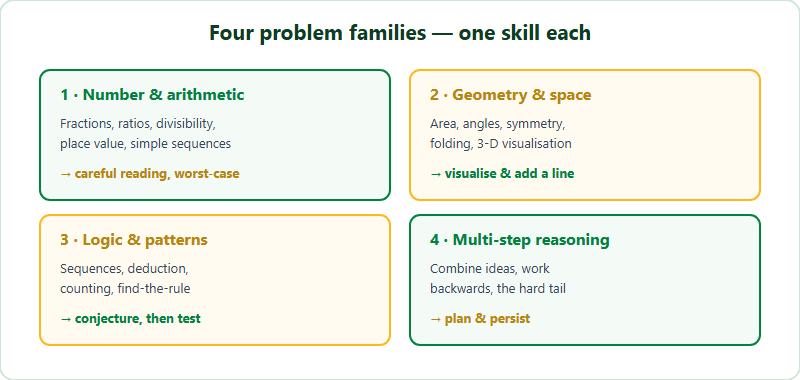
The Australian Mathematics Competition (AMC) paper is not a test of how many formulas you have memorised. Across its 30 questions (25 multiple-choice + 5 integer, 135 marks, no penalty for wrong answers), it draws on four broad families of problems — number and arithmetic, geometry and space, logic and patterns, and multi-step reasoning — each rewarding a different thinking skill. This 2026 guide tours those families with our own illustrative examples (not real past problems) so students and parents know what the paper actually asks for.
Why “problem types” matter more than topics
Set by the Australian Maths Trust (AMT) since 1978 and administered for the China and Asia region by ASDAN (阿思丹), the AMC is built so that every grade band — the six levels Pre-A to E covering Grades 1-12 — meets the same kind of thinking, just pitched to its age. The questions are not labelled “algebra” or “trigonometry.” Instead, each one is a short puzzle that hides which textbook chapter it belongs to. That is the point: the paper tests whether you can recognise the structure of an unfamiliar problem, not whether you have drilled a particular technique.
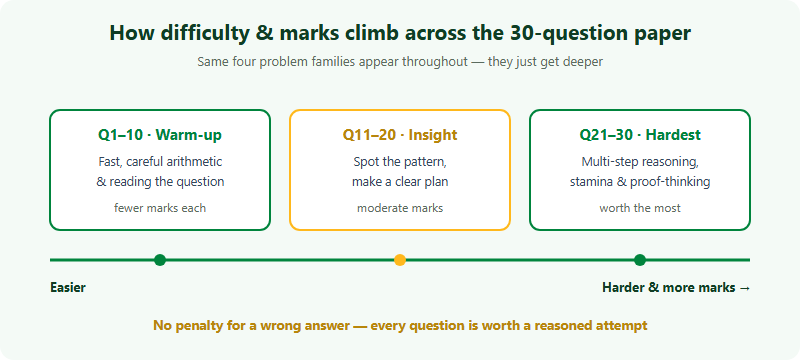
Because marks rise as questions get harder and there is no penalty for a wrong answer, the paper is designed so every student can attempt every question. The early questions reward careful, quick arithmetic; the middle reward insight and a clear plan; the last few reward genuine problem-solving stamina. Understanding the four families below helps a student read a question and ask the most useful first question of all: “What kind of problem is this?” For the format, scoring and level structure in full, see What Is the Australian AMC.
Family 1 — Number & arithmetic: precision under a little pressure
The most familiar family. These questions involve whole numbers, fractions, percentages, ratios, place value, divisibility and simple sequences. At the easier levels they look like sums; the skill being tested is accuracy and reading carefully — many students lose easy marks not to hard maths but to a misread word or a slipped digit.
An original illustrative example (our own, not a past AMC problem): “A box holds 3 red, 4 blue and 5 green counters. If you take counters out without looking, how many must you take to be sure you have two of the same colour?” The arithmetic is trivial; the test is whether you reason about the worst case (one of each colour first) rather than the average case. That shift — from “what usually happens” to “what is guaranteed” — is the AMC’s signature, even inside a number question.
Skill rewarded: careful reading, worst-case thinking, and resisting the obvious-but-wrong first answer. How to build it: slow arithmetic done accurately beats fast arithmetic done twice.
Family 2 — Geometry & space: seeing, not just calculating
Geometry on the AMC leans toward spatial visualisation — areas, angles, symmetry, counting shapes, folding and unfolding, and what a 3-D object looks like from a new angle. Younger levels favour counting and symmetry; senior levels add angle-chasing and area reasoning. The common thread is that the answer often becomes obvious once you add the right line or rotate the picture in your head.
Illustrative example (ours): “A square piece of paper is folded in half twice, then a small corner is cut off. When unfolded, how many holes are there?” No formula will help; you have to track the symmetry of the folds. That is geometry as the AMC means it — a reasoning skill dressed up as a shape, rewarding students who draw, mark and re-draw rather than hunt for an equation.
Skill rewarded: visualising transformations, adding helpful construction lines, and spotting symmetry. How to build it: always draw the figure yourself, even if one is given.
Family 3 — Logic & patterns: rules, sequences and deduction
This family is where the AMC feels least like a school exam and most like a puzzle. It includes number and shape patterns, simple logic (who-sits-where, true/false statements), counting possibilities, and finding a rule from a few examples. There is rarely a formula to recall; instead you must find the rule, test it, and extend it.
Illustrative example (ours): “Each figure in a sequence uses small tiles: 1, then 4, then 9 tiles. How many tiles in the 10th figure?” A student who spots that these are square numbers (1², 2², 3²) answers in seconds; one who keeps drawing eventually gets there too — but the AMC rewards the leap to the pattern. Logic questions teach the most transferable habit in all of competition maths: conjecture a rule from small cases, then check it holds.
Skill rewarded: pattern recognition, systematic listing, and elimination. How to build it: when stuck, write out the first few cases by hand — the rule usually reveals itself.
Family 4 — Multi-step reasoning: where the hardest marks live
The final third of the paper is dominated by problems that combine two or more of the families above. A single question might need a pattern observed, a small calculation, and a logical deduction — in the right order. These are the questions that separate strong scores, and they reward planning over speed.
Illustrative example (ours): “A staircase has steps you can climb 1 or 2 at a time. In how many different ways can you climb 5 steps?” Solving it well means working from small cases (1 step: 1 way; 2 steps: 2 ways; 3 steps: 3 ways…), noticing the Fibonacci-style pattern, and only then computing the answer for 5 — a logic-and-pattern insight feeding an arithmetic finish. The skill is holding a multi-step plan in mind and not abandoning it halfway.
Skill rewarded: decomposing a big problem into smaller known ones, working backwards, and persistence. How to build it: on a hard question, write down what you do know first — a partial path often opens the full one. For how this style compares with other contests, see How the Australian AMC Compares to Other Maths Contests.
How the families spread across the six levels
All six levels (Pre-A to E) draw on the same four families — the balance just shifts with age. Younger papers lean on number, counting and symmetry; senior papers add deeper geometry and longer reasoning chains. The table below is an illustrative guide to emphasis, not an official breakdown; the exact mix of any given year’s paper is set by the AMT — confirm on the official site.
| Level (grades) | Leans toward | Typical flavour |
| Pre-A (1-2) · new 2026 | Number & simple patterns | Counting, shapes, “what comes next” |
| A (3-5) | Number, geometry, easy logic | Arithmetic puzzles, symmetry, simple deduction |
| B (6-7) | Patterns & multi-step start | Ratios, area, find-the-rule sequences |
| C (8-9) | Reasoning grows | Angle-chasing, systematic counting, 2-step problems |
| D (10-11) | Heavier reasoning | Combined geometry + algebra, longer chains |
| E (12) | Hardest multi-step | Proof-style reasoning, the full difficulty range |
A useful takeaway for parents: a student does not need new “advanced” topics to move up a level — the same four families simply get deeper. Practising the skills (reading carefully, drawing, finding rules, planning) travels across every level far better than memorising formulas. Remember too that the paper is in both English and Chinese, so language need not be a barrier for students in China.
What this means for preparation
Because the AMC tests problem-types and thinking skills, the most effective preparation is broad and unhurried: work a few mixed problems regularly, always attempt every question (there is no penalty), and after each one ask “which family was that, and what was the key idea?” Naming the skill afterwards is what turns one solved puzzle into a habit you can reuse. There are no guaranteed outcomes in any competition, and the AMC is best treated as a low-pressure way to grow as a thinker — every entrant receives a certificate, and awards are by national percentile, so the goal is honest improvement, not a fixed score.
Frequently asked questions
What kinds of problems are on the Australian AMC?
Four broad families: number & arithmetic, geometry & space, logic & patterns, and multi-step reasoning. Most questions blend two or more, and they climb in difficulty across the 30-question paper.
Do I need advanced topics to do well?
No. The same four families appear at every level, just deeper. Practising the skills — careful reading, drawing, finding rules, planning — matters more than memorising formulas. Exact paper content is set by the AMT.
Is the Australian AMC the same as the American AMC or the AMO?
No. The Australian AMC is set by the Australian Maths Trust (AMT) and run in China by ASDAN. The American AMC is run by the MAA in the USA, and the AMO by SIMCC in Singapore — three different competitions.
Are the examples in this article real past problems?
No — they are our own illustrative mini-examples written to show each problem type. For official sample questions and past papers, confirm on the official site.
This is the editorial desk for the Australian Mathematics Competition (AMC) China region. The competition is run by the Australian Maths Trust (AMT) and administered in China and Asia by ASDAN (阿思丹); this content desk is operated by Hanlin Education for students in China. Dates, fees, levels and rules are set by the AMT and ASDAN and can change each year — always confirm current details on the official channels (amt.edu.au and the ASDAN China-region pages). Confirmed errors are corrected within 7 working days.