
Pre-A is the new entry level the Australian Mathematics Competition (AMC) introduces for the China region in 2026, opening the contest to Grades 1–2 for the first time. It is designed as a gentle first taste of competition maths: the shortest paper of all six levels (about 45 minutes), no penalty for a wrong answer, and a certificate for every child. The aim is a positive first experience, not pressure.
What Pre-A is — and why 2026 adds it
Until 2026, the youngest official entry point to the Australian AMC was Level A, for Grades 3–5. Pre-A changes that: for the first time, children in Grades 1 and 2 have a level built for them, set at their own grade band rather than asking a six- or seven-year-old to sit a paper written for older primary students. The competition is set by the Australian Maths Trust (AMT) — Australia's largest school mathematics competition, running since 1978 — and administered in China and Asia by ASDAN (阿思丹).
The reasoning behind a Grades 1–2 level is straightforward, and it is worth saying plainly to parents who wonder whether seven is "too young" for a competition. A maths competition pitched correctly is not an exam to be feared; it is a set of playful, puzzle-like questions that reward noticing patterns, counting carefully, and thinking a step beyond the obvious. Pre-A exists so that a young child meets that experience at the right difficulty — challenging enough to be interesting, not so hard that it discourages. If you are new to the contest itself, our overview of what the Australian AMC is covers the levels, format and awards first; this article is specifically about the youngest one.
One honest point first-time parents appreciate: Pre-A is optional, low-stakes, and not a gateway to anything compulsory. It is a single Sunday sitting, after which every entrant receives a certificate. There is no qualification to chase, no elimination, and no requirement to continue. For many families it is simply a friendly first benchmark — a way to see how a child enjoys mathematical puzzles in a slightly more structured setting than the classroom.
Who Pre-A is for — and who might wait a year
Pre-A is built for Grades 1 and 2, and the most reliable guide to readiness is not raw ability but disposition. A child who enjoys number puzzles, likes the moment a pattern "clicks", and can sit with a single question for a minute or two without frustration will generally have a good time. A child who is still settling into formal schooling, or who finds any test setting stressful, may be happier waiting a year — and that is a perfectly sound choice, because the level will still be there. Below is a calm, honest readiness picture rather than a checklist of skills.
| Pre-A tends to suit a child who… | It may be worth waiting a year if a child… |
| Enjoys number games, counting and simple puzzles for fun | Is still adjusting to the routine of formal school |
| Can focus on one question for a minute or two | Finds any test or timed setting genuinely upsetting |
| Is curious and likes being "a bit stuck" then figuring it out | Is not yet comfortable reading short instructions independently |
| Treats a wrong answer as a normal part of trying | Would feel that any unfamiliar setting is high-pressure |
Notice that nothing in the left column is about being "advanced" or "gifted". Pre-A is not an entrance test for a talent stream, and we make no claim that taking it improves admission odds anywhere. It is an introduction — valuable mainly because it is the right difficulty for the age. If you want a fuller view of how the AMC suits beginners across the grades, our piece on whether the Australian AMC is a good, gentle start in competition maths sets out the case without the hype.
The Pre-A paper: shorter, no penalties, designed to be encouraging
Pre-A shares the AMC's overall design philosophy but at the gentlest setting. The full AMC paper architecture — the same one AMT designs for every level — is 30 questions made up of 25 multiple-choice and 5 integer-answer questions, worth 135 marks, with no penalty for a wrong answer, and a sitting that runs 45 to 75 minutes depending on level. Pre-A, as the youngest level, sits at the shortest end, about 45 minutes. Two features matter most for a young child:
- No penalty for wrong answers. A guess never costs marks. This single rule removes most of the fear — a child is free to attempt every question, and a blank and a wrong answer are scored the same. It quietly teaches that trying is always worth it.
- A short, age-appropriate sitting (~45 minutes). Designed for the attention span of a Grade 1–2 child, the paper is over before it becomes tiring, with questions pitched so that the early ones are reachable for most and the later ones offer something to stretch towards.
The questions are available in English and Chinese, so a young child reads them in the language they are most comfortable with. To be clear about scope: the exact number of questions and the precise minutes for the Pre-A paper specifically are set by AMT and ASDAN, and where a detail is not yet officially confirmed we say so — confirm the current Pre-A specifics on the official site rather than rely on assumptions. What follows is an illustrative sense of the kind of thinking Pre-A rewards (these are our own examples, not real past problems):
- Pattern: the shapes go circle, square, circle, square, circle… what comes next? (Spotting a repeating rule.)
- Counting carefully: how many legs do 3 cats have altogether? (Putting a small idea to work, here 4 + 4 + 4.)
- A gentle step beyond: if you have 5 stickers and give 2 away, then get 1 back, how many now? (Holding a short sequence in mind.)
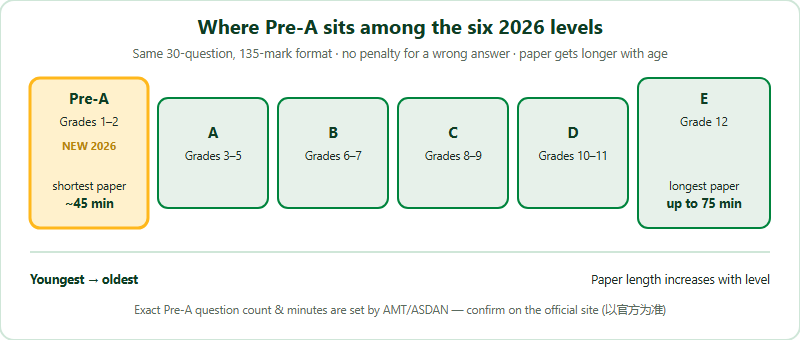
For a side-by-side view of every level and what to expect at each, see our Australian AMC by grade band guide, which maps Pre-A through E against the grades and the kind of questions each contains.
How parents can support a first competition
The single most useful thing a parent can do for a Grade 1–2 child sitting Pre-A is to keep the temperature low. A young child takes their emotional cue from the adults around them: if a parent treats the sitting as a high-stakes test, the child will too; if it is framed as a fun morning of puzzles, that is how it will feel. The goal of a first competition is a good experience that the child would happily repeat — not a particular score. Practical, low-pressure ways to help:
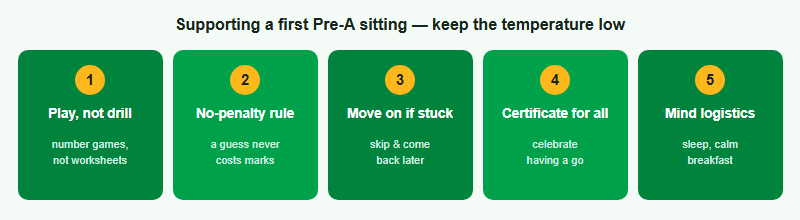
- Play, don't drill. In the weeks before, do a few number games, simple pattern puzzles, or counting challenges together — ten enjoyable minutes here and there, not worksheets. Familiarity with multiple-choice and with "circle your answer" helps more than any topic cramming.
- Explain the no-penalty rule. Tell your child plainly: a wrong answer never loses marks, so it is always worth having a go at every question. This one fact removes most first-time nerves.
- Practise "move on when stuck". Teach the gentle habit of skipping a hard question and coming back — a real skill for a timed paper, and a calming one for a child who might otherwise freeze.
- Frame the certificate honestly. Every entrant receives one, so a child finishes with something to be proud of regardless of score. Celebrate the having a go, not the result.
- Mind the logistics, not the maths. A good sleep, a calm breakfast, and arriving unhurried on the day do far more for a six-year-old's performance than any last-minute revision.
A note on registration timing, because it is the one date a parent must not miss. For the China region in 2026, registration closes on 28 September 2026 and the exam is sat on Sunday 11 October 2026. Pre-A is entered by grade, like every level — you simply choose Pre-A for a Grade 1–2 child at sign-up. The exact entry fee and the registration portal steps are set by ASDAN; please confirm those on the official region channels rather than assume.
Australian AMC, American AMC, AMO — not the same competition
Because "AMC" appears in more than one competition's name, it is worth being clear which one Pre-A belongs to before a parent searches for practice material. Pre-A is part of the Australian AMC, set by the Australian Maths Trust and administered in China by ASDAN. It is not the American AMC (a different competition run by the MAA in the United States, aimed at older students), and it is not the AMO (a separate competition run by SIMCC in Singapore). A Grade 1–2 Pre-A child will find nothing relevant on an American AMC or AMO page.
| Competition | Set by | Administered / run by |
| Australian AMC (this site · includes Pre-A) | Australian Maths Trust (AMT), Australia, since 1978 | ASDAN (阿思丹) in China & Asia; this desk by Hanlin Education |
| American AMC | MAA, USA | A different competition and pathway — not covered here |
| AMO | SIMCC, Singapore | A separate competition with its own paper and medals |
If a page, advert or portal you find mentions the MAA, AIME or SIMCC, it is not the Australian AMC, and Pre-A's dates and format do not apply to it. When unsure which contest a paper belongs to, check the official source for that specific competition before buying any preparation material.
Frequently asked questions
What is Pre-A in the Australian AMC?
Pre-A is the new 2026 level for Grades 1–2 — the competition's youngest entry point, with the shortest paper (about 45 minutes) and a gentle introduction to puzzle-style maths.
How long is the Pre-A paper, and is there a penalty for wrong answers?
Pre-A is the shortest sitting, about 45 minutes, and there is no penalty for a wrong answer — a guess never costs marks. Confirm exact Pre-A specifics on the official site.
Is my Grade 1 or 2 child too young for a maths competition?
Pre-A is designed for that age. If your child enjoys number puzzles and can focus briefly, it suits them; if test settings upset them, waiting a year is also fine.
When is the 2026 Australian AMC, and how do I enter Pre-A?
The exam is Sunday 11 October 2026; registration closes 28 September 2026. Choose Pre-A by grade at sign-up. The entry fee and portal steps are set by ASDAN.
This is the editorial desk for the Australian Mathematics Competition (AMC) China region. The competition is run by the Australian Maths Trust (AMT) and administered in China and Asia by ASDAN (阿思丹); this content desk is operated by Hanlin Education for students in China. Dates, fees, levels and rules are set by the AMT and ASDAN and can change each year — always confirm current details on the official channels (amt.edu.au and the ASDAN China-region channels). Confirmed errors are corrected within 7 working days.