
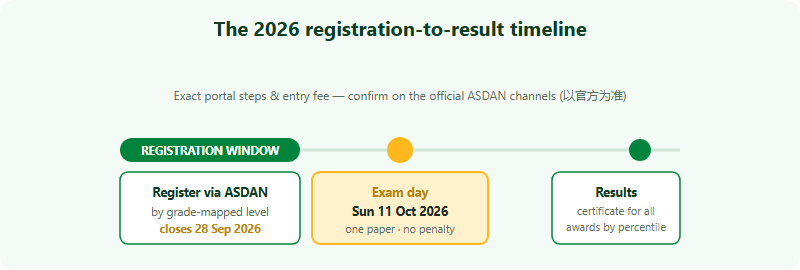
To register for the Australian Mathematics Competition (AMC) in China for 2026, you enter through ASDAN (阿思丹), the region's administrator, by choosing the level that matches your child's grade and signing up before the cut-off. The two dates that anchor everything are simple: register by 28 September 2026, then sit the single paper on Sunday 11 October 2026. This walkthrough takes you through it one step at a time, in plain language.
Registration in one minute: the shape of it
Before the detail, here is the whole process at a glance, so the steps below feel familiar rather than new. Registration is grade-led: you do not choose a difficulty — you choose the level that maps to your grade at competition time, and the paper is pitched accordingly. The exact online portal screens are set by ASDAN and can change year to year, so for the precise click-by-click of the entry form we point you to the official channels rather than guess.
| Stage | What happens | When |
| 1. Find the grade | Note the child's grade as it stands on exam day, 11 October 2026 | Anytime before you register |
| 2. Map to a level | Match the grade to one of six levels, Pre-A to E | Before you register |
| 3. Register via ASDAN | Enter through the ASDAN China-region channel for that level | By 28 September 2026 |
| 4. Prepare calmly | Get familiar with the 30-question, no-penalty format | The weeks before |
| 5. Sit the paper | One paper on the national exam day | Sun 11 October 2026 |
| 6. Results & certificate | A certificate for every entrant; awards by national percentile | After marking |
If the competition itself is new to you, it is worth reading what the Australian AMC is first — this page assumes you have decided to enter and just want the mechanics done right.
Step 1 & 2: Find your grade, then pick the level it maps to
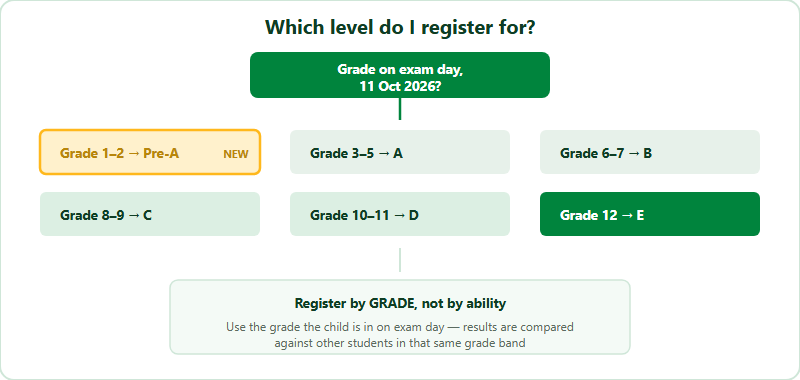
This is the step families most often get wrong, so it is worth slowing down on. You do not pick a level by how good your child is at maths; you pick it by grade. Register according to the grade the child is in at the time of the competition — that is, in October 2026 — not the grade they will move into later. Each level is a paper built for that grade band, so a Grade 4 child and a Grade 11 child sit genuinely different, age-appropriate papers.
For 2026 the China region runs six levels, and the headline change is a brand-new Pre-A level for Grades 1–2 — the youngest entry point the AMC has offered, opening it to children who previously had to wait for Level A. The table below is the fastest way to land on the right level.
| Your child's grade (Oct 2026) | Register for level | Note |
| Grade 1 or 2 | Pre-A | New for 2026 — the youngest level |
| Grade 3, 4 or 5 | A | Lower-primary |
| Grade 6 or 7 | B | Upper-primary / early-middle |
| Grade 8 or 9 | C | Middle-school |
| Grade 10 or 11 | D | Senior |
| Grade 12 | E | Final year |
A common worry: “My Grade 6 child is strong — should we enter Level C to stretch them?” The honest answer is that the level is tied to grade for a reason: the questions, marking and the national percentile a child is compared against all belong to their own grade band. The way to stretch a capable student is in how they prepare, not by jumping a level. The full ladder and what each level involves is set out in the complete 2026 guide for Grades 1–12.
Step 3: Register through ASDAN before 28 September
With the level chosen, the actual sign-up happens through ASDAN (阿思丹), which administers the AMC for the China and Asia region — handling registration, sitting the paper, marking to the Australian Maths Trust's global standard, and issuing certificates. You enter for the level you settled on in Step 2, and you must complete it by the registration cut-off of 28 September 2026.
Here is where we are deliberately careful. The broad shape of registration is verified — you register, by grade-mapped level, through ASDAN, before 28 September, for the 11 October sitting. But the exact portal steps (which page to start on, account creation, how a school group versus an individual enters, the fields on the form) are set by ASDAN and can change between years. Rather than invent a screen-by-screen flow that might be out of date, we'll say plainly: confirm the current entry steps and the entry fee on the official ASDAN China-region channels. What you can safely do now, before opening any form, is have the essentials to hand.
| Have ready before you start | Why it matters |
| The child's grade as of 11 Oct 2026 | Determines the level you register for |
| The chosen level (Pre-A–E) | You enter for a specific level |
| Preferred paper language — English or Chinese | The AMC is offered in both |
| Whether you enter via a school or individually | The route can differ — confirm with ASDAN |
| The entry fee | Set by ASDAN — confirm the current amount |
| The 28 September cut-off in your calendar | Late entries are not guaranteed |
A practical tip that costs nothing: treat the 28 September deadline as “a few days early.” Registration windows close firmly, and a calm sign-up a week ahead beats a rushed one on the final evening. For more on the administrator's role and the end-to-end pathway, see how the Australian AMC compares with the American AMC for China families, which also clears up a name mix-up we return to below.
Step 4 & 5: Prepare calmly, then sit one paper on 11 October
Once you are registered, preparation is mostly about familiarity, not cramming. Knowing the format removes most exam-day nerves, because the AMC's design is unusually forgiving. Every level sits a 30-question paper — 25 multiple-choice and 5 integer-answer questions — out of 135 marks. The questions climb in difficulty and the marks rise with them, so early questions are gentle and the hardest are worth the most. Time runs from about 45 minutes for the youngest level to 75 minutes for senior levels, and the paper is available in English and Chinese.
The single most useful thing to internalise is the no-penalty rule: a wrong answer and a blank score exactly the same — nothing is ever subtracted for trying. That turns the right strategy into something simple and calm: attempt every question, and on the hard ones make your best reasoned attempt rather than leaving them blank. For a younger child sitting Pre-A or A, that rule is what makes a first competition feel safe.
To picture the flavour of reasoning rather than recall, an early-level question might ask, “A pattern goes triangle, circle, triangle, circle — what comes 8th?” while a senior question might ask you to count how many three-digit numbers have digits that add to 6. These are our own illustrative examples, not real past questions — the AMC writes fresh problems each year, and we do not reproduce its papers. On the day itself, the child sits the one paper at their registered level; there is no second round to plan for.
Step 6: Results, certificates and what recognition means
After marking, every entrant receives a certificate — so the experience always ends with something to keep. National awards are then given by percentile: the top band nationally earns a Prize, followed by High Distinction, Distinction, Credit and Proficiency. A perfect paper is eligible for the O'Halloran Award. Because awards are percentile-based, a child is measured against others at their own level — a Pre-A entrant against other Grade 1–2 students, not against older children.
One honest framing to keep front of mind: an AMC result is a recognised line on an academic record and a genuine point of pride, but it is not a guarantee of admission to any school or programme, and the exact percentile cut-offs shift slightly each year. The competition is best treated as a worthwhile experience in mathematical thinking first, and a credential second. The exact recent cut-off scores are published on the official results pages — confirm those there rather than assume a fixed number.
Before you register: keep three look-alike contests straight
One clarification prevents a costly mistake: make sure you are registering for the Australian AMC. Several maths contests share the letters “AMC,” and a separate contest is called the AMO — they are run by different organisations, with different papers and different registration routes. The Pre-A level, the six-level ladder and the 11 October China date all belong to the Australian AMC only.
| Competition | Run by | What to know when registering |
| Australian AMC (this site) | Australian Maths Trust (AMT), Australia; ASDAN (阿思丹) in China/Asia | Six levels Pre-A–E (Grades 1–12); China region sits 11 Oct 2026; register via ASDAN |
| American AMC (AMC 8/10/12) | Mathematical Association of America (MAA), USA | A different competition and a separate sign-up — not this one |
| AMO | SIMCC, Singapore | A separate contest with its own paper and entry — not this one |
If a flyer or portal mentions the MAA or SIMCC, it is not the Australian AMC, and the dates and levels in this walkthrough do not apply to it. When in doubt about which contest a registration page is for, check the official source for that specific competition before paying anything.
Frequently asked questions
How do I register for the Australian AMC in China for 2026?
Find your child's grade as of 11 October 2026, match it to a level (Pre-A to E), then register for that level through ASDAN by 28 September 2026.
What is the registration deadline?
Register by 28 September 2026 for the 11 October 2026 exam. Treat it as a few days early — windows close firmly. Confirm the live date on the official ASDAN channels.
Do I pick the level by grade or by ability?
By grade. You register for the level matching the grade your child is in at competition time, and results are compared against others in that same grade band.
How much is the entry fee and what are the exact portal steps?
The entry fee and the precise online entry steps are set by ASDAN and can change — confirm the current details on the official ASDAN China-region channels.
This is the editorial desk for the Australian Mathematics Competition (AMC) China region. The competition is run by the Australian Maths Trust (AMT) and administered in China and Asia by ASDAN (阿思丹); this content desk is operated by Hanlin Education for students in China. Dates, fees, levels and rules — including the exact registration steps and entry fee — are set by the AMT and ASDAN and can change each year; always confirm current details on the official channels (amt.edu.au and the ASDAN China-region channels). Confirmed errors are corrected within 7 working days.