
An Australian Mathematics Competition (AMC) award is a percentile-based recognition from the Australian Maths Trust (AMT) — Participation, Proficiency, Credit, Distinction, High Distinction, a top Prize, plus medals and the Peter O'Halloran Award for a perfect score. On a university application it works as a verifiable, age-banded signal of mathematical ability and follow-through — meaningful as part of a wider profile, but never a guarantee of admission. This guide explains what each award means and how to present it honestly.
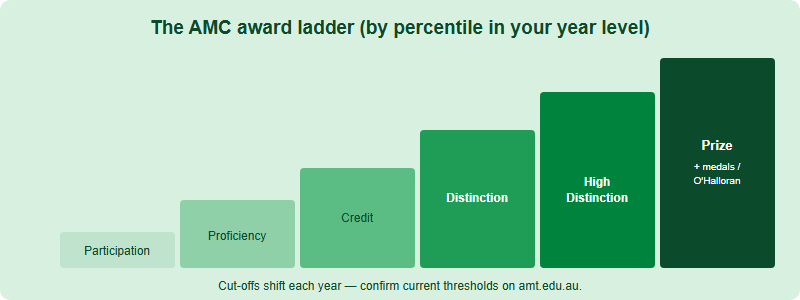
The award ladder, and what “percentile-based” really means
The AMC does not hand out awards at fixed scores. Instead, recognition is given by percentile within a year level, so the bar adjusts to the difficulty of each year's paper and to how peers performed. The AMT publishes a tiered set of certificates, topped by a Prize and a small number of medals. Because thresholds move year to year, treat the table below as the structure of the awards, not a fixed score chart — for the exact current percentile cut-offs, confirm on the official site.
| Award | What it recognises (basis) | How to read it |
| Prize | The top performers nationally in a year level | The strongest single line you can earn from the AMC |
| High Distinction | Top percentile band (well above average for the level) | A clear, selective achievement |
| Distinction | Next percentile band | Strong; above the great majority of entrants |
| Credit | Above-average band | Solid, creditable performance |
| Proficiency | Recognises sound work below the Credit line | Encouraging, especially for younger students |
| Participation | Every entrant receives a certificate | Evidence you took part; not a ranked award |
| Medals & Peter O'Halloran Award | Outstanding results; a perfect 135 can earn the O'Halloran Award | Rare, national-level distinction |
The percentile design is exactly why an AMC award travels well: a Distinction earned by a Grade 6 student and a Distinction earned by a Grade 11 student each mean “near the top of their own year level,” which is a fairer comparison than a raw score across ages. For how the score itself is built, see our breakdown of what the Australian AMC is and how it is marked.
How admissions readers actually use a competition result
Be clear-eyed about this. No single competition certificate admits a student anywhere, and any service that promises it can is misleading you. What a credible AMC award does is contribute several specific, useful signals to a holistic application:
- Verifiable ability, not self-report. A Distinction or higher is an externally marked, percentile-ranked result — harder to dismiss than “I enjoy maths.”
- Age-appropriate benchmarking. Because it is banded by year level, a strong AMC result shows standing among peers, which admissions readers can interpret without knowing your school's grading.
- Evidence of intellectual initiative. Entering an optional academic competition signals curiosity and follow-through — qualities universities repeatedly say they value.
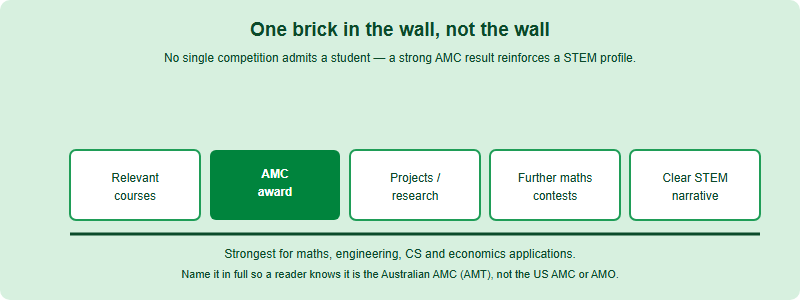
- A coherent narrative. An AMC result reads best when it sits inside a consistent STEM story (relevant courses, projects, perhaps further maths contests), not as an isolated trophy.
The honest framing is “supporting evidence within a wider profile.” A High Distinction will not, by itself, decide an Oxbridge or Ivy outcome; it can, however, reinforce a mathematics-leaning application and help a strong candidate stand out at the margin. Treat it as one well-chosen brick in the wall — not the wall.
Where an AMC result helps most — and least
| Context | How much the AMC tends to help |
| Maths, engineering, computer science, economics applications | Most — directly relevant evidence of quantitative ability |
| Younger students building an early record (Pre-A to B) | Useful as a confidence builder and an early, age-banded data point |
| Rounding out a humanities-leaning profile | Modestly — shows breadth, but is not the core signal readers seek |
| As a stand-alone “guarantee” of admission | Not at all — no competition functions this way |
For students aiming at the most selective universities, an AMC award is often a stepping stone rather than a destination: it can confirm readiness to pursue more advanced or invitational mathematics competitions, and a consistent record across years tells a stronger story than a single good day. Note that the Australian AMC sits in its own pathway — it is not the American AMC (run by the MAA, which leads toward AIME and USAMO), and it is not the Singapore-run AMO. Make sure your application names the right competition so a reader is not left guessing which “AMC” you mean.
Presenting your AMC award honestly (a quick checklist)
From our China-region editorial desk, here is how to list an AMC result so it is both accurate and credible:
- Name it in full: “Australian Mathematics Competition (Australian Maths Trust)” — and your level, e.g. Level C. This pre-empts confusion with the US AMC or AMO.
- State the award and year level: “High Distinction, Junior (Years 7–8), 2026.” Year level adds the percentile context.
- Do not inflate. A Credit is a Credit; relabeling it as anything else risks your whole application's credibility if checked.
- Keep proof. Retain your certificate; some applications or interviews may ask you to substantiate listed achievements.
- Let it support, not carry. Pair it with the rest of your STEM evidence rather than presenting it as decisive.
If you are still choosing which level to enter for the China-region sitting, or weighing the AMC against other contests, start with our overview of the six levels and the China exam day. Exam dates, registration deadlines and award details are set by the AMT and the China-region operator ASDAN (阿思丹) and change each year — confirm the current specifics on the official channels.
One coached cohort, for scale
Award ladders read differently when you can see how a real group landed on them. The following is the 2025 distribution across the coached cohort at this desk — our own record, per Hanlin, not AMT or ASDAN statistics, and a small sample rather than a representative one.
- 2 students took the top-tier recognition, including the Peter O’Halloran-level achievement award.
- Across levels A to E, the cohort took 6 first-tier, 23 second-tier and 39 third-tier China-region certificates.
Note the shape rather than the totals. The distribution is bottom-heavy by design — that is what a percentile-based ladder produces, and it is the same point made earlier on this page: the certificate tiers describe where you landed in the field that year, not a fixed score. A cohort that triples its third-tier count has usually widened participation, not raised its ceiling. For what each tier is called and how the cut-offs are set, use the ladder section above and confirm the current year on the official channels.
Frequently asked questions
Does an Australian AMC award guarantee university admission?
No. No competition guarantees admission. A strong AMC award is verifiable supporting evidence within a holistic application, most useful for STEM-leaning profiles.
What is the highest Australian AMC award?
The top tier is a Prize, with medals and the Peter O'Halloran Award for a perfect score. Awards are percentile-based; confirm current categories on the official site.
How should I list the AMC on an application?
Name it in full as the Australian Mathematics Competition (Australian Maths Trust), with your level, award and year level — for example “Distinction, Intermediate, 2026.”
Is this the same award as the American AMC?
No. The Australian AMC (AMT) is separate from the American AMC (MAA) and the AMO (SIMCC). Use the full name so admissions readers are not confused.
Published by the Australian AMC editorial desk, operated by Hanlin Education for China-based international-school students. The Australian Mathematics Competition is run by the Australian Maths Trust (AMT) and administered in the China and Asia region by ASDAN (阿思丹); the American AMC (MAA) and the AMO (SIMCC) are separate competitions. Official rules and award criteria are set by the competition and change yearly — confirm current details on amt.edu.au. Any confirmed error is corrected within 7 working days.