
On the Australian AMC, the marks a capable student loses almost never come from a problem that was genuinely too hard. They come from six quiet, avoidable mistakes — a misread word, a transcription slip, time spent in the wrong place. Because the paper carries no penalty for wrong answers, every one of these losses is recoverable. This guide names the six, shows you how to work out which are actually yours, and gives a concrete fix for each.
The diagnosis matters more than the drilling
The Australian AMC, run by the Australian Maths Trust since 1978 and operated in the China region by ASDAN, gives you 30 questions — 25 multiple-choice and 5 integer-answer — for a maximum of 135 marks, with marks rising through the paper and no penalty for incorrect responses. Most students prepare by doing more problems. But if your losses are coming from careless errors rather than knowledge gaps, more problems will not fix them — you will just make the same mistakes faster.
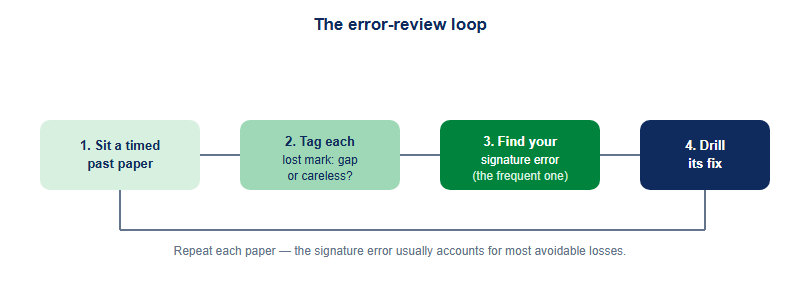
The fix is to read your own past papers like a detective. For every mark you dropped, ask a single question: “Did I not know how, or did I know how and still get it wrong?” Sort your errors into those two piles. If the second pile is large — and for strong students it usually is — the six mistakes below are where your points are hiding. If you are still learning the paper’s shape, our Australian AMC overview for students in China explains the levels and structure first.
| # | The mistake | Where it strikes | The one-line fix |
|---|---|---|---|
| 1 | Misreading a key word | Any question with a bound or constraint | Underline the word that would flip the answer |
| 2 | Transcription slips | Copying the answer to the answer sheet | Read the option letter back against your working |
| 3 | Time sink on one hard question | Middle and back of the paper | Set a hard cap; flag and move on |
| 4 | Unit and form errors | Geometry, rates, “how many” counting | Circle the units the answer must be in |
| 5 | Leaving questions blank | The back five (Q26–30) and integers | Never leave blank — no penalty exists |
| 6 | Arithmetic under pressure | Everywhere, especially near the end | Slow the final step; re-add once |
Mistakes 1–3: reading, transcribing, and timing
1. Misreading a key word. Competition questions turn on precise words — “at most”, “exactly”, “distinct”, “positive integer”, “consecutive”. Change one and the answer changes. Strong students, reading fast, skim these and solve the question they expected rather than the one on the page. The fix is physical: underline, in every question, the single word that would flip the answer if it were altered, and re-check it before you commit. On a bilingual China-region paper you have a second advantage — glance at that word in both language columns.
2. Transcription slips. You solve the problem correctly, then mark the wrong option, or copy an integer answer with a digit transposed. These are pure lost marks — the maths was right. The fix is a two-second habit: after marking each answer, read the letter or number back and confirm it matches your working. On the 5 integer questions especially, re-read the digits you wrote in the exact order.
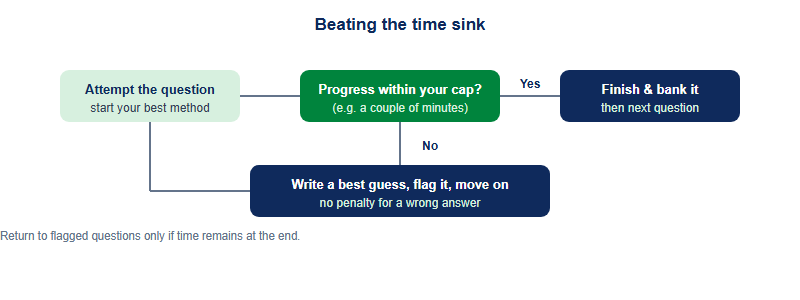
3. The time sink. A strong student sees an interesting hard question, commits to it, and looks up eight minutes later having answered nothing else. Meanwhile three gettable questions further down went untouched. The fix is a hard cap: if a question has not yielded progress in a set time, flag it, put down your best current guess (no penalty for a wrong one), and move on. You can return if time allows. Marks rise through the paper, but an unattempted 4-mark question in the middle is worth exactly as much as the 8-mark one you are stuck on — and far easier to bank.
Mistakes 4–6: units, blanks, and pressure arithmetic
4. Unit and form errors. The working is correct, but the answer is in the wrong unit — centimetres instead of metres, area instead of perimeter, “how many ways” answered as a probability. The question asked for one form; you delivered another. The fix is to circle, before solving, the exact quantity and unit the answer must take, and check your final value against that circle. This is the most common source of “I got it right but it was marked wrong” — which really means you answered a slightly different question.
5. Leaving questions blank. This one is almost unique to the AMC and almost free to fix. Because there is no penalty for incorrect answers, a blank is strictly worse than a guess — a guess has some chance of being right; a blank has none. Yet students routinely leave the back five and unfinished integer questions empty. The fix is a rule with no exceptions: before you hand in the paper, every question has an answer. On multiple-choice, an educated elimination raises your odds well above random.
6. Arithmetic under pressure. Near the end, with time short, the final calculation is where good reasoning dies — a dropped sign, a mis-added column, a factor left out. The fix is counter-intuitive: slow down on the last step. Do the reasoning at speed, then perform the final arithmetic deliberately and re-add once. A method that is 100% correct and an arithmetic slip still scores zero, so the last line deserves the most care, not the least.
Turn your errors into a personal checklist
The point of naming six mistakes is not to worry about all of them — it is to find your two or three. After each timed past paper, tally which of the six cost you marks. Within two or three papers a pattern appears: most students have a signature error (often reading or transcription) that accounts for the bulk of their avoidable losses. Fix that one and your score moves more than another month of new problems would move it.
A concrete way to run this: keep a single “error log” — one line per dropped mark, with the question number, the mistake category from the table above, and a five-word note on what happened. After three papers the log almost writes your revision plan for you. A student whose log reads “Q9 unit, Q14 misread, Q17 unit, Q22 transcription, Q19 unit” does not need more geometry practice; they need to circle the required unit before every geometry question. The log turns a vague feeling of “I keep making silly mistakes” into a specific, fixable habit.
Two practical cautions about diagnosing yourself honestly. First, do not relabel a knowledge gap as a “careless error” to feel better — if you genuinely did not know the method, that is a content point to learn, and it belongs in the other pile. Second, careless errors cluster near the end of the paper, when time is short and focus fades, so weight your review toward the questions you reached last. That is where the cheapest recoverable marks usually sit, and it is exactly the stretch where the no-penalty rule makes a considered guess strictly better than a blank.
Two honest notes before exam day. First, this article is about avoidable losses, not the current year’s rules: question counts, mark weightings and per-level timing are set by the competition and can change, so read the official instructions for your level and confirm specifics on the Australian AMC overview and amt.edu.au. Second, on names: the Australian AMC (AMT, operated in China by ASDAN) is a separate competition from the US AMC run by the Mathematical Association of America and from the American Mathematics Olympiad (AMO) run by SIMCC — practise the paper you are actually sitting, on 11 October 2026 for the China region (registration closes 28 September).
FAQ
Why do I lose marks even when I know the maths?
Usually to one of six careless errors: misreading a key word, transcription slips, time sinks, unit errors, leaving questions blank, or pressure arithmetic. Diagnosing which is yours matters more than doing more problems.
Should I ever leave an Australian AMC question blank?
No. There is no penalty for incorrect answers, so a blank is strictly worse than a guess. Make it a rule that every question has an answer before you hand in the paper.
How do I stop wasting time on one hard question?
Set a time cap. If a question has not yielded progress within it, write a best guess, flag it, and move on to gettable marks. Return only if time remains at the end.
What is the fastest way to raise my score?
Review past papers by error category, find your signature careless error, and drill its fix. For most students that moves the score more than another month of new problems.
Published by the Australian AMC editorial desk, operated by Hanlin Education for China-based international-school students. The Australian Mathematics Competition is run by the Australian Maths Trust (AMT) and operated in the China region by ASDAN; official rules are set by the competition and change yearly — confirm current dates, level structure and paper format on amt.edu.au before you rely on them. We correct any error within 7 working days.