
The single highest-leverage thing most Australian AMC candidates in China never do is sit a full, timed, exam-condition mock before 11 October 2026. Worksheets build skills; mocks build match fitness. This guide shows you how to run a faithful dress rehearsal at home — realistic timing, honest marking against the 135-point scale, and a review protocol that converts every mock into measurable improvement — on a three-mock schedule that fits the weeks left before exam day.
Why a Full Mock Beats Another Worksheet
Practising problems in ten-minute bursts after homework is useful, but it trains a different skill from the one the Australian Mathematics Competition actually tests. On 11 October, students in China sit one continuous paper — 30 questions, a difficulty curve that climbs steadily, and a clock that does not pause. Run by AMT (the Australian Maths Trust, which has operated the competition since 1978) and delivered in China through ASDAN, the paper rewards sustained concentration as much as mathematical knowledge. If you are new to the competition itself, start with our foundation guide, What Is the Australian AMC?, then come back here for the training method.
A full mock does three things a worksheet cannot:
- It exposes pacing problems. Many strong students lose marks not to hard maths but to spending eight minutes on question 12 and never seeing questions 26–30.
- It builds stamina. Sitting 45–75 minutes (timing depends on your level — confirm the exact duration for your division when you register) of uninterrupted problem-solving is a trained capacity, especially for younger candidates.
- It produces honest data. A marked mock tells you exactly which topic areas and which question positions cost you marks — far better information than a vague sense of “I'm okay at geometry.”
What a Faithful Simulation Looks Like
A mock only works if it is honest. Half-timed, phone-nearby, “I'll just check the answer to this one” practice teaches bad habits. Here is the standard to hold yourself to:
- One continuous sitting. No pauses, no snacks mid-paper, no checking answers until the end. Match the real format: the China sitting is a single session on Sunday 11 October 2026.
- Correct timing for your level. The six divisions (Pre-A through E, covering Grades 1–12) have set durations in the 45–75 minute range. Use the timing that applies to your level; if you are unsure, check with your registration channel or amt.edu.au.
- Full 30-question structure. The paper is 30 questions — 25 multiple-choice plus 5 integer-answer questions — with a maximum score of 135 and no negative marking. Your mock should mirror that structure so your guessing and pacing decisions transfer.
- Real answer recording. Write answers on a separate answer sheet, not next to the questions. Transferring answers takes time and produces transcription errors; you want to discover that in July, not October.
- Permitted materials only. Desk rules (what stationery and aids are allowed) are set by the competition and can change year to year — confirm the current rules on amt.edu.au or with your test centre before exam day, and use the same setup in your mocks.
The Three-Mock Schedule (July to October)
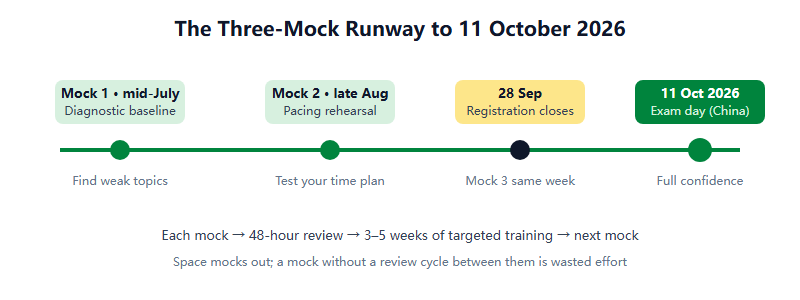
With roughly thirteen weeks between mid-July and exam day, three full mocks is the sweet spot for most candidates. More than that and you run out of review time between sittings; fewer and you arrive at the real paper with untested pacing. Each mock has a distinct job:
| Mock | When | Primary goal | What to measure | After-action focus |
|---|---|---|---|---|
| Mock 1 — Diagnostic | Mid-July | Establish a baseline under real conditions | Raw score /135; questions attempted; where time ran out | Identify 2–3 weakest topic areas; build a training plan around them |
| Mock 2 — Pacing rehearsal | Late August | Test a deliberate time plan for the 30-question curve | Time spent per 10-question block; marks lost to rushing vs. difficulty | Adjust the time plan; drill the question types that ate the clock |
| Mock 3 — Dress rehearsal | Last week of September | Full simulation, ideally at the same time of day as the real exam | Score stability; nerves; answer-sheet routine | Light review only — no new topics in the final fortnight |
Two scheduling notes specific to China candidates. First, registration closes on 28 September 2026, about two weeks before the exam — put the deadline in the family calendar now so the admin never collides with the final mock. Second, the China sitting is on Sunday 11 October; if you can, run Mock 3 on a Sunday at the same hour, so your brain has already practised doing competition maths at exactly that time of day.
How to Mark a Mock Honestly
Marking is where home mocks usually go soft. Hold the line on these rules:
- Mark against the official scheme for your paper. The maximum is 135, and there is no penalty for wrong answers. Use the mark allocation that comes with whatever practice paper you are using; per-question weights are set by the competition, so follow the printed scheme rather than inventing one.
- No “I basically had it” marks. A multiple-choice answer is right or wrong. If you circled (B) and the answer was (C), you get zero for it — even if your working was 90% correct. That discipline is exactly what the real paper applies.
- Record three numbers, not one. For each mock, log: (1) total score, (2) number of questions genuinely attempted, and (3) marks lost on questions you knew how to do but botched. Number three is your fastest source of improvement.
- Because there is no negative marking, an unanswered question is a wasted question. Check your mock answer sheet: any blanks at all mean your pacing plan needs work, since a considered guess always beats a blank on this paper.
The 48-Hour Review Protocol
A mock without a structured review is just a stressful morning. Within 48 hours of each sitting — while your reasoning is still fresh in memory — run this cycle:
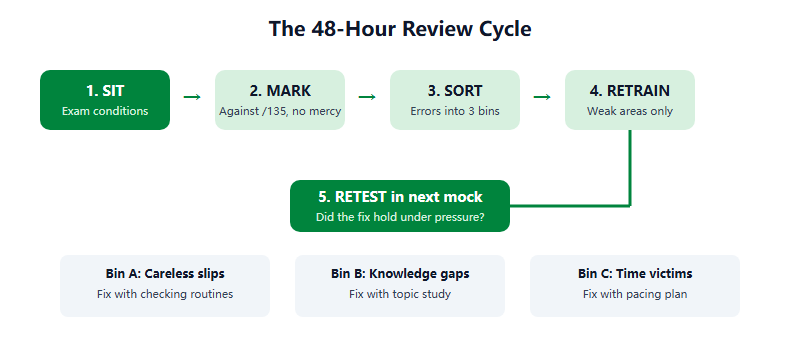
The sorting step is the heart of it. Every lost mark goes into exactly one bin: careless slips (you knew the method, botched the execution), knowledge gaps (you had no viable approach), or time victims (you never reached the question or rushed it in the final minutes). Each bin has a different cure — checking routines, topic study, and pacing plans respectively — and mixing them up is why generic “do more problems” advice fails. A student whose lost marks are 70% careless slips needs a slower, more disciplined checking habit, not harder problems.
Adapting the Method by Level
The dress-rehearsal principle applies across all six levels, but the execution scales with age. For Pre-A and A candidates (Grades 1–5), a parent should act as invigilator: manage the clock, keep the room quiet, and resist every urge to hint. The main training goal at this age is simply sitting still and working through the whole paper — a genuine achievement for a seven-year-old. For B and C candidates (Grades 6–9), students should manage their own timing with a visible clock and start practising the strategic decisions: when to skip, when to guess, when to return. For D and E candidates (Grades 10–12), mocks should be treated exactly like the real thing, including the answer-sheet routine and a fixed pre-exam warm-up of two or three easy problems. Since the paper in China is bilingual, do at least one mock working primarily from the English text — it is a free rehearsal for the reading demands of the real paper. For a fuller picture of how the six levels differ, see the level guide inside our Australian AMC overview.
FAQ
How many mock exams should I do before the Australian AMC?
Three full timed mocks between July and early October works for most candidates: a diagnostic, a pacing rehearsal, and a final dress rehearsal, each followed by a 48-hour review.
What should I use as mock material?
Use full 30-question papers at your level so the difficulty curve and timing are realistic. Practice sets and past materials are available through official channels and your registration provider.
Should I guess on questions I can't solve in a mock?
Yes — the Australian AMC has no negative marking, so a considered guess always beats a blank. Practise that habit in mocks so it is automatic on 11 October.
When is the last sensible date for a full mock?
About 10–14 days before the exam. The final fortnight should be light review and confidence work, not new full papers that risk a discouraging score swing.
Published by the Australian AMC editorial desk, operated by Hanlin Education for China-based international-school students. Official rules, timings and mark schemes are set by the competition organisers and can change each year — always confirm current details on amt.edu.au and with your ASDAN registration channel. If you spot an error, we correct it within 7 working days.