
Geometry is one of the Australian AMC's most reliable strands: nearly every paper, at every level from Pre-A to E, asks about angles, shapes, area, symmetry, and spatial reasoning. The good news for China-based students is that geometry rewards a small set of habits far more than a long list of memorised theorems. Here is what the geometry questions actually look like, how they get harder as the paper goes on, and a practice plan to get genuinely better at them.
The geometry you will meet on the Australian AMC
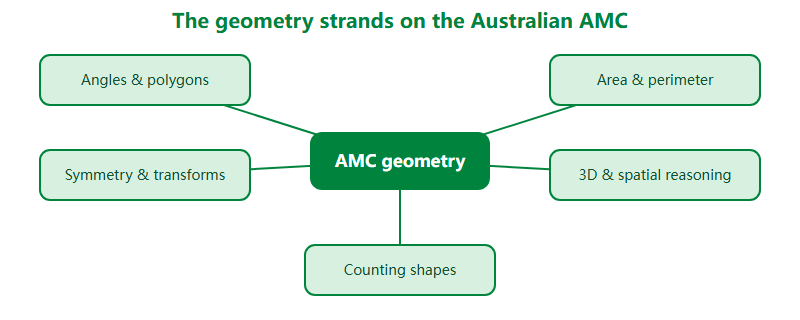
The Australian Mathematics Competition, run by the Australian Maths Trust (AMT, since 1978) and sat in China through ASDAN, spreads geometry across its 30-question paper rather than bundling it into one block. Across the six levels you will see five recurring sub-strands. At the earlier levels the emphasis is on recognising shapes, counting sides, and simple area; by the senior levels the same topics return with multi-step reasoning and three-dimensional twists. The exact mix changes by level and from year to year, so treat the map below as a guide and confirm current specifics on amt.edu.au or with your ASDAN coordinator. If you are still deciding whether the AMC suits your child, our What Is the Australian AMC overview sets the scene.
| Sub-strand | What it tests | How it deepens by level |
|---|---|---|
| Angles and polygons | Angle sums, triangles, parallel-line angles | From naming angles to multi-step angle chases |
| Area and perimeter | Area of rectangles and triangles, perimeter | From single shapes to dissected, shaded regions |
| Symmetry and transformations | Lines of symmetry, reflections, rotations | From spotting symmetry to using it as a shortcut |
| 3D and spatial reasoning | Solids, nets, folding, different views | From counting faces to reconstructing a folded shape |
| Counting shapes | Triangles or rectangles hidden in a figure | From small grids to systematic counting late on |
Angles, triangles, and polygons: the reliable earners
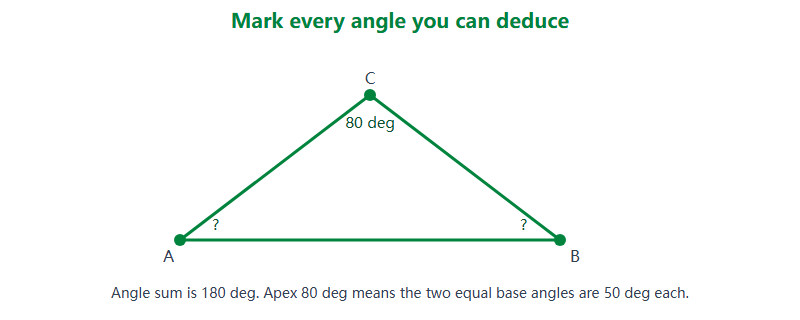
The most dependable geometry marks come from angle work, and a handful of facts carries an enormous amount of weight. Angles in a triangle add to 180 degrees; angles on a straight line add to 180 degrees; angles around a point add to 360 degrees; and an isosceles triangle has two equal base angles. The winning habit is simple: mark every angle you can deduce on the diagram before you try to answer. One known angle often unlocks a second, which unlocks a third, until the target angle is just the one left over.
Redraw the figure larger if the printed one is cramped — a big, clearly labelled diagram does half the thinking for you. When a problem gives parallel lines, look for the equal and supplementary angles they create; when it gives an isosceles or equilateral triangle, mark the equal sides and equal angles immediately. These moves feel almost mechanical once practised, which is exactly why they are reliable under time pressure.
Area, perimeter, and measurement: mind the picture and the units
Measurement questions look friendly and hide traps. The most common is confusing perimeter (the distance around a shape) with area (the space inside it) — read the question twice and underline which one it wants. Composite-shape problems, where a figure is built from rectangles and triangles, are best solved by cutting the shape into pieces you recognise, or by subtracting a missing piece from a larger whole. Both moves turn an unfamiliar figure into familiar arithmetic.
Watch units carefully. If lengths are in centimetres, area is in square centimetres, and a question may switch units part-way through to catch the hasty. A quick estimate protects you here too: if a shaded area should be a little under half of a 10-by-10 square, an answer near 45 is sensible and 450 is not. Estimation will not give you the exact mark, but it will stop you handing over a mark to a careless slip.
Spatial reasoning, symmetry, and counting shapes: the late-paper geometry
The geometry that separates strong students sits in the back half of the paper, where the marks are highest. Spatial questions ask you to fold a net into a cube and say which faces end up touching, or to picture a solid from a different view — skills that are hard to fake and well worth practising with real paper models. Symmetry stops being a topic and becomes a tool: if a figure has a line of symmetry, you can measure or count one half and double it, halving your work.
“Counting shapes” questions — how many triangles are hidden in this figure? — reward organised casework. Count by size first (the single small triangles, then the ones made of two, then of four), then by orientation, and keep a running tally so you never double-count. These questions are worth the most marks precisely because they resist a single formula; the student who stays organised beats the student who is merely fast.
How to get better at AMC geometry (a China-region plan)
Geometry improves fastest with deliberate, low-tech practice. Four habits help most:
- Draw big and mark knowns. Re-draw every figure large, then label every length and angle you can deduce before you attempt the answer.
- Build a bilingual vocabulary. The China-region paper is bilingual, so learn the English terms next to the Chinese — perimeter (周长), area (面积), vertex (顶点), symmetry (对称), diagonal (对角线) — so an unfamiliar word never blocks a familiar idea.
- Use physical models. For 3D, nets, and folding questions, cut and fold paper; spatial intuition is built by hand, not by staring at a flat page.
- Practise by strand. Work through earlier AMC papers one geometry type at a time and review every solution, not just your score. Confirm which past materials are available through ASDAN or on amt.edu.au.
For a reminder of where geometry sits among the paper's other strands, revisit What Is the Australian AMC before you plan your practice for the 11 October 2026 exam.
Frequently asked questions
How much geometry is on the Australian AMC?
Geometry appears on every paper across all six levels, from simple shapes early to spatial reasoning late. The exact proportion varies by level and year — confirm on amt.edu.au.
What angle facts should I learn first?
Angles in a triangle sum to 180 degrees, angles on a line to 180, angles round a point to 360, and isosceles triangles have equal base angles. Master these before harder theorems.
Do I need a protractor or ruler in the exam?
Check the allowed-materials rules for your level with ASDAN or on amt.edu.au before exam day; do not assume, as instructions can change from year to year.
Is Australian AMC geometry the same as US AMC geometry?
They are separate competitions with different papers: AMT runs the Australian AMC and the MAA runs the US AMC. This guide covers the Australian AMC only.
This article is published by the Australian AMC editorial desk, operated by Hanlin Education for China-based international-school students. Official rules are set by the competition and change yearly — confirm current details on amt.edu.au. Errors are corrected within 7 working days.