
Number problems — factors, multiples, remainders and digits — run through every Australian AMC paper, from the three-mark warm-ups to the ten-mark integer question that closes a Level A–E paper. They reward four specific tools rather than faster arithmetic. This guide sets out those tools, shows how the same idea is dressed differently at each of the six China-region levels, and gives you a way to drill them before 11 October 2026.
Where number problems sit on the AMC paper
The Australian Maths Trust (AMT), which has set the AMC since 1978, publishes the topic scope for the paper. Its list of what questions “may include” starts with basic arithmetic and ends with problem-solving (including enumeration) — with fractions and ratios, algebra and pre-algebra, geometry, measurement, and statistics and probability in between. Number work is the strand that quietly feeds all the others: a geometry question still finishes with a division, and a counting question still finishes with a factor.
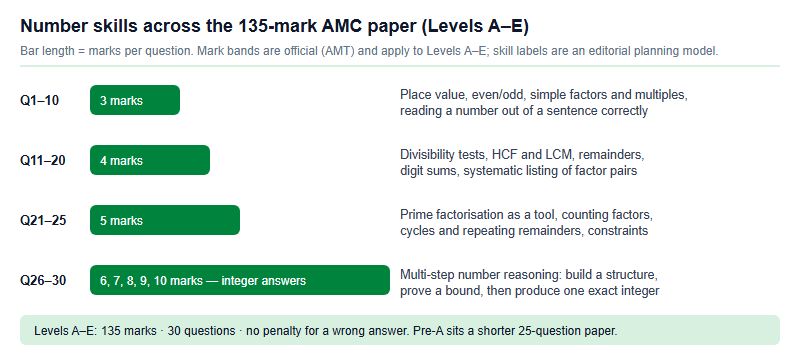
What the AMT does not publish is a per-question topic weighting. So treat any topic-to-question map — including the planning model below, built by this editorial desk — as a study tool rather than an official specification. The structure of the paper, though, is fixed and public. Levels A to E sit 30 questions (25 multiple-choice plus 5 integer-answer), 135 marks in total, and no penalty for a wrong answer. Marks climb with difficulty: questions 1–10 are worth 3 marks each, 11–20 are worth 4, 21–25 are worth 5, and the last five integer questions are worth 6, 7, 8, 9 and 10 marks. Pre-A (Grades 1–2) sits a shorter paper — 25 questions in 45 minutes — so those mark bands describe Levels A to E only; confirm the format for your level on our China Region page.
For students in China the paper is run by ASDAN, sat on Sunday 11 October 2026, with registration closing on 28 September 2026, in a bilingual English-and-Chinese booklet, over 45–75 minutes depending on level. If you are new to the competition, start with our foundation guide, What Is the Australian AMC?, then come back for the mathematics. Dates, timings and rules are set by the competition and can change year to year — confirm current details on amt.edu.au or with your registration channel.
The two engines: divisibility tests and prime factorisation
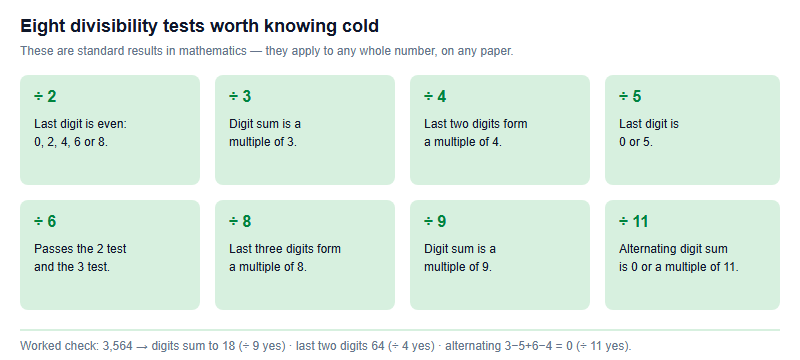
Almost every number question on the paper is solved faster by one of two engines. The first is a set of divisibility tests you should be able to apply without pausing.
The second engine is prime factorisation, and it is the single highest-return idea in AMC number work. Once a number is broken into primes, three separate question types collapse into one method:
- Counting factors. Write 72 = 23 × 32. The number of factors is (3+1)(2+1) = 12. You never have to list them.
- Highest common factor and lowest common multiple. For the HCF take the lowest power of each shared prime; for the LCM take the highest power of every prime that appears. Questions about buses leaving together, tiles fitting a floor, or lights flashing in step are LCM questions wearing a costume.
- Perfect squares and cubes. A number is a perfect square exactly when every prime exponent is even. That one sentence answers a whole family of late-paper questions such as “what is the smallest positive integer n so that 588n is a perfect square?”
Factor-pair listing deserves a word of its own, because it is where careless students lose 4- and 5-mark questions. If a question says ab = 36 with a and b positive integers, the ordered possibilities come from the factors 1, 2, 3, 4, 6, 9, 12, 18, 36. If the question adds “with a < b“, the pair (6, 6) drops out and four pairs remain. Read the constraint before you count — the constraint is the question.
Remainders, cycles, and the last-digit trick
Remainder questions look intimidating and are usually mechanical. Two patterns cover most of them.
Pattern one: a shared remainder. “What is the smallest whole number greater than 1 that leaves remainder 1 when divided by 4, 5 and 6?” Subtract the remainder and the problem becomes a plain LCM: you need a multiple of 4, 5 and 6, which is 60, so the answer is 61. The general move is: strip the remainder, find the LCM, put the remainder back.
Pattern two: a repeating cycle. Anything that repeats — days of the week, positions around a circle, the last digit of a growing power — is a division-with-remainder question. The last digits of powers of 7 run 7, 9, 3, 1, then repeat every four steps. To find the last digit of 72026, divide 2026 by 4 to get remainder 2, so the answer matches 72 = 49 and the last digit is 9. Calendar questions work identically with a cycle of 7.
The skill to train is not the arithmetic but the recognition: when you see the words every, repeats, returns to, the 100th, or a very large exponent, your first action should be to find the cycle length and divide.
Digits and place value: turning words into 10a + b
A surprising number of mid-paper questions are about digits rather than quantities, and they become easy the moment you write the number algebraically. A two-digit number with tens digit a and units digit b is 10a + b. Reverse it and you have 10b + a. Subtract, and the difference is 9(a − b) — which instantly tells you that the difference between a two-digit number and its reverse is always a multiple of 9. Add them instead and you get 11(a + b), a multiple of 11.
That single translation, plus the digit-sum tests above, handles most of the digit family: “the digits sum to 12 and the number is divisible by 4”, “reversing the digits increases the number by 27”, “how many three-digit numbers have all different odd digits”. The last one is a counting question with a number-theory constraint — which is why our companion guides on counting and on the integer questions are worth reading alongside this one.
Same idea, six levels — and where marks leak
The China region runs six levels, Pre-A to E, covering Grades 1–12, with Pre-A introduced for the youngest students. A useful way to see the progression is to follow one idea — divisibility — up the ladder. The mathematics does not change; the number of steps between the question and the answer does.
| Level (China region) | Grades | What a number question tends to ask | The tool it is really testing |
|---|---|---|---|
| Pre-A (25 questions / 45 min) | 1–2 | Skip counting, odd and even, sharing objects equally | Number sense; noticing a repeating pattern |
| A | 3–5 | Which of these is a multiple of 6? What is left over? | Divisibility by 2, 3, 5; remainder as “what is left” |
| B | 6–7 | Two events repeat every 4 and every 6 days — when do they coincide? | LCM and HCF, stated as a story |
| C | 8–9 | How many factors does this number have? Smallest n making it a square? | Prime factorisation as a working tool |
| D | 10–11 | Digit conditions plus a divisibility condition, combined | Place-value algebra (10a + b) with constraints |
| E | 12 | Multi-step: build the set, bound it, then count or extremise | Several tools chained, with an exact integer answer |
Level allocation follows your grade at the time of the competition, and the level structure used in China differs from the division names used in Australia — check the level you should enter on our China Region page or with your registration channel before 28 September. Our foundation guide sets out the six levels in full.
Four leaks account for most lost marks on number questions, and none of them is about difficulty:
- Confusing factor and multiple. A factor of 12 divides into 12; a multiple of 12 is built from it. Under time pressure students routinely answer the opposite question. In a bilingual paper, check the English and Chinese wording against each other if you are unsure.
- Ignoring the word “positive”, “distinct” or “between”. These words change the count. Underline them before you start.
- Stopping the factor list too early. Work in pairs from the outside in (1 × 36, 2 × 18, 3 × 12…) and stop only when the pair crosses over.
- Leaving an integer question blank. With no penalty for a wrong answer, a partially reasoned answer always beats nothing. On Levels A–E that matters most at questions 26–30, worth 6 to 10 marks each; the shorter Pre-A paper has no questions 26–30, but the same no-penalty logic applies.
To drill this strand in the weeks before 11 October, work in short, focused blocks rather than long sessions: fifteen minutes on divisibility and factor-pair listing until it is automatic, then a weekly set of six mixed number questions, taken from across the mark bands, marked honestly and logged by error type rather than by topic. The log is the point — students who record “misread the constraint” three weeks running fix a habit, while students who only record “got it wrong” repeat it.
Frequently asked questions
Is “number theory” an official AMC topic?
Not by that name. The AMT lists basic arithmetic and problem-solving among the topics; factor, remainder and digit questions sit inside those strands.
Do I need to memorise the divisibility test for 7?
No. The tests for 2, 3, 4, 5, 6, 8, 9 and 11 cover far more questions; for 7 it is usually faster to just divide.
Are calculators allowed in the China sitting?
Permitted materials are set by the competition. Confirm the current rules on amt.edu.au or with your test centre before exam day.
My child is in Grade 3 — is this strand relevant yet?
Yes, in its simplest form: skip counting, odd and even, and sharing equally are the Pre-A and Level A versions of divisibility.
Published by the Australian AMC editorial desk, operated by Hanlin Education for China-based international-school students. The Australian Mathematics Competition is set by the Australian Maths Trust (AMT) and administered in the China region by ASDAN; official rules, dates and formats are set by the competition and change yearly — confirm current details on amt.edu.au. Errors reported to the editorial desk are corrected within 7 working days.