
Ratio, rate and percentage questions are where the middle of an Australian AMC paper is won or lost. They are rarely hard mathematics — they are hard reading. This guide gives you one method that solves most ratio questions, the two phrases that cause the most misreadings, the average-speed trap, and the percentage base error, with a level-by-level map for the six China-region divisions sitting on 11 October 2026.
Where ratios and rates sit on the AMC paper
The Australian Maths Trust (AMT), which has set the competition since 1978, lists fractions and ratios as one of the topic strands the paper may draw on, alongside basic arithmetic, algebra and pre-algebra, geometry, measurement, statistics and probability, and problem-solving. What the AMT does not publish is how many questions come from each strand, so treat the level map later in this article as a planning tool from this editorial desk rather than an official specification.
The structure of the paper is public and fixed. Levels A to E sit 30 questions — 25 multiple-choice plus 5 integer-answer — totalling 135 marks, with no penalty for a wrong answer. Questions 1–10 are worth 3 marks, 11–20 are worth 4, 21–25 are worth 5, and questions 26–30 are worth 6, 7, 8, 9 and 10 marks. Pre-A (Grades 1–2) sits a shorter paper — 25 questions in 45 minutes — so those mark bands describe Levels A to E only; confirm the format for your level on our China Region page. Proportional-reasoning questions cluster in the middle of that curve, which makes them unusually valuable: they are the 4- and 5-mark questions that a well-drilled student can convert reliably, while the last five integer questions stay genuinely hard.
In the China region the competition is administered by ASDAN, sat on Sunday 11 October 2026 with registration closing 28 September 2026, in a bilingual paper over 45–75 minutes depending on level. New to the competition? Read What Is the Australian AMC? first. Dates, timings and rules are set by the competition and change year to year — confirm the current details on amt.edu.au or with your registration channel.
The unit-value method: one move that solves most ratio questions
Nearly every ratio question on the paper yields to the same three-step move. Draw the ratio as parts, work out what one part is worth, then answer whatever was actually asked. Students who learn this stop treating ratio questions as a category and start treating them as arithmetic.
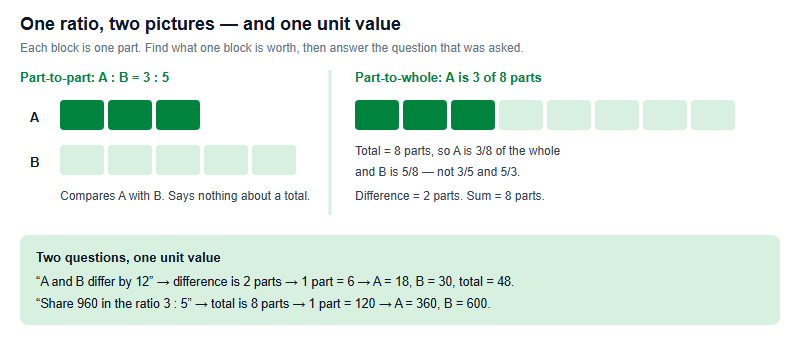
Three-term ratios are the version that catches Level C and D students. If A : B = 2 : 3 and B : C = 4 : 5, you cannot simply write 2 : 3 : 5. Scale both ratios so that B matches: multiply the first by 4 and the second by 3, giving A : B = 8 : 12 and B : C = 12 : 15, so A : B : C = 8 : 12 : 15. The rule is always the same — make the shared term equal, then chain.
Part-to-part or part-to-whole? The reading error that costs the most marks
In our editorial experience marking practice papers with students in China, the most common lost mark in this strand is not a calculation error at all — it is answering the right arithmetic for the wrong quantity. The competition paper is bilingual, which helps, but the ambiguity lives in the mathematics, not the language. Build the habit of translating the phrase before you compute.
| The phrase in the question | What it means mathematically | The common misread |
|---|---|---|
| “The ratio of boys to girls is 2 : 3” | Part-to-part. Boys = 2 parts, class = 5 parts | Reading boys as 2/3 of the class |
| “2/5 of the class are boys” | Part-to-whole. Boys : girls = 2 : 3 | Writing the ratio as 2 : 5 |
| “There are 12 more girls than boys” | The difference equals 1 part × (3 − 2) | Setting 12 equal to one part automatically |
| “A is twice as fast as B” | Speeds are 2 : 1, so times are 1 : 2 | Keeping times in the ratio 2 : 1 |
| “Increased in the ratio 5 : 4” | Multiply by 5/4, a 25% increase | Adding 1 part, or multiplying by 4/5 |
| “20% more than x” | 1.2x; the base is x | Assuming x is then 20% less than the result |
A practical exam habit: before writing any arithmetic, underline the number you are given and label it part, difference, or whole. That single annotation prevents most of the errors above and costs about three seconds.
Rates, speed and work: convert to “per one” or to “the whole job”
Rate questions are ratios with units attached, and two moves cover almost all of them.
Move one — go back to totals for average speed. Average speed is never the average of the speeds. If a cyclist rides 60 km at 60 km/h and then 60 km at 30 km/h, the times are 1 hour and 2 hours, so she covers 120 km in 3 hours: the average speed is 40 km/h, not 45. The reliable method is always total distance divided by total time, and the reason the shortcut fails is that more time is spent at the slower speed. Late-paper questions are built precisely on students who average the two numbers.
Move two — treat the job as 1 for work rates. If one pipe fills a tank in 6 hours and another in 3 hours, they fill 1/6 and 1/3 of the tank per hour. Together that is 1/6 + 2/6 = 1/2 per hour, so the tank fills in 2 hours. The same structure appears as painters painting, machines packing, and taps draining — and it extends to questions where one agent works against the others, in which case you subtract that rate instead of adding it.
Unit-price and best-buy questions belong here too: convert every option to the cost of one item or one gram, then compare. Measurement units are the usual trap, so check whether the question mixed minutes with hours, or grams with kilograms, before you compare anything.
Percentages: the base is the trap
Percentage questions on the AMC almost never test whether you can find 15% of a number. They test whether you know what the percentage is taken of.
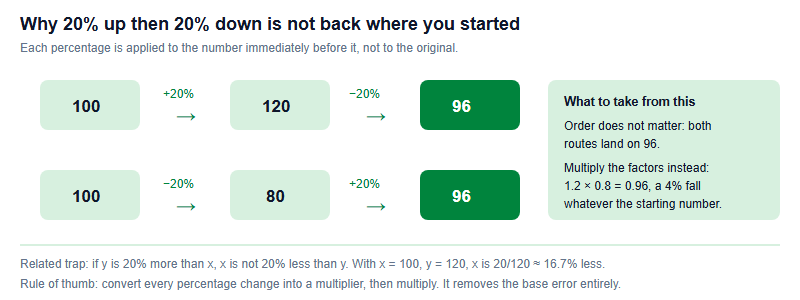
The multiplier habit generalises well. A 25% discount is × 0.75; a price restored to its original value after a 20% discount needs × 1.25, not × 1.20; three successive 10% rises give × 1.331, not a 30% rise. When a question asks for the single percentage equivalent to a chain of changes, multiply the factors and subtract 1.
Here is how the strand scales across the six China-region levels, which run Pre-A to E across Grades 1–12. You enter the level matching your grade at competition time; the level structure used in China differs from the division names used in Australia, so confirm your level on our China Region page or with your registration channel. Our foundation guide lists all six.
| Level | Grades | Typical proportional-reasoning demand | Skill to drill |
|---|---|---|---|
| Pre-A (25 questions / 45 min) | 1–2 | Sharing equally; half and quarter of a group | Equal grouping and fair shares |
| A | 3–5 | Fraction of a quantity; simple unit price comparisons | “One part is worth…” reasoning |
| B | 6–7 | Sharing in a given ratio; simple percentage of an amount | Bar models; part vs whole |
| C | 8–9 | Three-term ratios; percentage increase and decrease; speed | Chaining ratios; total distance ÷ total time |
| D | 10–11 | Successive percentage change; combined work rates | Multiplier method; rate addition |
| E | 12 | Ratio combined with algebra or constraints, exact answers | Setting a variable to one part, then solving |
To drill this strand before 11 October, favour variety over volume: a weekly set of six mixed questions — two ratio, two rate, two percentage, drawn from different mark bands — teaches recognition, which is the actual bottleneck. Mark honestly against the mark scheme for your level, and log every miss by cause: misread the base, averaged the speeds, wrong quantity answered. Because there is no penalty for a wrong answer, always commit to a best reasoned answer even when time is short.
Frequently asked questions
Is “fractions and ratios” officially examinable?
Yes. The AMT lists fractions and ratios among the topics AMC questions may draw on, though it does not publish a per-strand question count.
Why is average speed not the average of the two speeds?
Because more time is spent travelling at the slower speed. Always divide total distance by total time.
What is the fastest way to handle two percentage changes in a row?
Convert each to a multiplier and multiply them: a 20% rise then a 20% fall is 1.2 × 0.8 = 0.96.
Which level should my child enter for 2026?
The level follows the student’s grade at competition time, across Pre-A to E. Confirm it with your registration channel before 28 September.
Published by the Australian AMC editorial desk, operated by Hanlin Education for China-based international-school students. The Australian Mathematics Competition is set by the Australian Maths Trust (AMT) and administered in the China region by ASDAN; official rules, dates and formats are set by the competition and change yearly — confirm current details on amt.edu.au. Errors reported to the editorial desk are corrected within 7 working days.