
Pre-A is new for the 2026 Australian AMC and it is not a shrunken Level A. The paper is picture-heavy and read aloud, which means preparing a six- or seven-year-old for it is a listening-and-looking exercise rather than a reading one. That single fact changes almost everything about what useful practice looks like at home. Here is what it changes, and a rhythm that fits a young child.
What “read aloud and picture-heavy” actually changes
Parents preparing a Grade 1 or Grade 2 child usually reach for the same tools they would use for an older sibling: worksheets, timed drills, past questions to read through. Almost none of that maps onto the format the child will actually meet.
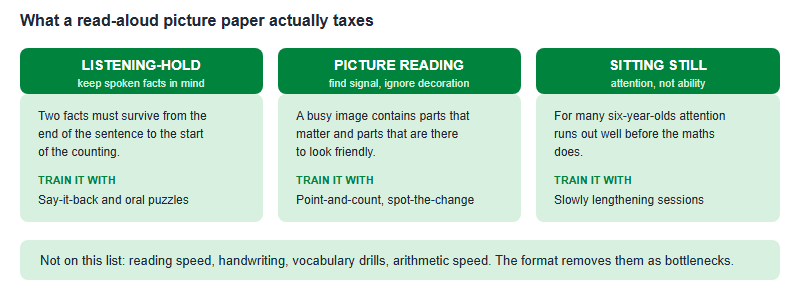
When questions are read aloud and carry pictures rather than dense text, three things stop being the bottleneck and three different things start:
- Reading speed stops mattering. A child who reads slowly is not disadvantaged in the way they would be on a written paper. Practising decoding words does not buy marks here.
- Writing load stops mattering. The child is not producing paragraphs of working. Handwriting practice is not competition preparation.
- Vocabulary in isolation stops mattering. The picture usually carries the situation. Drilling word lists is largely wasted effort.
And in their place:
- Listening-hold becomes the bottleneck. The child has to keep a spoken condition in their head long enough to use it. “There are five red balls and three more blue balls than red” is two facts that must survive until the counting starts.
- Picture reading becomes a skill. Finding the relevant detail in an illustration, rather than taking in the whole picture, is learnable and is genuinely trained by practice.
- Sitting still becomes a limiting factor. For many six-year-olds, sustained attention runs out before mathematical ability does.
That reframing is the whole point of this article. If you take nothing else: you are training attention and listening, not arithmetic speed. In our coaches' experience, arithmetic is rarely what holds a Grade 1–2 child back at this age. What they lack is the habit of holding a spoken problem still long enough to think about it. For the wider picture of how Pre-A sits inside the six-level structure, see our guide to what the Australian AMC is.
Practice activities that match the format
None of the following requires printed material, and all of it can be done in a car, at a dinner table, or while walking. That is deliberate: a six-year-old who associates competition preparation with a desk and a worksheet will resist it, and resistance costs more than any technique gains.
| Activity | What it trains | How to run it | Session length |
|---|---|---|---|
| Say-it-back | Listening-hold | You say a two-fact sentence — “There are four cats and two more dogs than cats” — and the child repeats it before answering anything. Only then ask the question. | 3–5 minutes |
| Oral puzzles | Listening-hold, reasoning | Small spoken problems with no paper allowed. If the child needs to write, the numbers are too big — shrink them. | 5–8 minutes |
| Point-and-count | Picture reading | Use any busy illustration from a storybook. Ask “how many things are red?” and require the child to point at each as they count. | 5 minutes |
| Spot-the-change | Picture reading, attention | Two similar pictures, or one picture looked at then covered. What is different? What was there? | 5 minutes |
| Explain-it-to-me | Reasoning, confidence | After any answer, right or wrong, ask “how did you know?” Never correct before they finish explaining. | Woven in |
| Sit-and-do | Sustained attention | One quiet seated session per week, no interruptions, gradually lengthened over the weeks. This is the only activity that needs a table. | Grows week to week |
A note on that last row, because it is the one parents skip. Whatever time allowance applies to your child's level — check it on amt.edu.au or with your school coordinator — a child who has never sat still and concentrated for anything like that long will lose marks that have nothing to do with mathematics. This is the most reliably fixable gap in the whole Pre-A picture, and it is fixed by patient repetition rather than by content.
Making your own practice problems at home
Parents almost always ask for material at this point, and the honest answer is that the most useful practice at this age is the kind you invent in ninety seconds using whatever is on the table. What follows are our own illustrative examples of the shape to aim for — not competition questions, and not a prediction of what will appear on any paper. Take the official format description from amt.edu.au, and take actual practice material from your school coordinator.
Three properties make a good home problem for a Grade 1–2 child:
- It has two facts, not one. “There are six apples, how many is that?” trains nothing. “There are six apples and two fewer oranges than apples” requires holding one fact while working out a second. That is the actual skill.
- It is answerable without writing. If your child reaches for a pencil, the numbers are too large. Shrink them until the problem is about the relationship rather than the arithmetic — the relationship is the hard part and the arithmetic is not.
- It can be pictured. Ask the child to describe the scene before answering. If they cannot picture it, the problem is too abstract for the format they will meet.
Some shapes worth rotating through, using objects around you: comparison (“who has more, and how many more?”), simple sharing (“four biscuits between two people”), position and order (“who is third from the front?”), simple patterns (“red, blue, red, blue — what comes next, and what about the one after that?”), and rough time and money in familiar contexts. These are ordinary early-primary ideas; what makes them competition-shaped is that you state them aloud, with two facts, and do not tell the child which operation to use.
That last clause is the whole difference between school practice and contest practice. A worksheet headed “Subtraction” has already answered the hardest question on the page. When you say a problem aloud with no label attached, the child has to decide for themselves what kind of problem it is — and deciding that, unprompted, is precisely the capability the paper is looking at.
Expect wrong answers, and expect a good share of them to be listening failures rather than mathematical ones. When a child answers a question you did not ask, that is not inattention to be scolded — it is a signal about listening-hold, telling you to slow your delivery down and return to say-it-back for a few days.
A seven-week rhythm to 11 October
The 2026 China-region sitting is 11 October, with registration closing 28 September. From late August that is around seven weeks — ample, provided the sessions are short and frequent rather than long and occasional. Five to fifteen minutes on most days beats an hour at the weekend, and for this age group it is not close.
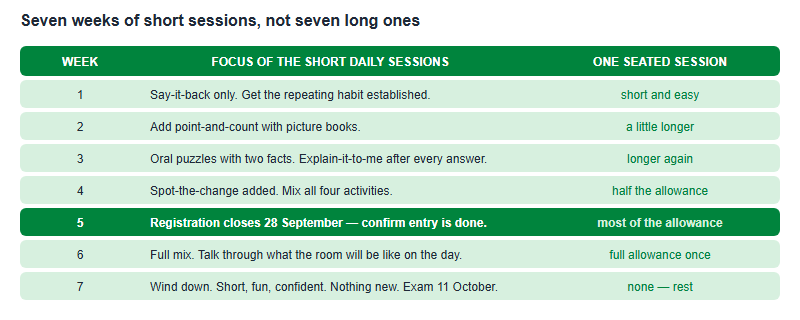
Two structural points about this rhythm. First, the seated session is the only element that escalates — everything else stays at the same low intensity throughout, because the daily activities are habit-forming rather than load-bearing. Second, week seven deliberately does less. Cramming a six-year-old in the final week reliably produces a tired, anxious child on the day, and there is no content gain available in seven days that offsets that.
Five things not to do
Our coaches see the same well-intentioned mistakes each year with young learners. Results vary by child, but these patterns are consistent enough to name.
- Do not time them early. Introducing a clock in week one teaches a young child that mathematics is a source of pressure. Time only appears in the seated session, and only after several weeks of comfortable practice.
- Do not run long sessions. Forty-five minutes on a Sunday is worse than seven minutes a day. Attention is the resource being built, and it is built by frequency.
- Do not correct mid-explanation. When you interrupt a wrong explanation, you learn nothing about where the thinking went astray and the child learns to stop explaining. Let them finish, then ask a question rather than issuing a correction.
- Do not transmit your own anxiety about the result. A Grade 1 or 2 child reads a parent's tone far more accurately than they read a question. If the household treats 11 October as a verdict, the child will too.
- Do not substitute worksheet volume for format practice. A stack of written arithmetic sheets prepares a child for a written arithmetic test. The paper in question is read aloud and picture-based.
It is also worth being clear about what Pre-A is for, and where it sits in the wider Pre-A to E structure. It is a first, gentle exposure to thinking about a problem that was not pre-labelled with a method — nothing more, and it should not be presented to a six-year-old as anything more. Award bands are set as percentiles of the national field, and AMT publishes the current band structure on amt.edu.au; no particular score is a target you should set for a child this age. The useful outcome is a child who found it interesting enough to want to sit it again next year.
Frequently asked questions
Does my child need to read well to sit Pre-A?
The Pre-A papers are picture-heavy and read aloud, so reading fluency is not the bottleneck. Confirm the exact arrangements for your sitting on amt.edu.au or with your coordinator.
How long should we practise each day?
Five to fifteen minutes on most days, plus one longer seated session weekly. Frequency matters far more than session length at this age.
Which level does a Grade 1 or Grade 2 child sit?
Level follows the year group the student is in from September 2026, so Grades 1–2 sit Pre-A. Confirm with your coordinator or on amt.edu.au.
What score should a Grade 1 child be aiming for?
None. Award bands are national percentiles and cut-offs move each year. Take any current band figures from amt.edu.au directly.
Published by the Australian AMC editorial desk, operated by Hanlin Education for China-based international-school students. Official rules are set by the competition and change yearly — confirm current details on amt.edu.au. Errors are corrected within 7 working days.