
Most practice for the Australian AMC produces a score and nothing else. An error log turns wrong answers into a repair list. This is not a catalogue of common mistakes — it is a method for finding yours, sorting them into four kinds that need four different fixes, and verifying the repair held. Here is the weekly loop, in the weeks before 11 October 2026.
Why a score is not feedback
A student finishes a past paper, marks it, gets 78, and feels informed. They are not. “78” tells you where you stood; it tells you nothing about what to do on Tuesday. Two students can score 78 on the same paper for entirely opposite reasons — one lost everything to rushed arithmetic on questions they understood, the other lost everything to genuinely not knowing how to start the back third — and the correct next fortnight for those two students has almost nothing in common.
The Australian AMC makes this more acute than a school test does, for a structural reason. The paper is 30 questions for a maximum of 135 marks, and later questions carry more — check the exact per-question values for your level on amt.edu.au. So the same raw drop of, say, twelve marks can mean four cheap slips at the front of the paper or one or two questions you never reached at the back. Those are not the same problem, and a score cannot distinguish them. If you want the structure of the paper first, see our guide to what the Australian AMC is.
An error log is simply the discipline of recording, for each wrong answer, what actually went wrong — in enough detail that a repair is obvious. It takes about ten minutes after a paper. It is the highest-return ten minutes available in the whole preparation cycle, and it is the one almost every student skips.
The four buckets
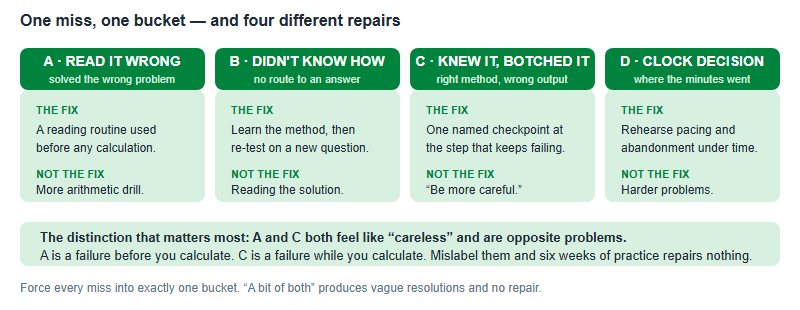
Every miss belongs in exactly one of four categories. Forcing yourself to choose one — not two, not “a bit of both” — is what makes the log useful, because each category has a different fix and mixing them produces vague resolutions like “be more careful,” which repair nothing.
- Bucket A — Read it wrong. You solved a real problem correctly; it was not the problem on the page. Missed a condition, misread a relationship, answered for the wrong quantity.
- Bucket B — Didn't know how. You understood the question perfectly and had no route to an answer. A genuine method or topic gap.
- Bucket C — Knew it, botched it. Right setup, right method, wrong output. Arithmetic slip, sign error, transcription error, wrong box on the answer sheet.
- Bucket D — Clock decision. You could have got it, and the reason you did not is where you spent your minutes — over-invested earlier, never reached it, or abandoned too late.
The distinction between A and C is the one students get wrong, and it matters more than any other. Both feel like “careless.” They are opposite problems. A is a reading failure and is fixed by changing how you approach a question before calculating. C is an execution failure and is fixed by changing what you do while calculating. A student who labels every A as “careless” will drill arithmetic for six weeks and misread exactly as many questions on 11 October as they did in August.
The log itself: five columns, ten minutes
Keep it deliberately small. Elaborate error journals get abandoned in week two. A notebook line or a spreadsheet row per miss is enough, and the discipline is that you write it the same day you sit the paper, while you can still remember what you were thinking.
| Column | What goes in it | The question you are answering |
|---|---|---|
| Question | Paper and question number, plus roughly where it sat in the paper | Front, middle or back third? Front-third misses are the expensive surprise |
| Bucket | A, B, C or D — exactly one | What kind of failure was this? |
| The moment | One short phrase naming where it broke: “missed ‘at least’”, “lost a minus sign at line 3”, “never saw it was a counting problem” | What specifically happened, in words you would recognise again? |
| Topic | Number, geometry, counting, ratio, pattern, data | Is the same topic recurring across buckets? |
| Re-test date | A date roughly ten days out | When will I check the repair held? |
The “moment” column is where the value lives. “Careless” is not an entry. “Silly mistake” is not an entry. If you cannot name the moment in a phrase, you have not yet understood the miss, and the honest thing to do is spend two more minutes on it or mark it as unresolved rather than write something vague.
The weekly loop
The log is inert unless it drives something. The loop below is designed around a normal school week, and it deliberately separates the day you log from the day you repair — because fixing errors while you are still annoyed about them produces bad diagnosis.
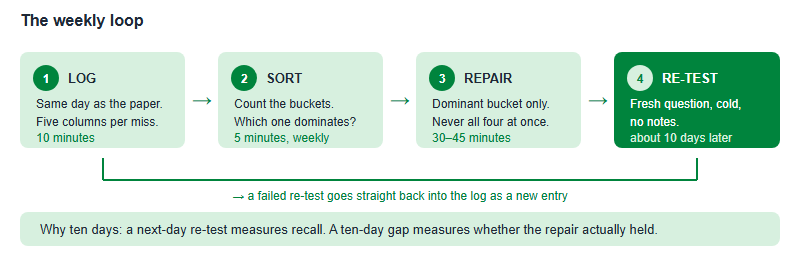
- Same day — log. Ten minutes, immediately after marking. Five columns per miss. No repairing yet.
- Once a week — sort. Count the buckets. Which one dominates? Which topic recurs? This takes five minutes and it is the step that turns a list into a decision.
- Once a week — one repair block. Thirty to forty-five minutes, aimed at the dominant bucket only. Not at everything. Trying to fix all four in one week is how students end up fixing none.
- Ten days later — re-test. Attempt a fresh question of the same type, cold, without looking at your notes. This is the only evidence that anything was actually repaired.
The ten-day delay is not arbitrary padding. Re-testing the next day mostly measures short-term recall, and a student can “pass” a next-day re-test while having changed nothing durable. A gap of about a week and a half is long enough that passing means something.
Reading the pattern — what your bucket counts are telling you
After three or four papers the shape of the log says something a score never could. These are the readings we use in coaching; treat them as a starting hypothesis to check against your own log rather than a verdict.
- Bucket A dominates. Your mathematics is ahead of your reading. Harder problems will not help and may hurt. The productive move is a fixed pre-calculation routine — identify what is asked, list the given conditions, then start — applied to easy questions until it is automatic.
- Bucket B dominates and clusters in one topic. This is the good news case, because it is the most directly fixable thing on the list. One topic, worked properly over two weeks, closes it.
- Bucket B dominates but scatters across topics. Different problem: the gap is in problem-solving approach rather than content. More topic revision will disappoint.
- Bucket C dominates. Check where in the paper. C errors concentrated at the front usually mean rushing to reach the back; C errors spread evenly usually mean a specific recurring execution step that needs one named checkpoint.
- Bucket D dominates. Nothing is wrong with your mathematics at all, and no amount of content work will move your score. What needs rehearsing is the clock: full-length timed sittings with a deliberate rule about when to leave a question. It helps to re-read how the thirty questions and 135 marks are distributed before setting that rule.
- Almost no entries at all. Either the papers are too easy for you or — far more often — you are not logging honestly.
One reading that comes up every year and is worth stating plainly: a log full of C entries at the front of the paper, paired with D entries at the back, is a pacing problem wearing a carelessness costume. The student is rushing the accessible questions to buy time for hard ones they then do not solve. They lose secure marks to gain nothing. The repair is not more practice — it is a decision, made in advance, about how much of the paper they are actually going to attempt.
Three ways error logs fail
We have watched plenty of these die. Almost always for one of three reasons:
- Too elaborate. Students who rewrite the full question and a model solution into a beautiful notebook are doing copying, not diagnosis, and they stop within a fortnight. Five short columns. That is the whole system.
- Logged but never sorted. A list of forty entries nobody has counted is a diary, not a diagnostic. The weekly count is the step that turns it into a plan, and it takes five minutes.
- No re-test. Without the ten-day check, “I understand it now” is the last thing anyone records, and understanding a solution you have just been shown is nearly worthless as evidence. The re-test is what makes the whole exercise honest.
With roughly seven weeks between late August and 11 October — and registration closing 28 September — there is room for about six full cycles of this loop. Six diagnosed and verified repairs is a large amount of movement for a student who would otherwise have sat six papers, felt vaguely better, and arrived on exam day making the same four mistakes. The log is not extra work; it is what makes the practice you were already doing count.
Frequently asked questions
How long should an error log take?
About ten minutes after a paper to log, five minutes weekly to sort. If it takes longer, it is too elaborate and will be abandoned.
What if a mistake fits two buckets?
Force one. Ask what would have saved the mark: better reading (A), a method (B), a checkpoint (C), or a clock decision (D).
Why re-test after ten days rather than the next day?
A next-day re-test measures recall. A ten-day gap tests whether the repair actually held, which is the thing you care about.
Does this replace doing past papers?
No — it is what you do with them afterwards. Confirm paper structure and marks for your level on amt.edu.au.
Published by the Australian AMC editorial desk, operated by Hanlin Education for China-based international-school students. Official rules are set by the competition and change yearly — confirm current details on amt.edu.au. Errors are corrected within 7 working days.