
Your Australian AMC level is set by the grade your school will record you in from September 2026 — not by your age, not by how strong your maths is, and not by the level an older sibling sat. Six levels cover Grades 1 to 12: Pre-A, A, B, C, D and E. The complication for international-school families is that year labels travel badly between systems, and Australia publishes different division names again.
The rule is a grade, and only a grade
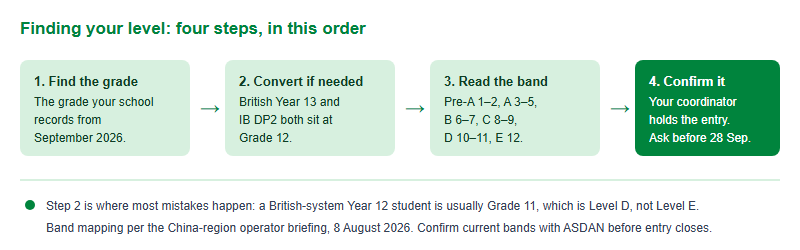
The China-region entry is banded by grade. From September 2026 the mapping is Pre-A for Grades 1–2, A for Grades 3–5, B for Grades 6–7, C for Grades 8–9, D for Grades 10–11, and E for Grade 12. That is the whole rule. It is deliberately mechanical, because the alternative — letting families self-select by perceived ability — would wreck the thing that makes the awards mean anything.
Awards on this competition are percentile-based, not score-based. Credit goes to roughly the top 55% of a band (top 60% at Level E), Distinction to the top 20% (25% at E), High Distinction to the top 3% (5% at E), and the Prize sits at the top 0.3% across Levels A to E. Those are the China-region figures in our operator briefing of 8 August 2026, and they only work if everyone in a band is genuinely in that band. A Grade 7 student sitting Level A would not be demonstrating anything; they would be distorting a percentile everyone else is measured against.
So the answer to “can my child sit a level up because they are ahead?” is not a question to settle at the kitchen table. Grade-banding is the operator’s rule, and unusual cases — a skipped year, a repeated year, a mid-year transfer between systems — belong with your school coordinator and with ASDAN, who run the competition in the China region. If you are new to the competition entirely, start with our overview of what the Australian AMC is and who runs it, then come back to the banding.
Australia’s divisions are not the China-region levels
This is the trap that costs families the most wasted preparation, and almost nobody warns about it.
The Australian Maths Trust, which has run this competition since 1978, publishes its own division structure on amt.edu.au: five divisions, named Middle Primary (Australian Years 3 and 4), Upper Primary (Years 5 and 6), Junior (Years 7 and 8), Intermediate (Years 9 and 10) and Senior (Years 11 and 12). The China region uses six levels, Pre-A through E, and the bands are cut at different points.
Compare them and the misalignment is immediate. A Grade 5 student sits Level A in the China region, alongside Grades 3 and 4. In the Australian structure, Year 5 sits Upper Primary, alongside Year 6. Those are not the same cohort and not the same label. A family who reads an Australian guide to “Upper Primary” and assumes it describes their Grade 5 child’s paper has quietly picked up the wrong reference point.
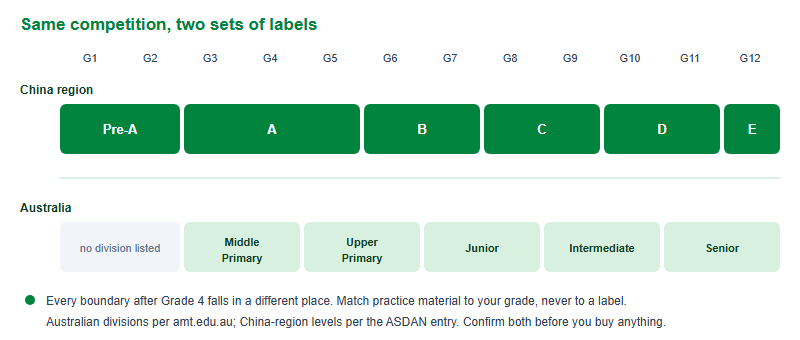
The same misalignment shows up in award wording. AMT publishes the wider Credit, Distinction and High Distinction percentages for its Senior division, which covers Australian Years 11 and 12. Our China-region briefing attaches those wider bands to Level E, which is Grade 12 alone. So a Grade 11 student — Level D in the China region — should not assume that Australian commentary about “Senior” thresholds describes their own band. If the exact percentage that applies to you matters, ask ASDAN for the figure attached to your level rather than inferring it.
A working conversion table
The operative number is always the grade your school records. But most international schools in China run a British, IB or American calendar, and the year label on a report card is not always a grade number. The rough rule that resolves nine cases out of ten: a British-system Year N is usually Grade N minus one.
| Level | Grade (US / Chinese numbering) | British system | Typical IB stage | Chinese school year |
|---|---|---|---|---|
| Pre-A | Grades 1–2 | Years 2–3 | PYP | Primary 1–2 |
| A | Grades 3–5 | Years 4–6 | PYP | Primary 3–5 |
| B | Grades 6–7 | Years 7–8 | MYP 1–2 | Primary 6 / Junior High 1 |
| C | Grades 8–9 | Years 9–10 | MYP 3–4 | Junior High 2–3 |
| D | Grades 10–11 | Years 11–12 | MYP 5 / DP1 | Senior High 1–2 |
| E | Grade 12 | Year 13 | DP2 | Senior High 3 |
Treat the right-hand columns as a working reference for narrowing down, not as an official ruling. Schools vary, some students transfer across systems mid-stream, and the entry itself is made on the grade. If your school’s label and this table disagree, the school wins — and the coordinator should be told about the discrepancy before the entry is submitted, not after.
Four cases that catch families every year
- The British-system Year 12 who assumes Level E. Year 12 in a British-system school is usually Grade 11, which is Level D. Sitting the wrong end of that boundary is the single most common senior-school error we see, and it is worth a specific email to your coordinator if you are in a sixth form.
- The Grade 5 who prepared as “Upper Primary”. As above: Grade 5 is Level A in the China region, banded with Grades 3 and 4. If you have been benchmarking against Australian Upper Primary material, you have been benchmarking a year group up.
- The accelerated student. A Grade 6 studying Grade 8 content still enters at Grade 6. That is not a demotion. The percentile bands are computed within a level, so competing in your own band is what makes an award readable to anyone later. If you want harder work, take harder practice — do not re-band yourself.
- The Grade 1 whose reading is still developing. Parents often assume Grade 1 is too early. Per our operator briefing, Pre-A papers are deliberately picture-led with minimal text and come with a read-aloud facility, so that children whose reading is still developing can compete fairly. That is a design decision, not a watered-down paper.
One more case worth naming: families who have been offered a different competition and assume it is this one. The Australian AMC is run by the Australian Maths Trust and delivered in the China region by ASDAN. It is a separate competition from the American Mathematics Competitions run by the MAA in the United States, and separate again from AMO, run by SIMCC out of Singapore. Similar initials, different organisations, different papers. Our introduction to the competition and its organiser sets out who is behind what.
What to settle before 28 September
The China-region sitting is on 11 October 2026 and registration closes on 28 September 2026. That leaves a short, specific to-do list, and none of it is maths:
- Write down the grade your school will record from September 2026. Not the current grade if a promotion is pending — the recorded one.
- Convert from a British or IB label if that is what your report card uses, then check it against the band table above.
- Send your coordinator two questions in one message: which level am I entered at, and which delivery mode is my seat. Both change how you should practise, and both are cheap to confirm now and expensive to discover on the day.
- Confirm the closing date and any school-internal deadline, which is often earlier than the regional one.
- Only then start band-matched practice. A fortnight of well-aimed work beats six weeks aimed at the wrong band.
The paper at Levels A to E is the same shape: 30 questions, a maximum of 135 marks, and no penalty for incorrect responses, per AMT; confirm the Pre-A format with ASDAN. What changes across Pre-A to E is the pitch, the reading load and, at the top, how far the last few questions reach. Getting the band right is the cheapest mark-per-minute decision available to you this month.
Questions we get asked
Does the Australian AMC level depend on age or on grade?
Grade. The China-region bands run off the grade your school records from September 2026, not birth date or maths level.
My child is in British-system Year 12 — is that Level E?
Usually no. Year 12 normally corresponds to Grade 11, which sits in Level D. Confirm with your school coordinator before entry closes.
Why do Australian materials use different division names?
AMT publishes five divisions banded by Australian year groups. The China region uses six levels, Pre-A to E, cut at different points.
Can a strong student enter a higher level?
Entry is banded by grade, and awards are percentiles within a band. Any exception is a question for your coordinator and ASDAN, not a family decision.
Published by the Australian AMC editorial desk, operated by Hanlin Education for China-based international-school students. Official rules are set by the competition and change yearly — confirm current details on amt.edu.au. Errors are corrected within 7 working days.