
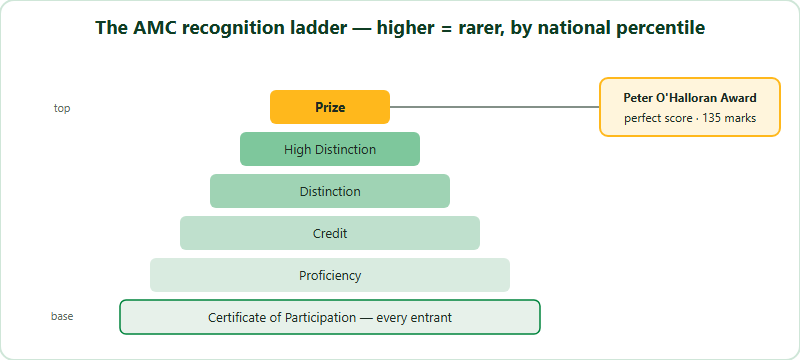
In the Australian Mathematics Competition (AMC), recognition rests on two simple ideas. First, every entrant receives a certificate, so no student finishes with nothing. Second, the named awards above that — Prize (the top tier), then High Distinction, Distinction, Credit and Proficiency — are decided by national percentile at each level, not by a fixed pass mark. A perfect paper can earn the Peter O'Halloran Award. Because the bands are percentile-based, the exact score needed shifts a little every year — for recent cut-offs, confirm on the official site.
The recognition ladder at a glance (2026 China region)
Australian AMC results are reported as a tier, not just a raw mark. At the base sits the certificate that goes to every participant. Above it, the named bands describe how a student performed relative to others at the same level, in the same year. That one design choice is what makes the competition feel welcoming at the bottom and genuinely demanding at the top — a Grade 4 child and a Grade 12 student each receive recognition measured against their own peers, never against each other.
| Recognition | What it means | Roughly who earns it |
| Prize | The top tier nationally at each level | A small top slice of entrants |
| High Distinction | Next band down, by national percentile | Upper percentile at the level |
| Distinction | Strong result, above the Credit band | A larger upper-percentile group |
| Credit | Solid, above-typical performance | A broad middle-upper group |
| Proficiency | Recognises sound work below Credit | Set by the marking scheme |
| Certificate of Participation | Goes to every entrant | All participants |
| Peter O'Halloran Award | For a perfect score (all 135 marks) | The rare full-mark papers |
A note on language before we go further: the “roughly who earns it” column is the shape of the ladder, not a promise of numbers. The precise share of students in each band, and the score that lands a student there, are set by the Australian Maths Trust (AMT) after marking each year's cohort and can move from year to year. Treat that column as orientation only, and read the exact distribution on the official results material. New to the competition itself? Our guide to what the Australian AMC is covers the six levels, dates and format first.
Why the bands are percentile-based — and why that is fair
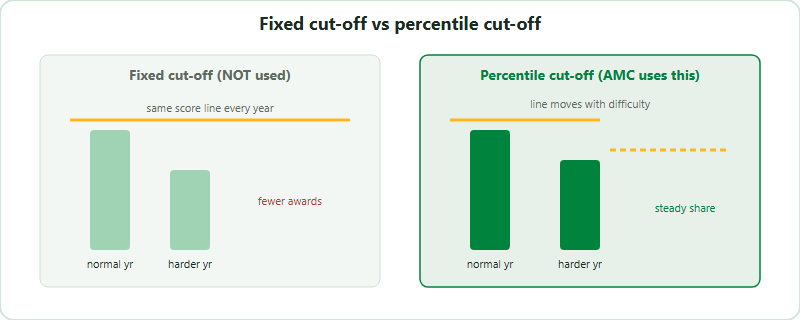
This is the part many families miss, so it is worth slowing down. A fixed cut-off would say something like “score 100 of 135 for a Distinction” — the same number every year. A percentile cut-off instead says “the top X% of students at your level earn a Distinction,” and then works backwards to whatever score that turned out to be this year. The Australian AMC uses the percentile approach.
The reason is fairness across years and across levels. The AMC is built from fresh problems every year, so one year's Level C paper might run a touch harder than the last. With a fixed cut-off, a harder paper would unfairly shrink the number of Distinctions; with a percentile system, the threshold simply slides so that comparable students get comparable recognition regardless of the paper's exact difficulty. It also keeps the bands meaningful within a level — a Grade 8 Distinction and a Grade 11 Distinction each describe the same standing among that grade band's entrants.
A worked example: how a raw mark becomes a band
To make the percentile idea concrete, here is a fully illustrative walk-through — the numbers below are invented to show the mechanism, not real cut-offs for any year or level. Imagine three students all sat Level B (Grades 6–7) in the same year:
| Student | Raw mark /135 | Where they ranked nationally at Level B | Band (illustrative) |
| Student A | 118 | Inside the top few % at the level | Prize |
| Student B | 96 | Comfortably in the upper percentile | Distinction |
| Student C | 72 | Above the typical mark for the level | Credit |
The key insight is that the band follows the ranking, not the bare number. If that year's Level B paper had been unusually hard and almost everyone scored lower, Student B's 96 might have ranked even higher and still earned a Distinction — or, on an easy paper where many students scored in the 90s, the same 96 might land a Credit instead. This is exactly why memorising “I need 96 for a Distinction” is unreliable: that 96 was never the target; the percentile was. It is also why a student's mark should be read alongside the band on the certificate, never on its own.
One more practical point follows from the marking. Because marks rise with difficulty — the easy early questions are worth fewer marks and the hard tail is worth the most — two students can reach the same raw total by very different routes, yet land in the same band. For a closer look at how those 135 marks are distributed across the 30 questions, see The Australian AMC 30-Question Difficulty Curve & 135-Mark Scoring, Decoded.
Why we will not publish exact cut-off scores
You will find blogs that confidently announce “the Distinction cut-off is 95” or similar. We deliberately do not, for one honest reason: those numbers are not fixed, and they are not ours to set. The award boundaries are determined by the Australian Maths Trust after marking each year's national cohort, and they vary by level and by year. Quoting a specific recent figure here would risk sending a Grade 6 family chasing a Grade 10 number, or anchoring on a threshold that has already moved.
What we can tell you reliably is the structure — certificate for all, percentile bands above, O'Halloran for a perfect paper — and the mechanics of the paper that feed into it. For the precise score that earned each band in a given year, the official results pages are the only authoritative source. When in doubt, confirm on the official site; do not plan around a number you saw on a third-party page.
How your 135 marks are built
Recognition starts with the paper, so it helps to know how the score itself is assembled. Every level sits a 30-question paper — 25 multiple-choice plus 5 integer-answer questions — worth 135 marks in total. The questions climb in difficulty and the marks climb with them: the easier early questions are worth fewer marks, the hardest are worth the most. There is no penalty for a wrong answer, which directly shapes award strategy: since a blank and a wrong guess both score zero on a question, leaving questions empty only caps your ceiling.
Two practical consequences follow for anyone hoping to reach a band:
- Attempt everything. With no penalty, every unanswered question is a small piece of percentile left on the table. Make a reasoned best attempt on the hard ones rather than skipping.
- Secure the early marks first. Because marks rise with difficulty but the easy questions are quick, banking the front of the paper cleanly is usually what separates a Credit from a Distinction — not heroics on the final few. For what those harder questions actually look like, see Australian AMC Problem Types: What the Paper Actually Tests.
| Paper element | Detail (2026 China region) |
| Questions | 30 total — 25 multiple-choice + 5 integer-answer |
| Total marks | 135, rising with difficulty |
| Penalty for wrong answers | None — attempt every question |
| Levels | Six: Pre-A (Gr 1–2, new for 2026), A (3–5), B (6–7), C (8–9), D (10–11), E (Gr 12) |
| Time | 45–75 minutes depending on level |
| Languages | English & Chinese |
| Perfect score | 135/135 → eligible for the O'Halloran Award |
For the 2026 China region, the paper is sat on Sunday 11 October 2026, with registration closing 28 September 2026. Those dates, along with the entry fee and portal steps, are set by AMT and ASDAN and can change — confirm current details on the official channels.
The Peter O'Halloran Award and reading your certificate
The Peter O'Halloran Award sits apart from the percentile ladder. It is not a band you reach by beating a share of other students — it is reserved for a perfect score, all 135 marks, with no questions dropped. Named after the founder of the Australian Maths Trust (AMT, established in Australia in 1978 and the country's largest school maths competition), it is rare by design and recognises a flawless paper rather than a relative ranking.
When results arrive, your certificate names your award band for your level. Read it as a statement of standing among students in your own grade band that year — a Distinction means a strong, above-typical result; a Prize means a top-tier national performance at that level. A few honest framing points for parents and students in China:
- The certificate recognises one paper on one day. It does not promise admission to any school or programme, and we make no such claims.
- A band earned at Level B is not “lower” than the same band at Level E — each is measured within its own grade band, so they are not directly comparable across levels.
- Because thresholds move yearly, comparing your raw score to a friend's from a previous year tells you little; the band is the meaningful comparison.
- A near-miss is still real progress. The honest goal is to do a little better against your own peers next year, not to clear a number someone posted online.
Keeping three look-alike competitions straight
Because the letters “AMC” appear in more than one contest, families in China are right to double-check which one a result belongs to — the awards described here apply only to the Australian AMC. The table below keeps the three apart.
| Competition | Run by | Recognition style |
| Australian AMC (this site) | Australian Maths Trust (AMT); ASDAN in China/Asia | Certificate for all + percentile bands (Prize…Proficiency) + O'Halloran for a perfect score |
| American AMC | MAA, USA | A different score-and-qualification system (e.g. pathway to AIME) — not covered here |
| AMO | SIMCC, Singapore | Its own medal/award scheme — a separate competition |
If a certificate, advert or results page mentions the MAA, AIME or SIMCC, it is not the Australian AMC. When unsure which contest a given award belongs to, check the official source for that specific competition.
Frequently asked questions
Does every student get something from the Australian AMC?
Yes. Every entrant receives a certificate of participation. The named bands — Proficiency up to Prize — are awarded above that by national percentile.
What exact score do I need for a Distinction or High Distinction?
There is no fixed number. Bands are set by national percentile and shift each year and by level, so confirm recent cut-offs on the official site.
What is the Peter O'Halloran Award?
It recognises a perfect score — all 135 marks with nothing dropped. It is separate from the percentile bands and is rare by design.
Is the Australian AMC award the same as the American AMC or AMO?
No. This is the Australian AMC (AMT/ASDAN). The American AMC (MAA, USA) and the AMO (SIMCC, Singapore) are different competitions with their own award systems.
This is the editorial desk for the Australian Mathematics Competition (AMC) China region. The competition is run by the Australian Maths Trust (AMT) and administered in China and Asia by ASDAN (阿思丹); this content desk is operated by Hanlin Education for students in China. Dates, fees, levels, rules and award thresholds are set by the AMT and ASDAN and can change each year — always confirm current details on the official channels (amt.edu.au and the ASDAN China-region channels). Confirmed errors are corrected within 7 working days.