
For Australian AMC Pre-A 2026 results in the China region, there is no historical Pre-A cutoff to compare against. If your child sat the new Pre-A paper on 11 October 2026, the 2026 season is the first Pre-A cohort described in the supplied Hanlin Courses article, so a raw score out of 100 and an award label such as Credit are different pieces of information. The notice says China-region results and rankings are expected within 6–8 weeks after the examination; as of 9 November 2026, the published expectation still places results within that window, and families should check the publisher’s actual release rather than assume a date. It does not publish a 2026 Pre-A pass mark. The 2025 Mathematics Skills Award line of 32 was a score-based line for the prior A–E level set, not a Pre-A cutoff. Read the result as raw marks first, published label second, any reported rank or percentile third, and leave unsupported cutoffs blank. This is a Hanlin preparation-perspective explainer, not an official result notice.
What the Pre-A paper actually scores
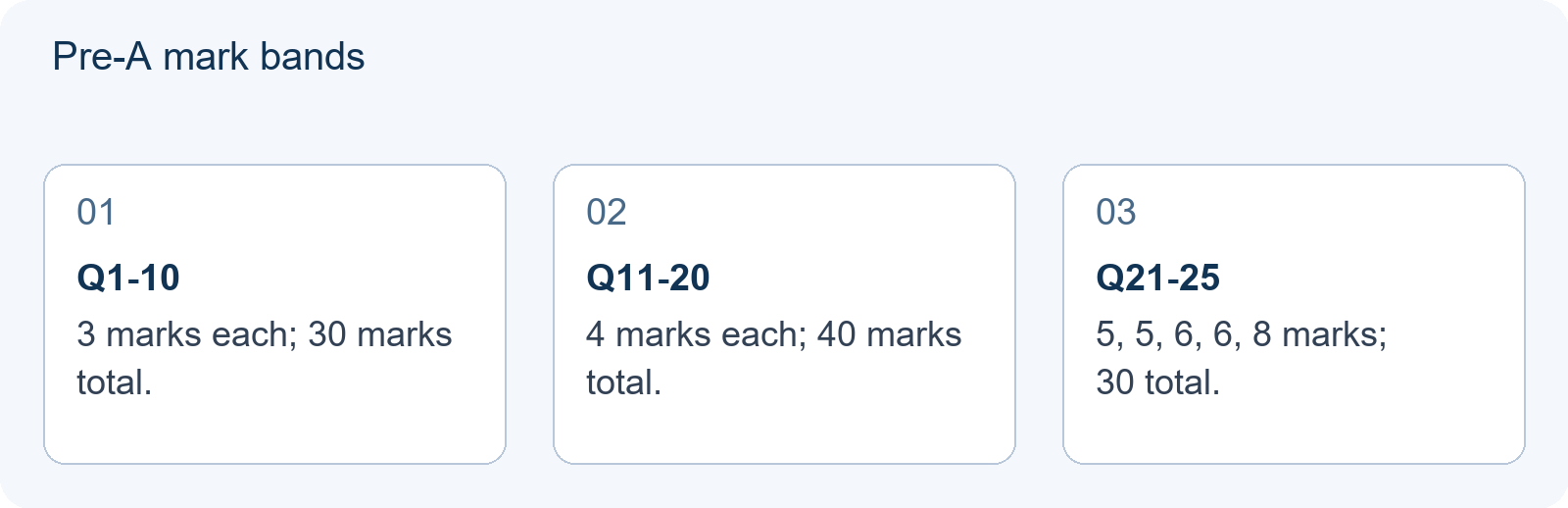
The Pre-A paper is not a miniature version of A–E. The Hanlin Courses article dated 11 October 2026 states that Pre-A has 25 questions and 100 marks: Questions 1–10 are worth 3 marks each, Questions 11–20 are worth 4 marks each, Questions 21–22 are worth 5 marks each, Questions 23–24 are worth 6 marks each, and Question 25 is worth 8 marks. Wrong or blank answers are not penalised. That last point matters: a blank is worth zero, but it does not subtract marks.
| Band | Questions | Marks each | Maximum |
|---|---|---|---|
| Front | Q1–Q10 | 3 | 30 |
| Middle | Q11–Q20 | 4 | 40 |
| First back pair | Q21–Q22 | 5 | 10 |
| Second back pair | Q23–Q24 | 6 | 12 |
| Final question | Q25 | 8 | 8 |
| Total | 25 questions | — | 100 |
The arithmetic is worth doing once, because it shows why a raw score is not a vague impression. Teaching illustration: if a child answered Q1–Q8 correctly, Q11–Q15 correctly, Q21–Q22 correctly, and Q23 correctly, then the mark is 8×3 + 5×4 + 2×5 + 6 = 24 + 20 + 10 + 6 = 60 out of 100. If Q24 and Q25 were blank or wrong, there is no deduction; the score remains 60. This is a constructed example, not a predicted score for any child. For the full scoring structure, see Australian AMC Pre-A Scoring: 25 Questions, 100 Marks, No Penalty.
Why the 2025 32-point line is not a Pre-A cutoff
The supplied notice makes two statements that are easy to merge by mistake. First, the 2025 Mathematics Skills Award line was 32 for all grades. Second, the new 2026 Pre-A level has no corresponding prior-year cutoff line. Those statements do not cancel each other; they describe different things. The 32-point line belongs to a score-based award in a prior season and an older level set. Pre-A did not exist in that prior form, so there is no Pre-A distribution from which a 2026 Pre-A cutoff could have been carried forward.
There is also a population issue. A line described for “all grades” in 2025 is not a line computed from a 2026 Pre-A cohort, because the 2026 Pre-A cohort is new. And there is an award-type issue: the Mathematics Skills Award is listed separately from the top-percentage labels. Subtracting 32 from a Pre-A raw score is arithmetic, but it is not interpretation. A child with 60 marks is not “28 marks above a Pre-A cutoff,” because no 2026 Pre-A cutoff has been supplied. Families should write “2025 Mathematics Skills line: 32” in a historical note, not in a Pre-A award column.
How to read the Pre-A award label without inventing a cutoff
The same notice lists China-region award labels as top-percentage descriptions. Prize is top 0.3% for Pre-A to E. High Distinction is top 3% for Pre-A to D and top 5% for E. Distinction is top 20% for Pre-A to D and top 25% for E. Credit is top 55% for Pre-A to D and top 60% for E. The Mathematics Skills Award is score-based and listed separately; the notice describes students who meet the score requirement and do not receive the above awards as having an opportunity to receive it.
| Label | China-region description in the notice | What it is not |
|---|---|---|
| Prize | Top 0.3%, Pre-A to E | A mark threshold |
| High Distinction | Top 3%, Pre-A to D; top 5%, E | A fixed Pre-A score |
| Distinction | Top 20%, Pre-A to D; top 25%, E | A percentage of marks |
| Credit | Top 55%, Pre-A to D; top 60%, E | A synonym for 55 or 60 marks |
| Mathematics Skills Award | Score-based and separate | A top-percentage label |
Do not sum these percentages, and do not assume the labels are disjoint in a way that lets you convert one into another. Each is a top-percentage description; a student’s actual label is whatever the report prints. A Credit label does not mean “55 marks,” just as a raw score of 60 does not mean “60th percentile.” The distinction between raw score and award band is explained further in Australian AMC Results: Why a Raw Score Does Not Set Your Award Band.
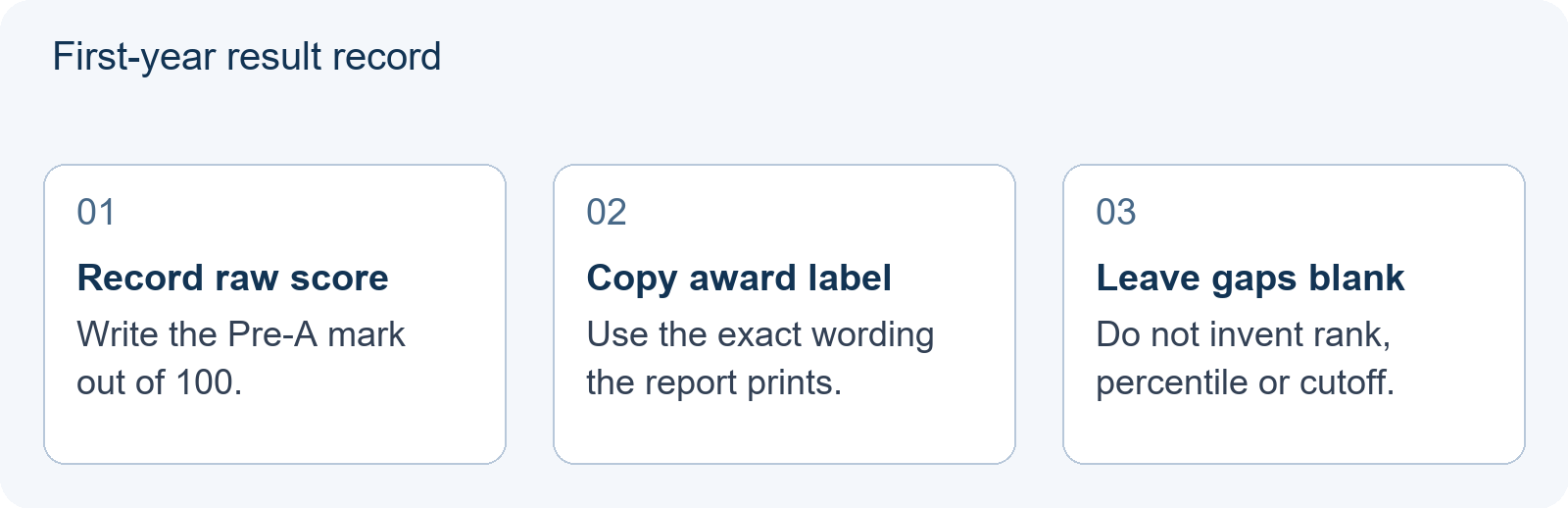
A worked first-year record for a family file
Because 2026 is the first Pre-A year, a simple record is more useful than a guessed cutoff. The table below is a suggested record-keeping format, not an official form. Fill only what the publisher actually reports.
| Field | Example entry | Rule |
|---|---|---|
| Level and sitting | Pre-A, 11 October 2026 | Keep the level separate from A–E |
| Raw score | 60/100 | Use the published mark, not an estimate |
| Award label | Credit | Copy the exact wording |
| Reported rank or percentile | Blank if not supplied | Do not infer one |
| Cutoff comparison | Blank for Pre-A | No prior Pre-A cutoff exists |
In the hypothetical 60-mark example above, the family can record “Raw 60/100” and, if the report says so, “Credit.” It should not write “Credit = 60” or “32-point line plus 28.” If the report supplies a percentile or rank, record that exact figure with its label; if it does not, leave the cell blank. A blank is more accurate than a fabricated conversion. This is why a first-year Pre-A result needs a different reading protocol from a level that has years of published cutoffs.
What cannot be known yet
Several things cannot be known from the supplied notice. There is no historical Pre-A trend, because 2026 is the first Pre-A cohort in this China-region description. There is no valid comparison between a Pre-A raw score and A–E cutoff tables, because the papers, mark totals and populations differ. There is no basis for turning a practice-paper percentage into a Pre-A award prediction, because practice conditions and the live cohort are not the same. And there is no published 2026 Pre-A pass mark in the notice.
The timing point also needs a qualifier. The notice says results and rankings are expected within 6–8 weeks after the examination. That is an expectation, not a guaranteed release date. As of 9 November 2026, families should still treat the result as pending unless the responsible publisher has actually released it. For the China-region window and who to ask, see Australian AMC 2026 China Results: The 6–8 Week Window, Score Report and Who to Ask. Do not convert “expected within 6–8 weeks” into “out on a specific day.”
While waiting: a memory-based question-band audit
A family can use the waiting period for a self-review, clearly labelled as memory-based and not an official rescoring. The point is to notice where marks were lost, not to reconstruct an award. Use the Pre-A mark values to keep the audit honest.
| Band | Maximum marks | What to note |
|---|---|---|
| Q1–Q10 | 30 | Handling, reading, careless slips |
| Q11–Q20 | 40 | Method choice and multi-step accuracy |
| Q21–Q22 | 10 | First back-pair reasoning |
| Q23–Q24 | 12 | Longer reasoning or unfamiliar setup |
| Q25 | 8 | Final-question strategy and time |
Teaching illustration: suppose a child remembers leaving four questions in Q11–Q20 blank and not solving Q23, but believes everything else was correct. If that memory is accurate, the maximum possible raw score is 100 − (4×4) − 6 = 78. That is an upper bound from a memory audit, not a confirmed score. It can still help a parent see whether the loss cluster is in the 40-mark middle band or in the back five. The purpose is to choose a review focus, not to announce a band.
Turning the result into a support decision
Once the published result is in hand, separate three questions. First, did the child lose marks in the front band through handling, reading or rushed checking? Second, did the middle band show a method gap that repeats across several questions? Third, did the back five show a time-allocation problem rather than an unknown topic? A practical teaching judgment is that front-band losses should be checked for handling before a content gap is assumed, while repeated middle-band losses can call for targeted instruction. Neither judgment is an award prediction.
If the pattern is handling or reading, a short diagnostic and a checking routine may be enough. If the pattern is conceptual, targeted support is more sensible than comparing a Pre-A raw score to A–E cutoff tables. If requesting a diagnostic, bring the published raw score, the exact award label, and two or three question-band notes. Do not ask a provider to convert the result into a guaranteed band; no responsible reading can do that from a first-year label alone.
General event background is available at Event background.
Frequently Asked Questions
Is 32 the Pre-A cutoff for 2026?
No. The supplied notice says the 2025 Mathematics Skills Award line was 32 for all grades, and that the new 2026 Pre-A level has no corresponding prior-year cutoff line. The 32-point figure is a prior score-based line, not a 2026 Pre-A cutoff.
Does my child’s raw Pre-A score determine the award label?
No. The notice describes Prize, High Distinction, Distinction and Credit as top-percentage labels, while the Mathematics Skills Award is score-based and listed separately. A raw score out of 100 and an award label are different pieces of information, so do not convert one directly into the other.
When are China-region Pre-A results expected?
The Hanlin Courses article dated 11 October 2026 says China-region results and rankings are expected within 6–8 weeks after the examination. As of 9 November 2026, results remain pending under that expectation. It is an expected window, not a guaranteed release date.