
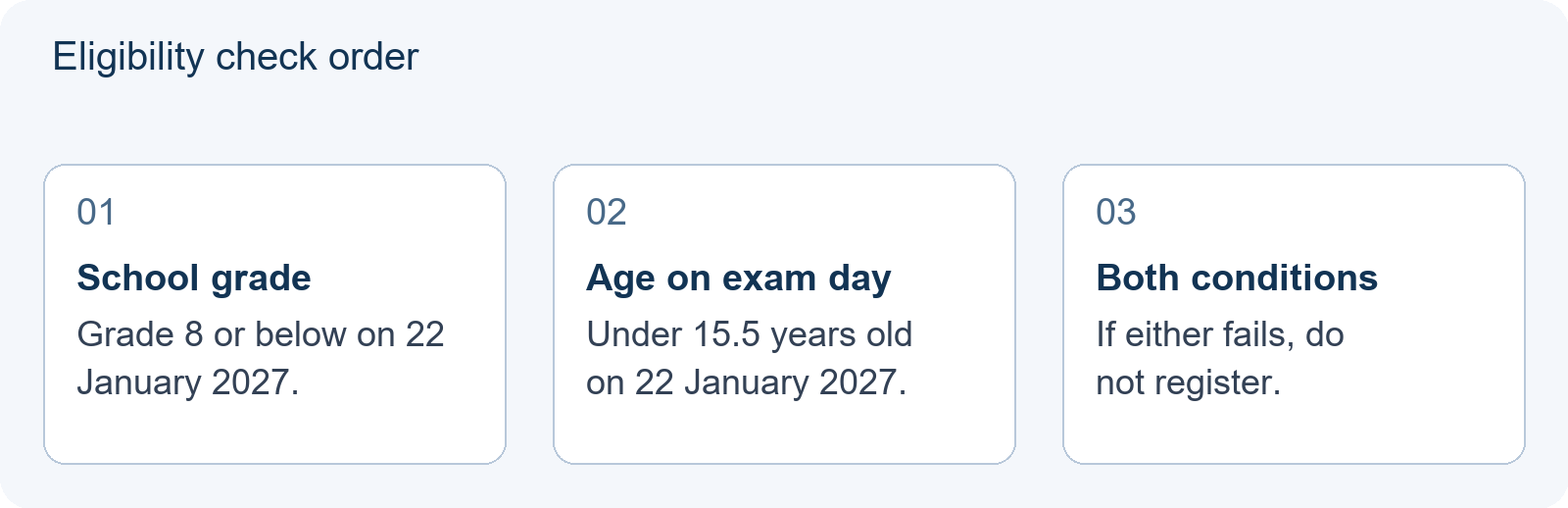
Your child’s Australian AMC level does not decide AMC8 eligibility. For the China-region 2027 AMC8, Hanlin Course’s 11 October 2026 report gives the exam as 22 January 2027, 17:00–17:40, and lists two eligibility conditions: the child must be in Grade 8 or below on the exam day, and must be under 15.5 years old on that day. Hanlin Course’s 2 October 2026 comparison article reports the China-region registration deadline as 12 January 2027. If either eligibility condition fails, do not register on the strength of a strong Australian AMC result. If both pass, eligibility is settled; readiness is a separate question.
This is a Hanlin preparation perspective based on the cited operator reports, not an official eligibility ruling. Confirm current details with the registration channel before paying or making travel plans.
Eligibility check: two conditions, not three
Families often treat the Australian AMC level letter as if it were an AMC8 entry ticket. The 11 October 2026 Hanlin Course note does not list the Australian AMC level, award band or raw score as an AMC8 condition. It lists school grade and age only. That makes the eligibility check shorter, but less forgiving: a high Australian AMC award cannot cure a grade or age failure.
| Check | What to use | Reported threshold | What it means |
|---|---|---|---|
| School grade | Grade on 22 January 2027 | Grade 8 or below | A Grade 9 child fails this condition even if the Australian AMC level was high. |
| Age | Age on 22 January 2027 | Under 15.5 years old | A Grade 8 child who is already 15 years 7 months on exam day fails the age condition. |
| Australian AMC level | Level sat in October 2026 | Not an AMC8 eligibility criterion in the note | A Level A–E letter neither creates nor removes eligibility. |
Those two examples show why the check must be done on the exam date, not on the date of the Australian AMC sitting. A child may be eligible in October and ineligible on 22 January 2027 if they cross the age cutoff or grade boundary. Record the grade and age position against 22 January 2027, then stop using the Australian AMC level as a proxy.
The China-region 2027 schedule and what it does not tell you
The 11 October 2026 Hanlin Course article, “2026 Australian AMC Opens Today! How Many Marks Can You Score This Year? Past Papers + Answers + Analysis Preview,” reports the China-region AMC8 exam time, eligibility rule and paper format. Hanlin Course’s 2 October 2026 comparison article, “How to choose among eight maths competitions for Grades 3–8? Timelines and difficulty,” reports the China-region registration deadline as 12 January 2027 and also lists the 22 January exam time.
| Item | China-region detail reported by Hanlin Course |
|---|---|
| Registration deadline | 12 January 2027, reported in the 2 October 2026 comparison article |
| Exam date and time | 22 January 2027, 17:00–17:40, reported in the 11 October 2026 note and the 2 October 2026 comparison article |
| Eligibility | Grade 8 or below and under 15.5 years old on exam day |
| Format | 25 multiple-choice questions in 40 minutes; 25 points; no penalty for wrong answers |
This is a China-region schedule. Do not transfer it to another country or assume that a different registration channel has the same deadline. The notes also do not establish fees, seat availability, late-registration rules or test-centre arrangements. Those are operational questions for the registration channel, not conclusions to draw from a past Australian AMC sitting.
Why the Australian AMC award band is not the registration gate
The 2026 Australian AMC was held on 11 October 2026. The same Hanlin Course note says results and rankings are expected within six to eight weeks after the exam. That window falls before the reported 12 January 2027 deadline, but it does not control eligibility. A family can check grade and age now, before any Australian AMC award is known.
Waiting for an award band can consume preparation time without changing either eligibility condition. A Distinction or High Distinction does not make a Grade 9 child eligible; a Credit does not make an eligible Grade 7 child ineligible. The award may inform readiness, but only as one piece of evidence. It is not a registration gate.
The two competitions also share three letters but not rules. The Australian AMC is an AMT competition with its own levels and scoring; AMC8 is a separate MAA competition with its own eligibility and format. For the contest distinction, see Australian AMC vs US AMC: Same Three Letters, Two Different Competitions (2026). For award-band interpretation on the Australian side, keep the Australian AMC result separate from AMC8 registration.
The format gap: 25–30 questions and 100–135 marks versus 25 in 40 minutes
The format difference is not just a smaller paper. It changes the time budget and the cost of a slow start. The Australian AMC timings below come from Hanlin Course’s 2 October 2026 comparison article. The mark totals and no-penalty rule come from the 11 October 2026 note.
| Paper | Questions | Time | Marks or points | Average time per question | Wrong-answer penalty |
|---|---|---|---|---|---|
| Australian AMC Pre-A | 25 | 50 minutes | 100 marks | 2.0 minutes | None reported |
| Australian AMC Levels A–B | 30 | 60 minutes | 135 marks | 2.0 minutes | None reported |
| Australian AMC Levels C–E | 30 | 75 minutes | 135 marks | 2.5 minutes | None reported |
| China-region AMC8 2027 | 25 | 40 minutes | 25 points | 1.6 minutes | None reported |
The averages are arithmetic, not difficulty judgments. A 135-mark paper and a 25-point paper are on different scales, so do not convert one score into the other. What transfers is the pacing habit: AMC8 gives an average of 1.6 minutes per question across the whole paper, while Australian AMC A–B gives 2.0 minutes and C–E gives 2.5 minutes. A child who relies on extra reading time at the Australian AMC may feel a genuine squeeze in AMC8.
A 40-minute readiness diagnostic: teaching illustration, not official guidance
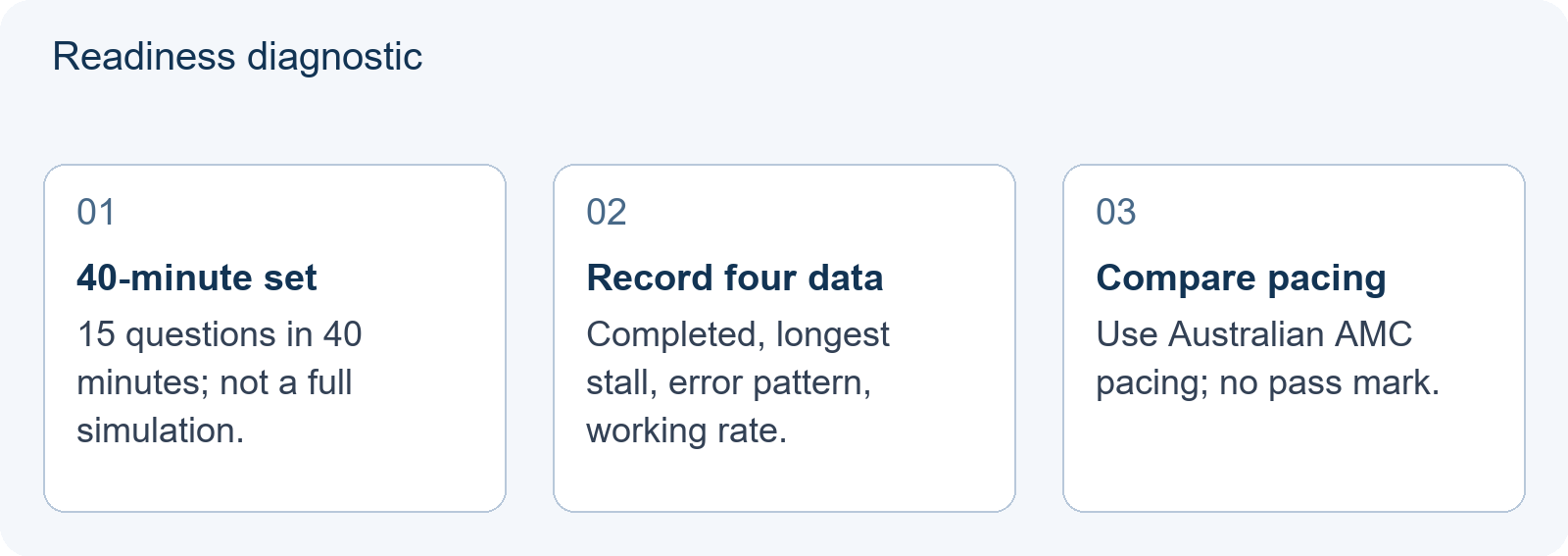
Once eligibility passes, run a short readiness diagnostic rather than asking whether the child “did well” on the Australian AMC. A suggested diagnostic is a 15-question set under a 40-minute timer. It is not a full AMC8 simulation. At the AMC8 paper pace of 25 questions in 40 minutes, a 15-question slice would take 24 minutes. The extra 16 minutes in this diagnostic are deliberate: they let you observe reading time, stalled questions and error types, not just speed.
Record four things: how many questions were completed, the longest stall on one question, the error pattern, and the working rate. The two hypothetical cases below are teaching illustrations, not real students and not official scoring guidance.
| Diagnostic record | Hypothetical child A | Hypothetical child B |
|---|---|---|
| Completed | 11 of 15 | 15 of 15 |
| Longest stall | 9 minutes on one question | Under 2 minutes on any question |
| Error pattern | 3 arithmetic slips, 1 misread | 2 misreads |
| Working rate | 40 ÷ 11 ≈ 3.6 minutes per completed question | 31 minutes to finish, then 9 minutes checking; 31 ÷ 15 ≈ 2.1 minutes per working question |
| Readiness signal | Completion and arithmetic need repair | Pace is closer, but reading accuracy and timing still need work |
Child A’s 3.6 minutes per completed question is not a pass mark, but it flags a completion problem: four questions were not completed, and one question absorbed nine minutes. Child B finished the set in 31 minutes and checked for nine, which is a different profile. At 2.1 minutes per working question, B is closer to the AMC8 paper average of 1.6 minutes, but still above it. B’s diagnostic does not prove readiness either; it shows that the next work is reading accuracy and timed decision-making.
The decision rule is therefore not “score above X.” A child with A’s profile should not register only because the Australian AMC award looks strong. A child with B’s profile can consider registration if eligible and if recent Australian AMC pacing supports the picture, but should still plan timed practice. For the skill-bridge view, see Australian AMC to AMC8 transition: From Australian AMC October to AMC8 January: A Three-Month Skill Bridge.
Registration decision timeline before 12 January 2027
| When | Decision action | Evidence to keep |
|---|---|---|
| Early November 2026 | Check grade and age against 22 January 2027 | Grade on exam day; age relative to the 15.5 cutoff |
| November–December 2026 | Run the 40-minute diagnostic and review error types | Completed count, longest stall, error pattern, working rate |
| Before 12 January 2027 | Register only if both eligibility conditions pass and readiness work is planned | Confirmed deadline from the registration channel |
| 22 January 2027 | Sit the reported China-region exam, 17:00–17:40 | Arrival and identity requirements from the operator |
Do not wait for the Australian AMC award band if eligibility and readiness can be checked independently. The award may arrive within the reported six-to-eight-week window, but the AMC8 deadline is reported as 12 January 2027 by the 2 October 2026 Hanlin Course comparison article. Equally, do not assume that registration will remain open, that a seat will be available, or that a particular preparation service exists. Confirm those points with the registration channel.
If the diagnostic says “not yet”
A forced January sitting can produce a score that tells the family little, especially if the child left several questions unreached or lost marks to arithmetic slips. The better decision may be to delay the attempt and use the time to repair pacing, reading and calculation habits. The three-month skill bridge linked above is one planning frame; it is not a guarantee of a later score.
If the issue is not AMC8-specific but a broader gap between school maths and competition handling, see Australian AMC Tutoring: Which Gaps Need Support Beyond School Maths?. The practical distinction is whether the child needs content repair, reading accuracy, or timed decision-making. A single Australian AMC award band does not answer that question.
Preparing a course-fit or resource request
A useful consultation request is short and evidence-based. Bring the child’s school grade on 22 January 2027, the age position relative to the 15.5 cutoff, the Australian AMC level and sitting date, and the diagnostic record. You do not need to disclose a full score or a real name; use initials and dates.
- Ask whether both eligibility conditions are met under the reported China-region 2027 arrangements.
- Ask whether the diagnostic pattern points to pacing, reading, arithmetic or content work.
- If a resource pack is offered, ask for its exact contents and which years’ solutions are included; do not assume a pack or diagnostic is part of a course.
- Ask how the provider will measure progress before 22 January 2027, without treating a practice score as an official result.
The decision should rest on two yes-or-no eligibility conditions and a separate readiness record. The Australian AMC level letter is useful context, but it is not the AMC8 entry ticket. Start with the grade and age check, then decide whether the January sitting is a sensible next step rather than a forced one.
General event background is available at Event background.
Frequently Asked Questions
Does my child’s Australian AMC level decide AMC8 2027 eligibility?
No. The China-region 2027 AMC8 eligibility reported by Hanlin Course on 11 October 2026 is Grade 8 or below and under 15.5 years old on the exam day. The Australian AMC level letter is not listed as an eligibility condition, so check the child’s grade and age against 22 January 2027 instead.
Should we wait for the Australian AMC award before registering for AMC8?
You can check eligibility without waiting for the award. Australian AMC results are reported as expected within six to eight weeks after the 11 October 2026 exam, while Hanlin Course’s 2 October 2026 comparison article reports the China-region AMC8 deadline as 12 January 2027. An award may inform readiness, but it does not create or remove AMC8 eligibility.
What should a 40-minute AMC8 readiness diagnostic measure?
Use a 15-question set and record completed questions, longest stall, error pattern and working rate. It is a teaching illustration, not official guidance or a pass mark. Compare the pattern with the child’s Australian AMC pacing, and remember that AMC8 allows an average of 1.6 minutes per question across 25 questions in 40 minutes.