
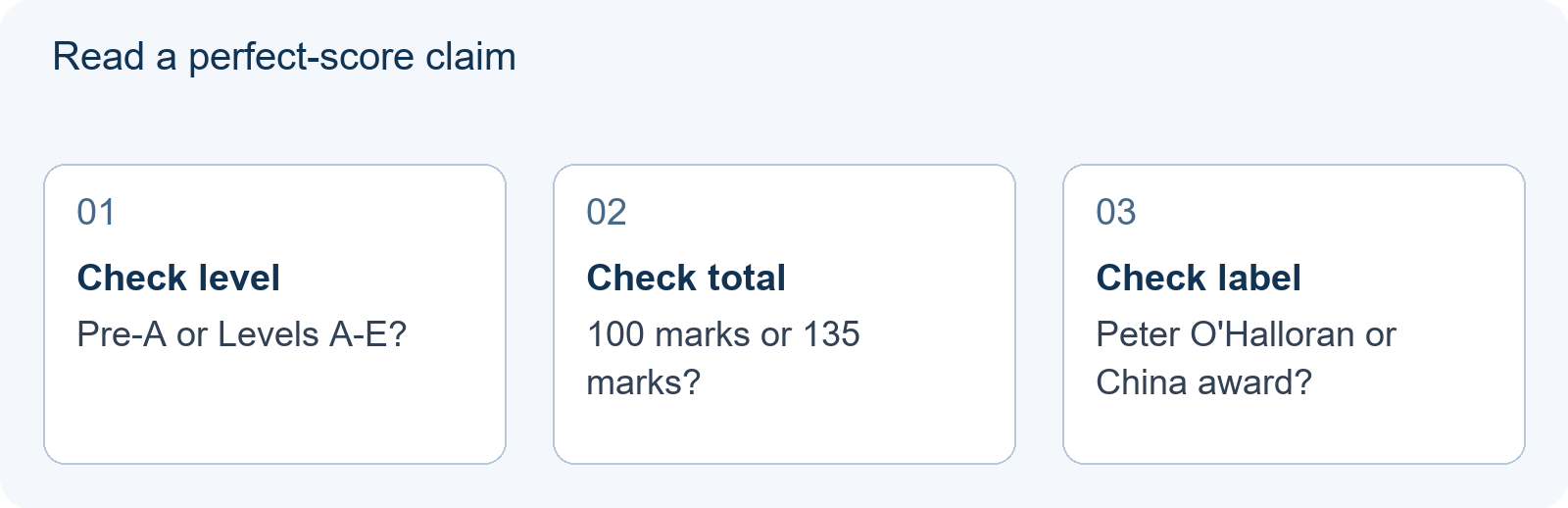
In Hanlin’s 2026 Australian AMC guide, the Peter O’Halloran Award is listed as a global recognition for a full-mark paper — not as another name for a China-region Prize. A full-mark claim must match the paper: Pre-A is scored out of 100, while Levels A–E are scored out of 135. Check the level, total and exact label on the results report.
Two recognition systems, not one ladder
Hanlin Courses’ 2026 Australian AMC Mathematics Competition Complete Guide (Grades 1–12), published 16 June 2026, places the Peter O’Halloran Award on a global-award line: it is listed for a full-mark score. The same guide lists China-region awards separately: Prize, High Distinction, Distinction, Credit and Proficiency. That separation matters because the labels answer different questions. One asks whether the paper was perfect; the other describes a position or threshold inside the China-region award structure.
| Label as listed by Hanlin | What it recognises | Basis stated | What to verify |
|---|---|---|---|
| Peter O’Halloran Award | A full-mark paper | Global award line, listed for full marks | Exact wording on the report; level and paper total |
| China-region Prize | Top 0.3% in the China-region listing | Ranking band | That the report says Prize, not a global full-mark award |
| High Distinction | Pre-A–D top 3%; Level E top 5% | Ranking band | Level and grade grouping used in the report |
| Distinction | Pre-A–D top 20%; Level E top 25% | Ranking band | Level and grade grouping used in the report |
| Credit | Pre-A–D top 55%; Level E top 60% | Ranking band | Level and grade grouping used in the report |
| Proficiency | Meets or exceeds a stated score line and receives no higher award | Score threshold, varying by year | The line for the relevant year; do not treat an old line as a forecast |
The table is deliberately not a conversion chart. A full-mark label is a score condition; a China-region Prize label is a ranking description. Hanlin’s guide lists them on separate lines, and it also notes that China-region awards are handled within each difficulty level, with grades judged separately rather than mixed. Do not infer that a China-region Prize label proves Peter O’Halloran, and do not assume that a full-mark line also proves a China-region Prize; the score report is the evidence. The broader point is developed in Australian AMC Results: Why a Raw Score Does Not Set Your Award Band.
The two totals behind a perfect-score claim
Hanlin Courses’ 11 October 2026 article, “2026 Australian AMC Starts Today: How Many Marks Can You Get This Year? Past Papers + Answers + Explanations Reservation Channel Open!”, published on the day of the China sitting, gives the scoring structure that families should use when reading a full-mark claim. Pre-A is listed as 25 questions and 100 marks: questions 1–10 are worth 3 marks each (30), 11–20 are worth 4 each (40), 21–22 are worth 5 each (10), 23–24 are worth 6 each (12), and question 25 is worth 8. The arithmetic is 30 + 40 + 10 + 12 + 8 = 100.
Levels A–E are listed as 30 questions and 135 marks: questions 1–10 are worth 3 each (30), 11–20 are worth 4 each (40), 21–25 are worth 5 each (25), and questions 26–30 are worth 6, 7, 8, 9 and 10 respectively (40). The arithmetic is 30 + 40 + 25 + 40 = 135. The same article states that wrong or blank answers do not incur a penalty. No penalty is not a bonus: a blank item still earns zero for that item, so a perfect score still requires every mark to be earned. The Pre-A arithmetic uses the same logic with a smaller maximum: the maximum is 100, not 135.
For background on the standard Australian paper, AMT’s current AMC page describes a standard 30-question, 135-mark format and notes that the separate Early Primary offering has a different format. That reference is useful for understanding the standard paper, but it is not a China-region results page and does not replace the level-specific report a family receives.
A teaching illustration: one back-five question removes the full-mark claim
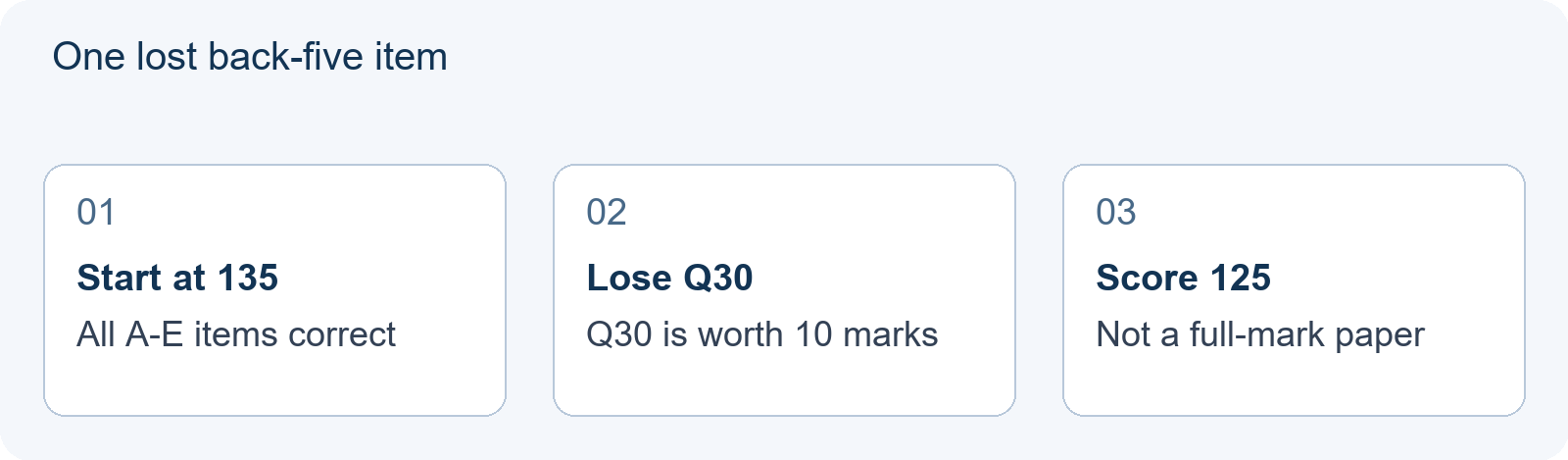
Teaching illustration (invented, not an official Australian AMC question): suppose an A–E candidate answers all 30 questions, and every answer except question 30 is correct. Question 30 is worth 10 marks. The candidate’s score is 135 − 10 = 125 out of 135. That is a high raw score, but it is not a full-mark paper and therefore does not fit the full-mark description in Hanlin’s guide. Losing question 29, worth 9 marks, would give 126; losing question 26, worth 6 marks, would give 129. The exact lost item matters for the score, but any lost item removes the perfect total.
The Pre-A example uses a different denominator. If a Pre-A candidate answers all 25 questions and loses only question 25, worth 8 marks, the score is 100 − 8 = 92 out of 100. A family should not call that 92/100 a perfect paper, and should not compare it directly with 125/135 from Levels A–E. The two papers have different lengths, different maximum scores and different mark distributions. This is arithmetic, not a cutoff prediction. The next diagnostic step is to read the question-band pattern, as explained in Australian AMC Grading System: A Post-Sitting Score Audit by Question Band.
Why a strong China-region award is a different question
A China-region award band answers a ranking question: where a result sits in the relevant China-region listing, as described by the award rules for that season. A full-mark recognition answers a score question: did the candidate earn every available mark on that paper? A 125/135 does not by itself establish any China-region band; the report wording and the cohort determine that. A 135/135 may also appear alongside a China-region band, but the two labels are not substitutes. Without the report wording, a family should not convert one into the other.
Season and source also matter. That 11 October 2026 article says China-region results and ranking are expected 6–8 weeks after the sitting. At the time of writing on 16 November 2026, that window has not closed. Families may still be waiting, and should check the school or registration channel rather than relying on a search snippet. The same article records a 2025 Proficiency line of 32 for each grade; that is a past line, not a 2026 forecast. Results timing and the score-report route are covered in Australian AMC 2026 China Results: The 6–8 Week Window, Score Report and Who to Ask.
A results report can carry more than one useful fact. A candidate might have a high raw score and a China-region award, or a full-mark paper and a China-region label. The safe reading is to record each printed term as its own statement rather than turning one term into a synonym for another. If a family writes a short profile note, the note should use the printed label, the level, and the raw score with its total. That keeps the claim checkable without asking a reader to infer what a label meant.
Reading a result line: four checks
First, check the level. A claim of 100/100 belongs to Pre-A, while 135/135 belongs to Levels A–E. If a report shows a percentage or a raw score without the denominator, do not guess; ask for the total. Second, check the exact label. Peter O’Halloran, Prize, High Distinction, Distinction, Credit and Proficiency are different printed terms. If the report says only Prize, do not upgrade it to Peter O’Halloran in conversation or on a profile.
Third, check the season and the paper. A 2026 China-region report should be read against the 2026 sitting and the level actually taken, not against a 2027 standard-paper reference or an older sibling’s report. Fourth, keep the original report. A screenshot of a results page may omit the level, the total or the award line. The original wording is what a school, registration channel or later reviewer can actually check.
A short comparison note can help a family avoid accidental mixing. Write four fields: level taken; score and total possible; exact award wording; and one or two question bands where marks were lost. If any field is missing, leave it blank rather than filling it from memory. That note is more useful for a later review than a paragraph that blends a raw score, a ranking band and a global award into one sentence.
What a perfect score does not prove
A perfect score shows that the candidate earned every available mark on one paper in one sitting. It does not set the cutoff for another year, guarantee a repeat, or prove that every question was easy. It does not convert a China-region Prize into a separate global award unless the report says so. It also does not establish an admission outcome, a scholarship or a future ranking. Those are different claims with different evidence.
Equally, a non-perfect score does not erase a strong China-region result. A family can say both things accurately: the candidate did not achieve a full-mark paper, and the candidate may have earned a China-region award band. The report should be allowed to carry both facts without one label being stretched to cover the other.
Preparing a useful post-sitting review
Before asking any provider for a post-sitting review, prepare four lines of information: the level taken, the raw score and total possible, the exact award wording printed on the report, and the one or two question bands where the largest mark loss occurred. If the report does not mention Peter O’Halloran, do not ask a provider to confirm it; ask the school or registration channel about the report first. A course-fit conversation can then focus on the next paper rather than on relabelling the last one.
This is also the point to separate a score review from a resource request. A score review asks what the reported result means. A resource request asks for practice material or a diagnostic for a future sitting. Neither request needs an award promise. If a family later uses the site’s contact page, a useful message is short and factual: level, score, total, printed label and the question bands that need work. That gives a teacher something concrete to respond to without guessing at an outcome.
Frequently Asked Questions
Is the Peter O’Halloran Award the same as a China-region Prize?
No. In Hanlin’s 2026 guide, Peter O’Halloran is listed as a global full-mark recognition, while Prize is a China-region ranking band listed at top 0.3%. Check the exact wording on your score report; do not convert one label into the other.
Does a full-mark Australian AMC score mean 100 or 135?
It depends on the level. In Hanlin’s 2026 China-region structure, Pre-A is listed as 25 questions and 100 marks; Levels A-E are listed as 30 questions and 135 marks. A 100/100 claim belongs to Pre-A, while a 135/135 claim belongs to Levels A-E.
If my child misses the 10-mark final question, can they still get Peter O’Halloran?
According to the full-mark definition in Hanlin’s 2026 guide, no: if every other item is correct, losing the 10-mark final question gives 125/135, not a full-mark paper. A China-region award is a separate ranking question, so check the report wording.