
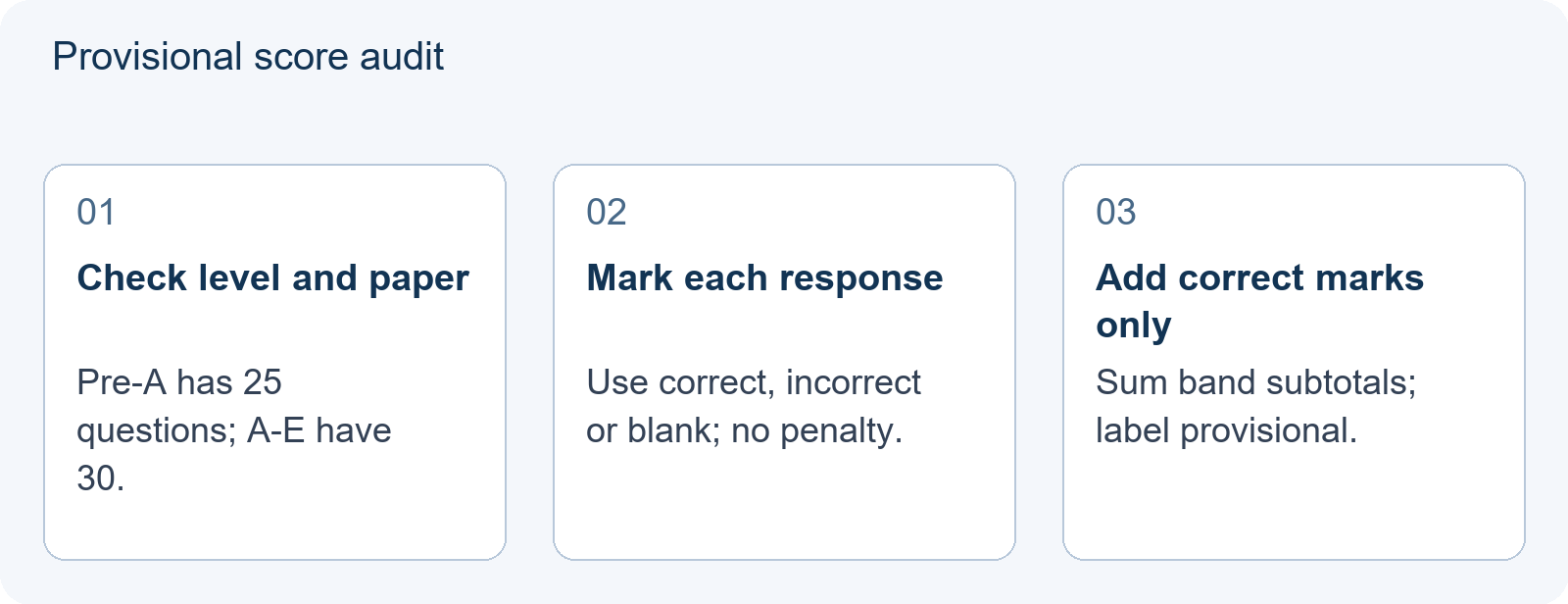
If your family kept a response record from the 11 October 2026 Australian Mathematics Competition sitting, you can reconstruct a provisional raw score without waiting for the official report: confirm the level, mark each question correct, incorrect or blank, then add only the marks attached to correct questions. For Pre-A, the paper is 25 questions and 100 marks; for Levels A-E, it is 30 questions and 135 marks. Wrong and blank answers do not deduct marks. Label the result provisional and do not turn it into an award-band prediction. The China-region result window reported in Hanlin’s 11 October 2026 course article was 6-8 weeks after the sitting, so a family audit is a repair tool, not an official score.
What a post-sitting audit can and cannot establish
A post-sitting audit answers a narrow question: given this response record, what is the sum of marks attached to the questions I believe I answered correctly? That is useful because it turns a vague feeling after the paper into a band-by-band profile. It can show whether most lost marks sit in the first ten questions, the middle ten, or the final high-value questions. It can also expose a recording error: a question left blank on the answer sheet but worked on the script, or a question marked in the wrong row.
It cannot establish an official score, a rank, a percentile or an award. Those come from the official report. The mark bands used here come from Hanlin Courses’ 11 October 2026 article, ‘2026 Australian AMC Starts Today! How Many Points This Year? Past Papers + Answers + Analysis Preview…’ (English translation of the source title), reporting the China-region arrangements for Pre-A and Levels A-E. This is a teaching and reporting source, not an official score notice. For the separate question of when China-region results are expected and what the report contains, see Australian AMC 2026 China Results: The 6–8 Week Window, Score Report and Who to Ask.
If you do not have a trustworthy answer record, do not invent one. You can still count attempted and blank questions on your own response sheet, but a provisional total needs a reliable correct/incorrect judgement for each question.
The mark bands to use
The two tables below are the only arithmetic needed for the reconstruction. Use the table that matches the paper actually sat. Do not mix Pre-A and A-E bands: they have different question counts and different totals.
| Pre-A band | Questions | Marks per question | Band subtotal |
|---|---|---|---|
| Early | 1-10 | 3 | 30 |
| Middle | 11-20 | 4 | 40 |
| Late pair | 21-22 | 5 | 10 |
| Late pair | 23-24 | 6 | 12 |
| Final | 25 | 8 | 8 |
| Total | 25 | 100 |
| Levels A-E band | Questions | Marks per question | Band subtotal |
|---|---|---|---|
| Early | 1-10 | 3 | 30 |
| Middle | 11-20 | 4 | 40 |
| Late | 21-25 | 5 | 25 |
| Back five | 26, 27, 28, 29, 30 | 6, 7, 8, 9, 10 | 40 |
| Total | 30 | 135 |
The no-penalty rule matters for the audit. A wrong answer and a blank answer both contribute zero; neither subtracts from the total. So the reconstruction is an addition problem, not a balancing problem. Correct answers earn the full mark for their question; everything else earns nothing.
Reconstruct the score line by line
Make a four-column worksheet: question number, your recorded answer, status, and marks earned. Use only three statuses: correct, incorrect, blank. If you are unsure whether a written answer was transcribed correctly, mark that question for re-checking rather than guessing in the total. Then add the marks earned in each band and sum the band subtotals. The result is your provisional raw score.
Before doing any arithmetic, check the level code on the paper and the question numbering. A Pre-A script has 25 questions; an A-E script has 30. If your worksheet has 30 rows but the paper was Pre-A, the total will be wrong even if every individual mark is right. Also check that the final five A-E questions have not been copied into a Pre-A table. The same correct/incorrect discipline applies, but the marks are different.
Once the total is written down, separate the lost marks by band. Lost marks are the marks attached to questions not marked correct. For a 135-mark paper, lost marks equal 135 minus the provisional total. For a 100-mark Pre-A paper, lost marks equal 100 minus the provisional total. This gives a rough profile, not a diagnosis. The diagnosis comes in the triage section below.
Teaching illustration 1: a Level C-style script
This is a teaching illustration, not an official contest problem and not a real student script. Suppose a Level C-style response record shows 9 correct in Questions 1-10, 7 correct in Questions 11-20, 3 correct in Questions 21-25, and correct answers to Questions 26 and 28 only among the back five. Nothing else is correct.
- Questions 1-10: 9 x 3 = 27 out of 30.
- Questions 11-20: 7 x 4 = 28 out of 40.
- Questions 21-25: 3 x 5 = 15 out of 25.
- Back five: Question 26 gives 6 and Question 28 gives 8, so 14 out of 40.
The provisional total is 27 + 28 + 15 + 14 = 84 out of 135. The lost-mark profile is 3 in the early band, 12 in the middle band, 10 in Questions 21-25, and 26 in the back five. That profile does not say why marks were lost. It does show that the largest raw loss sits in the back five, while the middle band also has a meaningful loss. A repair plan should not treat those as the same problem.
The arithmetic is deliberately simple: each band subtotal is the number correct multiplied by the band’s per-question mark, except the back five, where each question has its own value. This is exactly why a line-by-line worksheet is safer than trying to estimate a total from a percentage.
Teaching illustration 2: a Pre-A-style script
This is a second teaching illustration, not an official problem or a real child’s paper. Suppose a Pre-A-style response record shows 8 correct in Questions 1-10, 6 correct in Questions 11-20, and correct answers to Questions 21 and 23 only in the final section.
- Questions 1-10: 8 x 3 = 24 out of 30.
- Questions 11-20: 6 x 4 = 24 out of 40.
- Question 21: 5 marks.
- Question 23: 6 marks.
The provisional total is 24 + 24 + 5 + 6 = 59 out of 100. The lost-mark profile is 6 in the first ten, 16 in the middle ten, and 19 across Questions 21-25. Again, the profile is descriptive. It tells the family where the arithmetic loss is concentrated, not whether the child ‘should’ have received an award.
Notice how easily a Pre-A total can be misread if the A-E table is used. Questions 21 and 23 are worth 5 and 6 marks on Pre-A, but Questions 21-25 are each worth 5 marks on A-E, and Questions 26-30 carry the larger values. The level check is therefore part of the calculation, not an administrative afterthought.
Turn lost marks into three repair buckets
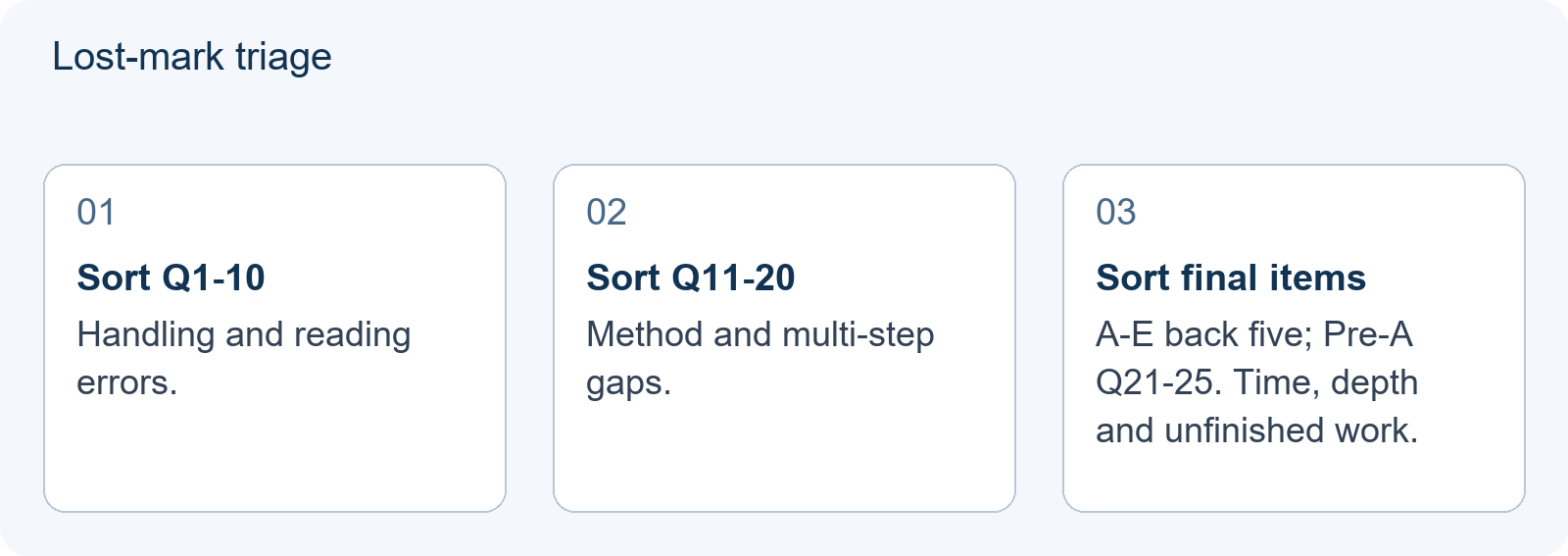
A useful 45-minute error triage uses three buckets rather than a single ‘careless’ label.
- Handling and reading: mainly early-band losses, such as a misread condition, a unit slip, a transcription error, or an answer put in the wrong place. These are not necessarily easy questions; they are questions where the mathematics was probably available but the response record lost contact with the condition.
- Method and multi-step gaps: mainly middle-band losses, where a familiar topic appears in an unfamiliar combination. The repair is a short method set, not a full redo of the paper.
- Time and depth: mainly final-section losses, where a question was unfinished, rushed, or abandoned. The repair is a timed set with a stopping rule, not an immediate push into harder papers.
For the Level C-style illustration, the back-five loss of 26 marks would trigger a time-and-depth review; the middle loss of 12 would trigger a method review. For the Pre-A-style illustration, the middle loss of 16 would trigger a method review, while the final-section loss of 19 would trigger a short ‘read, choose, stop’ routine. The point is to choose one repair set, not to redo the whole paper. For reasoning checks before watching a solution, see Australian AMC Answer Review: Check Your Reasoning Before Watching a Worked Solution. A separate repair note can turn one unfinished solution into a short practice set, but the audit itself should stop at choosing the set.
Why the provisional total cannot set an award band
A provisional raw score is a home reconstruction from a response record. An award outcome is an official result that depends on the official marking, the official population and the award rules for the relevant level and region. The two are not the same object. A total of 84 out of 135 can locate lost marks; it cannot tell you that the script is above or below an award line, because the line is not set by the home sum.
This is especially important when a family remembers a prior-year number. A prior-year line is not a 2026 standard, and award bands are not a single fixed score across levels. The reported 2025 China-region Mathematics Skills Award line of 32 for the year groups then offered does not become a 2026 Pre-A line; the source also states Pre-A has no corresponding prior-year line because the level is new in the China-region structure reported by Hanlin. Keep the audit in the ‘provisional score’ column and keep the award question in the ‘official report’ column. For the award-band warning in more detail, see Australian AMC Results: Why a Raw Score Does Not Set Your Award Band.
The same caution applies to probabilities. A provisional total does not give an individual success probability, and a family should not convert a band profile into a predicted medal.
When the official report arrives, and how to prepare a targeted request
When the official report arrives, compare the band profile before comparing the total. If the official total differs from the home reconstruction, re-check question numbering, the level code, any blank-answer assumptions and any questions you marked as uncertain. A difference is not automatically an official error; it is more often a recording difference, a transcription issue, or a question where the home judgement was wrong. Use the official report as the reference and keep the home worksheet as a repair record.
If you ask a teacher or programme for help, bring the band profile rather than only the total: for example, ‘9/10 early, 7/10 middle, 3/5 late, Questions 26 and 28 correct’ is more useful than ’84 out of 135′. A targeted request can ask for one method set for the middle band and one timed set for the back five. It should not ask for a guaranteed score change or an award prediction. A useful preparation note for a consultation lists the level, the paper date, the bands with the largest losses, and one example question type from each weak band. That is enough to discuss course fit without turning the audit into a sales conversation.
General event background is available at Event background.
Frequently Asked Questions
Can I calculate a provisional Australian AMC raw score from my own answers?
You can calculate a provisional raw score if you have a reliable response record and the correct mark bands for your level. For Pre-A, add 3 marks for each correct Question 1-10, 4 for 11-20, 5 for 21-22, 6 for 23-24 and 8 for Question 25. For Levels A-E, add 3 for 1-10, 4 for 11-20, 5 for 21-25, and 6, 7, 8, 9, 10 for Questions 26-30. Wrong and blank answers add zero. The result is provisional, not an official score.
Does a provisional total of 84 out of 135 mean an award?
No. A provisional total locates lost marks by band, but it does not set an award band. Award outcomes depend on the official report, the official marking and the applicable rules for the level and region. Do not convert a home reconstruction into an award prediction.
What should I do if the official total differs from my audit?
First re-check the level code, question numbering, blank-answer assumptions and any questions you marked uncertain. Then compare the official band profile with your worksheet. Use the official report as the reference and keep the worksheet as a repair record, not as evidence of an official error.