
The short, honest answer: the Australian Mathematics Competition (AMC) has no published chapter-by-chapter syllabus. Instead of a fixed topic list, each level's 30-question paper (25 multiple-choice + 5 integer, 135 marks, no penalty for a wrong answer) draws on a few broad domains — number and arithmetic, geometry and measurement, counting and combinatorics, and logic and patterns — and is curriculum-agnostic and reasoning-led. Nothing assumes a particular school course. For the exact scope of any given year's paper, confirm on the official site.
Why "syllabus" is the wrong word for the AMC
Many families search for the "AMC syllabus" expecting a list like algebra, trigonometry, calculus, statistics — the way a school course or an AP/A-Level subject is defined. The Australian AMC does not work that way, and this is a feature rather than an oversight. Set by the Australian Maths Trust (AMT) since 1978 and administered for the China and Asia region by ASDAN (阿思丹), the AMC is built to test how a student thinks, not whether they have finished a specific textbook. A more accurate phrase than "syllabus" is a topic domain pool: a small number of mathematical areas the questions can draw from, with the actual content of each paper decided fresh every year.
That distinction matters in practice. A syllabus implies coverage — "learn all of this and you are ready." A domain pool implies the opposite — a question can appear from any of these areas, at any depth appropriate to the level, often blending two areas in one puzzle. So the useful question for a student is not "have I covered the syllabus?" but "can I reason through an unfamiliar problem from these domains?" If you are new to the competition itself, our guide to What Is the Australian AMC sets out the six levels, dates and format first.
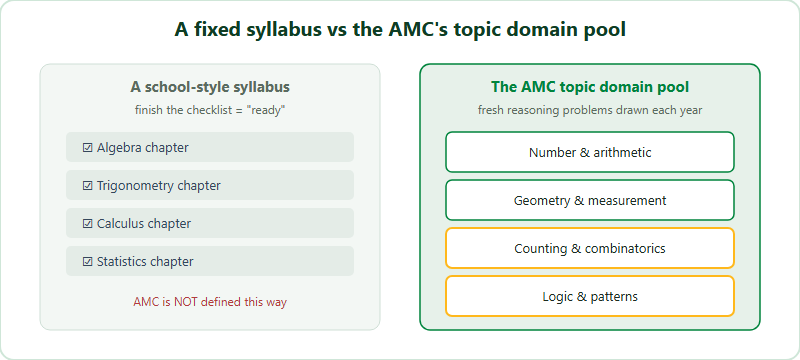
The four topic domains, in plain terms
Here is what each domain means as content — the mathematical territory a question can sit in. (This is about topics; for the thinking skills each rewards and worked mini-examples, see our companion piece, The Complete 2026 Australian AMC Guide for China.)
- Number & arithmetic — whole numbers, fractions, decimals, percentages, ratio and proportion, place value, factors and multiples, divisibility, and simple numerical sequences. The bread-and-butter of the early questions at every level.
- Geometry & measurement — length, area, perimeter and volume; angles; symmetry and reflection; counting shapes; nets, folding and 3-D visualisation; and, at senior levels, angle-chasing and area reasoning. Coordinate ideas may appear at the top levels.
- Counting & combinatorics — systematic listing, counting possibilities, simple probability framed as counting, and arrangements. Rarely needs a memorised formula; it rewards organised enumeration.
- Logic & patterns — finding and extending rules, true/false and who-sits-where deduction, working backwards, and spotting structure in a sequence of cases. This is the domain that feels least like a school exam.
Two honest caveats. First, these labels are a map for parents, not official AMC categories — the paper never tells you which domain a question belongs to, and most harder questions blend two or more. Second, depth varies by level: "geometry" for Pre-A means counting squares and recognising symmetry, while for Level E it can mean a multi-step argument about angles and areas. The domains stay the same; the depth climbs.
What is in scope — and, just as important, what is not
Because the AMC publishes no syllabus, families understandably worry about over-preparing — drilling advanced topics that never appear. So it is worth stating the boundary as plainly as we honestly can. The table below is our editorial read of the competition's public design, written to stop students chasing the wrong material; it is not an official scope statement, and the final word on any year's paper is the AMT's. Where a detail genuinely depends on official rules, we say so.
| Generally in scope | Generally out of scope / not required |
| Arithmetic, fractions, ratio, percentages | University-level mathematics |
| Plane geometry, area, angles, symmetry | Calculus (differentiation / integration) — not part of the AMC |
| Systematic counting and simple probability | Writing out formal, graded proofs (AMC answers are a letter or an integer) |
| Patterns, sequences, logical deduction | Memorising a large formula sheet — none is needed or provided |
| Early algebra & expressions (senior levels) | Heavy data/statistics coursework, programming, or essay-style work |
| Age-appropriate problem-solving at each level | Topics beyond a student's own level (you sit one level only) |
The practical message for a student in China: you almost certainly do not need to rush ahead into calculus or advanced algebra — the AMC rewards thinking carefully about familiar ideas, not racing through the curriculum. One genuine open item is the calculator policy (whether, and which type, is permitted), which is set by the organisers and can differ by region and year — do not assume; confirm on the official site before exam day. For how the 2026 edition added the youngest level and other changes, see What's New in the 2026 Australian AMC: The Pre-A Level & More.
Curriculum-agnostic: why IB, A-Level, AP and PEP students all fit
"Curriculum-agnostic" is the single most useful thing to understand about what's on the paper. The AMC is written so it does not assume any one school system. A student following the International Baccalaureate, Cambridge IGCSE/A-Level, the American AP track, or the Chinese national curriculum (人教版 / PEP) can all sit the same level and meet questions pitched to ideas they have plausibly met — because the questions live in the universal domains above, not in the vocabulary or sequencing of a particular course.
This is why there is little to "align": the AMC is not mapped onto a syllabus, so there is no gap to close between your school course and the contest. What carries over is the reasoning — careful reading, drawing a figure, listing cases, finding a rule — which every curriculum builds in its own way. The paper is also offered in both English and Chinese, so language need not be a barrier for students in China. The implication is freeing: a child does not need a special "AMC curriculum" to take part, only steady practice at thinking through unfamiliar problems.
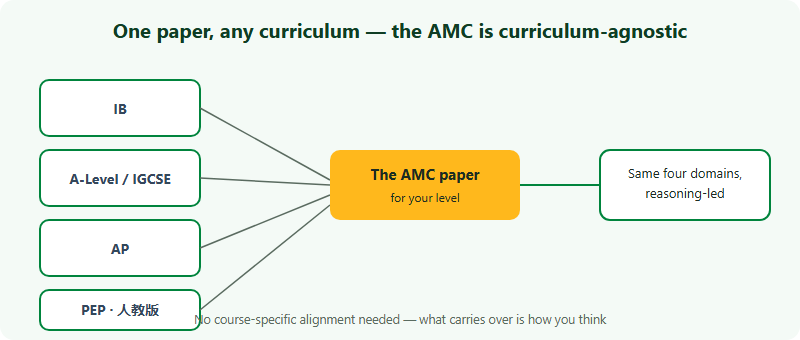
How the domains scale across the six levels
The 2026 China region runs six levels, and a student sits only the one matching their grade. The same domains run through all six — what changes is which ideas become available and how deep the reasoning goes. The grid below shows, in broad terms, where each domain is drawn on lightly versus heavily. It is an orientation, not an official weighting; the exact balance of any paper is the AMT's to set.
| Level (grades) | Number | Geometry | Counting | Logic / patterns |
| Pre-A (1–2) · new 2026 | Core | Shapes & symmetry | Light | What-comes-next |
| A (3–5) | Core | Growing | Light | Simple deduction |
| B (6–7) | Ratios & proportion | Area & angles | Growing | Find-the-rule |
| C (8–9) | Strong | Angle-chasing | Systematic | Multi-step |
| D (10–11) | + early algebra | Combined geometry | Heavier | Longer chains |
| E (12) | Full range | Deepest reasoning | Heaviest | Proof-style logic |
The takeaway for parents: moving up a level is not about unlocking exotic new topics — it is the same domains, asked more deeply and combined more often. A Level D paper does not suddenly require calculus; it asks harder questions about number, shape, counting and logic. That is exactly why preparation built on thinking habits travels well from one level to the next, while chasing "advanced syllabus" content rarely pays off. For a fuller study plan by level, the complete guide linked above lays out a calm, low-pressure routine.
Three competitions, three different scopes — keep them apart
Because "AMC" appears in more than one contest, the topic scope described here applies only to the Australian AMC. The other two so-named or similarly-aimed competitions are different events with their own content and rules — do not transfer this scope onto them.
| Competition | Run by | Scope & format (in brief) |
| Australian AMC (this site) | Australian Maths Trust (AMT); ASDAN (阿思丹) in China/Asia | No fixed syllabus; reasoning-led across number, geometry, counting, logic; 30 questions, 135 marks, no penalty |
| American AMC | MAA, USA | A different competition (e.g. AMC 8 / 10 / 12) with its own scope and a pathway to AIME — not covered here |
| AMO | SIMCC, Singapore | A separate Olympiad with its own syllabus, format and medals |
If a syllabus, sample paper or advert references the MAA, AIME or SIMCC, it is describing a different contest — not the Australian AMC. When unsure which competition a topic list belongs to, check the official source for that specific event. The dates that matter for the Australian AMC this year: the paper is sat on Sunday 11 October 2026, with registration closing 28 September 2026; the entry fee and portal steps are set by AMT and ASDAN and can change.
Frequently asked questions
Does the Australian AMC have a fixed syllabus?
No. It has no published chapter list. Questions are drawn from broad domains — number, geometry, counting and logic — and are reasoning-led. Exact scope is set by the AMT.
Is calculus tested on the Australian AMC?
No — calculus is not part of the AMC, and no formula sheet is needed. The paper rewards careful reasoning about familiar ideas, not advanced coursework. Confirm any rule detail on the official site.
Do IB, A-Level, AP or PEP students need to align a curriculum?
No. The AMC is curriculum-agnostic, so there is no syllabus gap to close. Any school system fits; what transfers is reasoning, and the paper is in English and Chinese.
Is the Australian AMC scope the same as the American AMC or AMO?
No. This is the Australian AMC (AMT/ASDAN). The American AMC (MAA, USA) and the AMO (SIMCC, Singapore) are different competitions with their own scope and rules.
This is the editorial desk for the Australian Mathematics Competition (AMC) China region. The competition is run by the Australian Maths Trust (AMT) and administered in China and Asia by ASDAN (阿思丹); this content desk is operated by Hanlin Education for students in China. Dates, fees, levels, rules and the scope of each paper are set by the AMT and ASDAN and can change each year — always confirm current details on the official channels (amt.edu.au and the ASDAN China-region channels). Confirmed errors are corrected within 7 working days.