
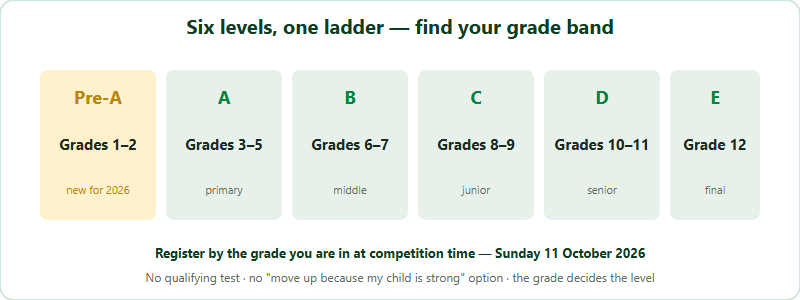
Choose your Australian AMC level by the school grade your child will be in at competition time — Sunday 11 October 2026 — not by age or by the grade they have just left. There are six levels: Pre-A (Grades 1–2, new for 2026), A (3–5), B (6–7), C (8–9), D (10–11) and E (Grade 12). Every level sits the same-shaped paper, so the only real decision is matching the grade band correctly.
The six levels at a glance — and the one rule that sets them
The Australian Mathematics Competition (AMC) is set by the Australian Maths Trust (AMT), founded in 1978 and Australia's largest school maths competition, and administered for the China and Asia region by ASDAN (阿思丹). In the China region there are six levels, each tied to a band of school grades. The selection rule is refreshingly simple: you do not choose a difficulty, you identify your grade band. A Year-7 student sits Level B; a Year-9 student sits Level C; there is no "move up because my child is strong" option, and no test to qualify into a level. If you are new to the competition itself, our overview of what the Australian AMC is covers the dates, format and awards first; this guide is purely about picking the right level.
Because the level follows the grade, the question most parents actually need answered is not "which level is best?" but "which grade counts?" The answer is the grade your child is enrolled in on the day of the exam. For 2026 that day is Sunday 11 October, with registration closing 28 September 2026. The table below maps every level to its grade band so the match is unambiguous.
| Level | Grades (China region) | Typical age | What the band is really testing |
| Pre-A (new 2026) | Grades 1–2 | ~6–8 | Number sense, counting, simple patterns — read-aloud friendly |
| A | Grades 3–5 | ~8–11 | Arithmetic fluency, basic shapes, short logic "story" problems |
| B | Grades 6–7 | ~11–13 | Fractions and ratios, area and perimeter, organised counting |
| C | Grades 8–9 | ~13–15 | Early algebra, multi-step word problems, number-theory basics |
| D | Grades 10–11 | ~15–17 | Functions, combinatorics, harder geometry, proof-style thinking |
| E | Grade 12 | ~17–18 | Advanced problem-solving and speed on the demanding back half |
"Which grade counts?" — the Northern- vs Southern-Hemisphere trap
This is the one genuinely confusing point for families in China, and it is worth slowing down on. Australia's own school year runs January to December, and the home AMC is sat in August. The China-region paper is sat two months later, in October, and many international and bilingual schools in China run a Northern-Hemisphere academic year that begins in September. The practical consequence: a child entering the exam on 11 October will, in most Northern-Hemisphere school calendars, already have started their new grade a few weeks earlier.
So the safe rule is to register by the grade your child is enrolled in during October 2026, not the grade on their summer report card. A student who finished "Grade 5" in June and started "Grade 6" in September is, for this competition, a Grade 6 student — and Grade 6 sits Level B, not Level A. Getting this wrong is the most common level error we see, and it is entirely avoidable. Because school-year systems differ (some schools in China follow a different calendar or numbering), the grade-to-level mapping for an unusual case should always be confirmed with ASDAN before you register.
A short worked example makes it concrete. Imagine two children both turning eleven in 2026. Child A attends a school whose year runs September–June and has just begun Year 6 — she registers for Level B. Child B attends a school whose year runs August–July and is repeating the second half of Year 5 through to mid-2026, so in October is still classified Grade 5 — he registers for Level A. Same age, different levels, because the level tracks the enrolled grade at competition time, not the birthday.
The paper is the same shape at every level — so this is the only choice that matters
It reassures most parents to learn that choosing a level is not choosing a different kind of exam. Every level — Pre-A through E — sits a paper with the same architecture: 30 questions (25 multiple-choice plus 5 integer-answer), worth 135 marks, with no penalty for a wrong answer. What changes between levels is the content and the time allowed, which runs from about 45 minutes for the youngest levels up to 75 minutes for the senior ones. The difficulty is calibrated to the grade band, so a correctly-placed student meets problems that are challenging but fair for their year.
This is exactly why the grade-band rule exists and why "moving up" is not offered: the paper is already pitched at the right stretch for each band, so a well-placed Grade 4 student gets a Level A paper designed to extend a Grade 4 student, not to overwhelm one. For a fuller look at how those 30 questions and 135 marks are weighted across the paper, see our companion guide to the Australian AMC syllabus and topics tested. The reference table below summarises the shared format so you can see what does — and does not — change with level.
| Feature | Same at every level? | Detail (2026 China region) |
| Number of questions | Yes | 30 — 25 multiple-choice + 5 integer-answer |
| Total marks | Yes | 135, rising with difficulty |
| Wrong-answer penalty | Yes | None — a blank and a wrong answer score the same |
| Languages | Yes | English & Chinese |
| Time allowed | No | ~45–75 minutes, shorter for younger levels |
| Question content / difficulty | No | Calibrated to each grade band |
| Awards | Yes (structure) | By national percentile within your level — Prize, High Distinction, Distinction, Credit, Proficiency; a certificate for every entrant; the O'Halloran Award for a perfect 135 |
What to do when your child sits right between two bands
Sometimes the worry is not which grade counts but whether a child is suited to their band at all — a mathematically advanced Grade 5 who finds Level A easy, or a Grade 8 who feels stretched by Level C. The honest answer for almost every family is the same: enter at your grade-appropriate level. The competition is structured around grade bands precisely so that a student is measured against peers in the same band, by national percentile, and there is no mechanism to self-select a harder level on the China-region entry. The decision guide below walks through the realistic scenarios.
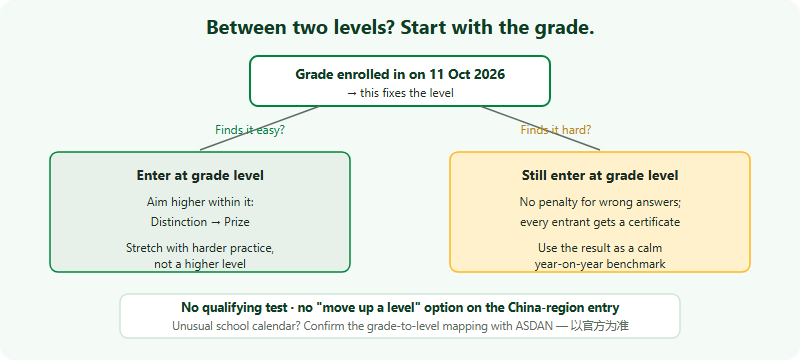
For the advanced child, the productive ambition is a higher award band within their own level — climbing from Credit toward Distinction, High Distinction or Prize — and stretching with harder practice problems, rather than chasing a level above their grade. Because awards are ranked by national percentile against peers in the same band, a strong Grade 5 at Level A who reaches the top percentiles has a genuinely impressive, comparable result. For the child who finds the band hard, entering is still worthwhile: there is no penalty for wrong answers, every entrant receives a certificate, and the percentile is a low-pressure benchmark to track year on year. None of this is a guarantee of any school or programme admission, and we make no such claim — the AMC is a measure of mathematical problem-solving, not an entry ticket.
Once you have your level, the next step is registering correctly
With the level settled, the rest is administrative. Registration for the 2026 China-region competition closes on 28 September 2026, ahead of the Sunday 11 October 2026 exam, and is handled through ASDAN's China-region channels. When you register, you will select the level that matches your child's October grade using the bands above — so the single most important thing to get right at sign-up is the grade-to-level match, especially for a child near a band boundary or on an unusual school calendar. For a step-by-step walkthrough of the sign-up itself, see our Australian AMC registration walkthrough.
The exact entry fee, the precise registration portal steps and any rules for unusual placements are set by AMT and ASDAN and can change — confirm those current details on the official channels before you commit. What will not change is the principle this guide is built on: register by the grade your child is in at competition time, and let the grade decide the level.
Don't confuse the Australian AMC with two look-alike contests
A quick but important clarification, because the level structure here belongs to one specific competition. Several maths contests share the letters "AMC," and one nearby contest is called the AMO — and they have completely different level systems. The six-level, grade-band structure described above is the Australian AMC only. The table keeps the three apart so a parent comparing options never applies the wrong levels to the wrong paper.
| Competition | Run by | How its levels work (in brief) |
| Australian AMC (this site) | Australian Maths Trust (AMT); ASDAN in China/Asia | Six grade-band levels: Pre-A (Gr 1–2), A (3–5), B (6–7), C (8–9), D (10–11), E (Gr 12) |
| American AMC | MAA, USA | A different structure (e.g. AMC 8 / 10 / 12 by grade ceiling) and its own pathway — not covered here |
| AMO | SIMCC, Singapore | A separate competition with its own divisions and medal scheme |
If a results page or advert mentions the MAA, AIME or SIMCC, it is not the Australian AMC, and the Pre-A–E grade bands here do not describe it. When unsure which contest a level or score belongs to, check the official source for that specific competition.
Frequently asked questions
Which grade decides my child's Australian AMC level?
The grade your child is enrolled in at competition time — Sunday 11 October 2026 — not their age or the grade they just finished in summer.
My child is strong at maths — can they sit a higher level?
No. The China-region entry has no qualifying test and no move-up option; enter at grade level and aim for a higher award band such as Distinction or Prize instead.
What is the new Pre-A level in 2026?
Pre-A is a new 2026 level for Grades 1–2, opening the Australian AMC to younger students with number-sense and pattern questions that are read-aloud friendly.
My child is between two grade bands — which level should they pick?
Go by the grade enrolled in during October 2026. If a school calendar is unusual, confirm the grade-to-level mapping with ASDAN.
This is the editorial desk for the Australian Mathematics Competition (AMC) China region. The competition is run by the Australian Maths Trust (AMT) and administered in China and Asia by ASDAN (阿思丹); this content desk is operated by Hanlin Education for students in China. Dates, fees, levels, the grade-to-level mapping and rules are set by the AMT and ASDAN and can change each year — always confirm current details on the official channels (amt.edu.au and the ASDAN China-region channels). Confirmed errors are corrected within 7 working days. Note: the Australian AMC (AMT / ASDAN) is a different competition from the American AMC (MAA, USA) and the AMO (SIMCC, Singapore).