
In China, the Australian Mathematics Competition (AMC) is run as an official region: the Australian Maths Trust (AMT) sets the paper, the marking standard and the award levels, exactly as it has since 1978, while ASDAN (阿思丹) administers the competition locally — handling registration, invigilation, marking to AMT's global standard, and certificates. The contest your child sits in October 2026 is the same AMC, on the same standard, organised for students here.
Two roles, one competition: what "official region" actually means
The simplest way to understand the AMC in China is to separate two questions that are easy to blur together: who designs the competition and who organises it for you. The answer is two organisations doing two distinct jobs. The Australian Maths Trust — Australia's largest school mathematics competition body, founded in 1978 — owns the intellectual core: the questions, the difficulty design, the marking scheme, and the award thresholds. ASDAN (阿思丹) is the regional administrator for China and Asia, responsible for getting students registered, running the sitting under proper exam conditions, processing the marking against AMT's standard, and issuing the certificates and results that come back.
This is a common and well-established model for international academic competitions: a globally-set paper, delivered through a trusted regional partner so that students outside the home country can take part on equal terms. It matters for one practical reason above all — the standard does not change at the border. A Distinction earned in China is measured the same way as anywhere the AMC runs, because the marking rubric and the percentile bands are AMT's, not the region's. If you are new to the competition itself, our overview of what the Australian AMC is covers the levels, format and awards first; this article focuses specifically on how the China region is operated.
| Responsibility | Australian Maths Trust (AMT) | ASDAN (阿思丹) · China region |
| The questions & paper | Sets all 30 questions and the difficulty design | Delivers the official paper unchanged to sitters |
| The marking standard | Owns the marking scheme & 135-mark scoring | Marks entries to that same global standard |
| Award thresholds | Defines Prize / High Distinction / Distinction / Credit / Proficiency | Applies them by national percentile, issues certificates |
| Registration | — | Runs enrolment and the entry deadline locally |
| Invigilation | Sets the exam conditions framework | Organises the supervised sitting in China |
| Languages | Provides the paper | Available in English & Chinese for the region |
This content desk sits underneath that arrangement: it is operated by Hanlin Education to explain the China-region process to families and students. The facts below — dates, levels, format — are AMT's and ASDAN's; anything we cannot confirm from the official channels, we say so rather than guess.
From registration to certificate: the China-region pathway in 2026
Because ASDAN administers the contest regionally, the student journey in China has a clear, predictable shape across the 2026 cycle. The most important fixed points are the dates: the exam is sat on Sunday 11 October 2026, and registration closes on 28 September 2026. Everything else — enrolling, sitting, marking, and receiving results — hangs off those two anchors. The sequence below is the operating flow; the precise portal steps and the entry fee are set by ASDAN and should be confirmed on the official region channels.
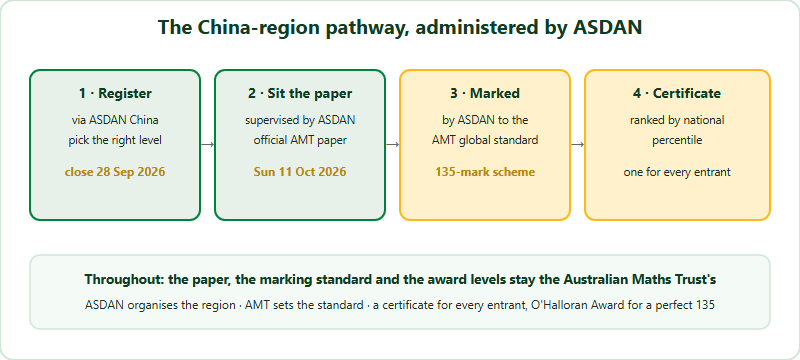
A few details are worth drawing out. Registration is by level, and you choose the level by your child's current grade — there are six in 2026, and getting this right at sign-up is the one decision a parent makes that the marking later depends on. The sitting is supervised, which is what keeps a China result comparable to results elsewhere; an unsupervised score would not carry the same meaning. And every entrant receives a certificate, not only the top scorers — the recognition runs all the way down the award ladder, which is part of why the AMC suits a wide range of abilities rather than only contest specialists.
The six 2026 levels — the same paper architecture, organised by grade
For 2026 the China region runs six levels spanning Grades 1 to 12, and ASDAN places each student into one of them at registration. The headline change this year is at the youngest end: Pre-A is new for 2026, opening the competition to Grades 1–2 for the first time. We have written separately about why this matters — see Pre-A for Grades 1–2: the new 2026 division for young learners, and a step-by-step parent's guide to registering a Grade 1–2 child for Pre-A.
Whatever the level, the paper architecture ASDAN delivers is the same one AMT designs: 30 questions — 25 multiple-choice plus 5 integer-answer — worth 135 marks, with no penalty for a wrong answer, and a sitting of 45 to 75 minutes depending on level. Younger levels get the shorter sittings; senior levels get the longer ones. The questions themselves are pitched to each grade band, but the scoring logic and the no-penalty rule are constant across all six.
| Level (2026 China region) | Grades | Notes |
| Pre-A | Grades 1–2 | New for 2026 — the youngest entry point |
| A | Grades 3–5 | Lower-primary level |
| B | Grades 6–7 | Upper-primary into junior secondary |
| C | Grades 8–9 | Junior secondary |
| D | Grades 10–11 | Senior secondary |
| E | Grade 12 | Final year |
One honest caution at registration: pick the level that matches the current grade rather than reaching up a band in the hope of a tougher paper. The award is decided by national percentile within a level, so a student is compared against their own peer group — placing correctly is what makes the result meaningful, and it is the part ASDAN cannot fix after the fact.
How awards work — set by AMT, issued through ASDAN
The award structure is a clean illustration of the two-role model in action. AMT defines the award levels and where the percentile lines fall; ASDAN applies them to the China-region cohort and issues the certificates. Results are ranked by national percentile, and the recognition ladder runs Prize → High Distinction → Distinction → Credit → Proficiency, with a certificate for every entrant. A perfect paper — all 135 marks — is eligible for the O'Halloran Award.
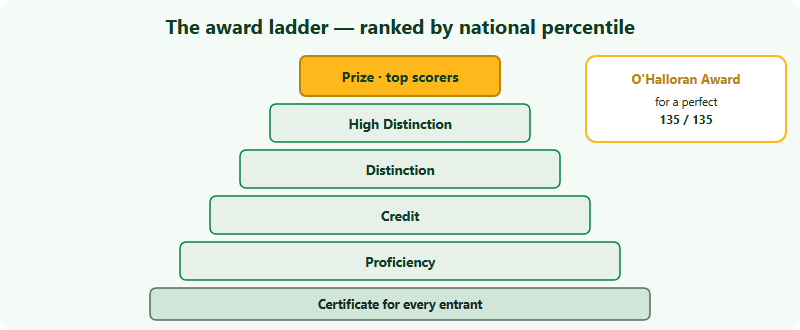
Two things are worth being plain about. First, the exact percentile cut-offs for each award shift slightly from year to year — they are AMT's to set, and we do not publish them as fixed numbers; confirm the current thresholds on the official channels. Second, an AMC award is a genuine, nationally-benchmarked recognition of mathematical ability, and a strong result is something to be proud of — but it is not a guarantee of admission to any school or programme, and we make no such claim. It is one credible signal among many, valued precisely because the standard behind it is consistent.
Australian AMC, American AMC, AMO — three different competitions
Because the regional-administration model can sound similar to other contests, it is worth stating clearly which competition this is. The Australian AMC described here is set by the Australian Maths Trust and administered in China by ASDAN. It is not the American AMC (a different competition run by the MAA in the United States), and it is not the AMO (a separate competition run by SIMCC in Singapore). The table keeps the three apart so a parent comparing options is never caught out.
| Competition | Set by | Administered / run by |
| Australian AMC (this site) | Australian Maths Trust (AMT), Australia, since 1978 | ASDAN (阿思丹) in China & Asia; this desk by Hanlin Education |
| American AMC | MAA, USA | A different organisation and pathway — not covered here |
| AMO | SIMCC, Singapore | A separate competition with its own paper and medals |
If a results page, advert or registration portal mentions the MAA, AIME or SIMCC, it is not the Australian AMC, and the dates and structure on this site do not apply to it. When in doubt about which contest a paper or certificate belongs to, check the official source for that specific competition.
Frequently asked questions
Who runs the Australian AMC in China?
The Australian Maths Trust sets the paper and standard; ASDAN (阿思丹) administers it in China and Asia — registration, invigilation, marking and certificates. This desk is operated by Hanlin Education.
Is the China-region paper the same as Australia's?
It is the same AMC, marked to the same Australian Maths Trust global standard. The China region sits it in October across six levels; confirm exact details on the official site.
When is the 2026 Australian AMC in China, and when does registration close?
The exam is on Sunday 11 October 2026, and registration closes 28 September 2026. The entry fee and portal steps are set by ASDAN.
Does ASDAN change the questions or marking for China?
No. The questions, the 135-mark scheme and the award levels are the Australian Maths Trust's. ASDAN organises the sitting and marks entries to that same standard.
This is the editorial desk for the Australian Mathematics Competition (AMC) China region. The competition is run by the Australian Maths Trust (AMT) and administered in China and Asia by ASDAN (阿思丹); this content desk is operated by Hanlin Education for students in China. Dates, fees, levels and rules are set by the AMT and ASDAN and can change each year — always confirm current details on the official channels (amt.edu.au and the ASDAN China-region channels). Confirmed errors are corrected within 7 working days.