
Yes — the Australian Mathematics Competition (AMC) is one of the gentler ways for a first-time or younger student to try competition maths. Three features make it beginner-friendly: there is no penalty for a wrong answer, so a guess can never cost marks; the papers are pitched to a child's grade band across six 2026 levels; and the questions reward careful reasoning over raw speed or memorised tricks. It is encouraging by design — without over-promising what one paper can do.
Why "gentle" is the right word: three things that lower the stakes
Many parents hesitate over their first maths competition for the same honest reasons: the word "competition" sounds high-pressure, a child who is good at school maths might still "not be a competition kid", and nobody wants a discouraging first experience that puts a young learner off the subject. The Australian AMC is unusually well-suited to a cautious first attempt because its structure — not just its marketing — softens each of those worries. It is the same competition set by the Australian Maths Trust (AMT), Australia's largest school maths competition since 1978, and administered in China by ASDAN (阿思丹); nothing about being a region changes how forgiving the format is.
The single most reassuring fact for a nervous first-timer is the marking. Each paper is 30 questions — 25 multiple-choice plus 5 integer-answer — worth 135 marks, with no deduction for an incorrect answer. A blank and a wrong answer score exactly the same. That one rule quietly removes the fear that makes children freeze: there is no way to "go backwards" by trying. A student who reasons their way to two plausible options and picks one has lost nothing by attempting it. Below, the three structural reasons the AMC reads as a soft landing rather than a high-wire act.
| What worries a first-timer | How the AMC is built | Why that helps a beginner |
| "A wrong answer will hurt my score" | No penalty for wrong answers (135 marks, 30 questions) | Attempting is always safe; an informed guess can only add marks |
| "My child is too young / not ready" | Six levels for 2026, each pitched to a grade band | The paper meets the child at their grade, not above it |
| "It'll be a race against the clock" | 45–75 minutes by level; early questions ease in | There is time to think; the paper rewards reasoning, not panic |
| "What if they finish near the bottom?" | A certificate for every entrant; recognition runs down the ladder | Everyone leaves with something; effort is acknowledged |
| "Will the language trip them up?" | Paper offered in English & Chinese | A bilingual learner reads in whichever language is clearer |
No penalty for wrong answers: the rule that takes the fear out
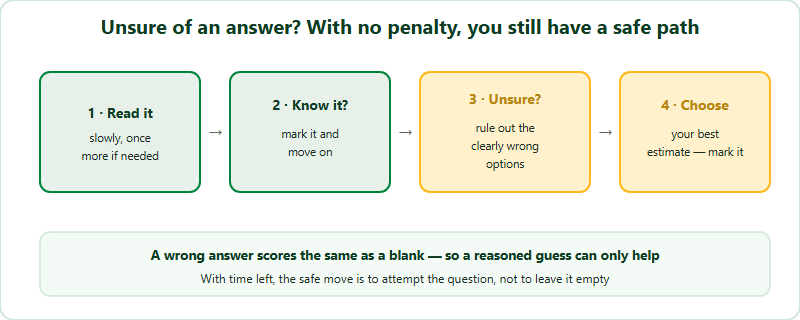
It is worth dwelling on the no-penalty rule, because it changes how a beginner should approach the whole paper. In a contest that subtracts marks for mistakes, the safe move is to leave hard questions blank — and that teaches a child to play defensively and second-guess themselves. The AMC does the opposite. Because a wrong answer costs nothing, the rational and intended strategy is to attempt every question you have time for, even where you are unsure. For a first-timer this is liberating: the paper effectively says "have a go", and the marking backs that up.
This also makes the AMC a good teacher of a genuinely useful habit — narrowing down. On a multiple-choice question, a student who cannot see the full answer can often still rule out two of the five options as obviously too big or too small, then choose between what remains. That is real mathematical thinking, and the no-penalty design rewards it rather than punishing the uncertainty. The diagram below shows how a calm beginner can work a question they are not sure of, without ever risking a mark.
Age-pitched papers: six 2026 levels meet a child where they are
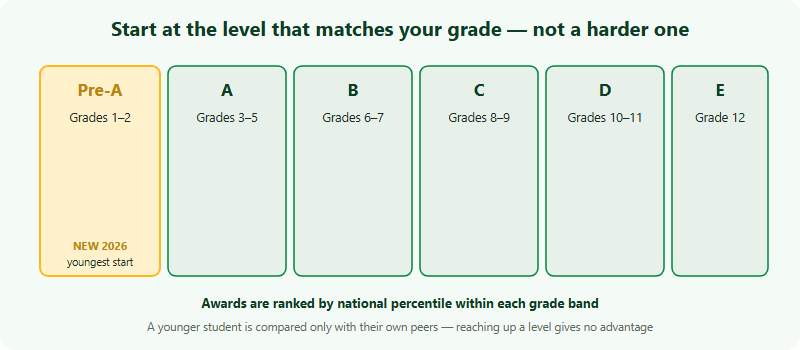
A beginner's second worry — "is my child old enough, or ready enough?" — is answered by how the AMC is split into levels. For 2026 the China region runs six levels across Grades 1–12, and a student sits the level that matches their current school grade, not a harder one. The newest and most beginner-relevant addition is Pre-A, new for 2026 for Grades 1–2, which opens a first competition to children as young as lower primary — an age group that previously had no level to enter at all. For the full picture of structure and history, our explainer on what the Australian AMC is is the place to start.
Pitching by grade matters for a gentle start in two ways. First, the questions are written for the band, so a Grade 3 child meets Grade 3-appropriate ideas, not senior-secondary algebra. Second — and this is the part parents often miss — awards are decided by national percentile within the level, so a child is only ever compared to peers in their own grade band. A younger entrant is never ranked against Grade 12 students. The honest implication is the opposite of the usual instinct: there is no advantage in "reaching up" to a harder level, because it only places the child against older students on harder questions. Matching the grade is both the fair way and the kind way in.
Reasoning over speed: what a beginner-level question actually rewards
The third reason the AMC suits beginners is the kind of thinking it asks for. The early questions on any paper are designed to ease a student in, and across the whole paper the emphasis is on clear reasoning rather than memorised formulas or fast arithmetic. A child does not need a stockpile of advanced techniques to start; they need to read carefully, notice a pattern, and think a step at a time. With 45 to 75 minutes depending on level, there is genuinely time to think — this is not a sprint where only the fastest survive.
Here is an illustrative example of the flavour of an early, beginner-friendly question (our own example, not a real past problem): "A frog climbs 3 steps up a staircase each minute, then slips back 1 step. How many minutes until it first reaches the top of a 7-step staircase?" A child does not need algebra. They can reason it out: after minute one the frog is on step 2 (up 3, back 1), after minute two on step 4, after minute three on step 6 — and on the next climb of 3 it reaches step 9, passing the top, so it first reaches step 7 partway through minute four. The point is not the frog; it is that a careful, unhurried thinker gets there with nothing but reasoning. That is exactly the muscle the AMC builds, and why a "not-a-competition-kid" can still do well and enjoy it.
Two honest notes belong here. First, the questions do get harder as the paper goes on — the later problems stretch even strong students, and that is intentional, so a beginner should feel no obligation to finish every one. Doing the early questions well is a real success. Second, every entrant receives a certificate, and the recognition ladder runs Prize → High Distinction → Distinction → Credit → Proficiency, so there is acknowledgement well beyond the top scorers; a perfect 135 is eligible for the O'Halloran Award. To see how that recognition is benchmarked, our guide to the Australian AMC awards and cut-off scores explains how the percentile bands work.
An honest word for hesitant parents: what a first AMC can and can't do
It would be easy to oversell this, so we will not. A first AMC is a low-pressure, confidence-building introduction to thinking mathematically under gentle exam conditions, and a certificate is a real, nationally-benchmarked acknowledgement of effort and ability. What it is not is a guarantee of anything — it does not secure a school place, it does not "prove" a child is gifted or not, and a single sitting is a snapshot, not a verdict. We make no admission or guaranteed-results claims, and any source that does should be treated with caution. The right expectation for a beginner is simple: a positive first experience and a clearer sense of whether the child enjoys this kind of problem.
If you decide to enter, the planning is light. The 2026 China-region exam is Sunday 11 October 2026, and registration closes 28 September 2026; you register by grade-matched level through ASDAN. The entry fee and the exact registration steps are set by ASDAN and can change, so confirm those on the official channel. For the full dates-and-entry walkthrough, see our companion guide to the 2026 Australian AMC key dates and registration. A calm plan — enter at the right level, try a few practice questions for familiarity, and treat the day as a friendly challenge — is all a first-timer needs.
One last clarity point, because the name causes real confusion. The competition described here is the Australian AMC, set by the Australian Maths Trust and administered in China by ASDAN. It is not the American AMC (run by the MAA in the United States), and it is not the AMO (run by SIMCC in Singapore). For a hesitant beginner, the Australian AMC's no-penalty, grade-pitched, reasoning-first format is the gentlest of the three to start with — but make sure the contest you register for is this one.
| Competition | Set / run by | Beginner-relevant note |
| Australian AMC (this site) | Australian Maths Trust (AMT); ASDAN (阿思丹) in China/Asia | No penalty, six grade-pitched levels, October sitting — a gentle start |
| American AMC | MAA, USA | A different contest and pathway (e.g. to AIME) — not this one |
| AMO | SIMCC, Singapore | A separate competition with its own paper and medals |
Frequently asked questions
Is the Australian AMC really suitable for a first-timer?
Yes. No penalty for wrong answers, papers pitched to the child's grade, and reasoning-based questions make it a low-pressure first competition.
What is the youngest grade that can enter in 2026?
Grades 1–2, through the new Pre-A level added for 2026. There are six levels in total covering Grades 1–12.
Does my child need special preparation or advanced maths?
No. Early questions ease students in and reward careful reasoning over memorised tricks. A little practice for familiarity is enough.
What if my child scores low — is it discouraging?
Every entrant gets a certificate, and recognition runs down the ladder. A low score on hard later questions is normal and expected.
This is the editorial desk for the Australian Mathematics Competition (AMC) China region. The competition is run by the Australian Maths Trust (AMT) and administered in China and Asia by ASDAN (阿思丹); this content desk is operated by Hanlin Education for students in China. Dates, fees, levels and rules are set by the AMT and ASDAN and can change each year — always confirm current details on the official channels (amt.edu.au and the ASDAN China-region channels). Confirmed errors are corrected within 7 working days.