
The Australian Mathematics Competition (AMC) is Australia's largest school maths competition, set by the Australian Maths Trust (AMT) since 1978 and administered for China and Asia by ASDAN (阿思丹). For 2026, the China region runs six levels across Grades 1–12 (Pre-A to E), with a single national paper on Sunday 11 October 2026. This page is the all-in-one map: what it is, who runs it, the levels, the format, the awards, and how it differs from the American AMC and AMO — with links out to the detail.
Start here: the 2026 China region at a glance
If you read nothing else, read this table. It gathers every headline fact for the 2026 China-region AMC in one place, so the sections below simply expand on what you have already seen. Two dates anchor the year — register by 28 September, sit the paper on 11 October — and everything else hangs off the level you choose by grade.
| What it is | One maths paper per level; problems that climb in difficulty; reasoning rewarded over speed |
| Set by | Australian Maths Trust (AMT), Australia — founded 1978, the country's largest school maths competition |
| China / Asia administrator | ASDAN (阿思丹) — registration, invigilation, marking, certificates |
| Operated by | This editorial desk is run by Hanlin Education for students in China |
| Levels | Six: Pre-A, A, B, C, D, E — covering Grades 1–12 (Pre-A is new for 2026) |
| Exam day (China) | Sunday 11 October 2026 · register by 28 September 2026 |
| The paper | 30 questions (25 multiple-choice + 5 integer) · 135 marks · no penalty for wrong answers · 45–75 min by level · English & Chinese |
| Awards | By national percentile — Prize, High Distinction, Distinction, Credit, Proficiency; a certificate for every entrant; O'Halloran Award for a perfect score |
| Entry fee | Set by ASDAN — confirm the current amount on the official site |
New to the competition entirely? Begin with What Is the Australian AMC, then come back here to navigate the rest. Dates, fees and rules are set by AMT and ASDAN and can change each year — always confirm the live specifics before you enter.
Who runs it: the AMT and ASDAN (and why that matters)
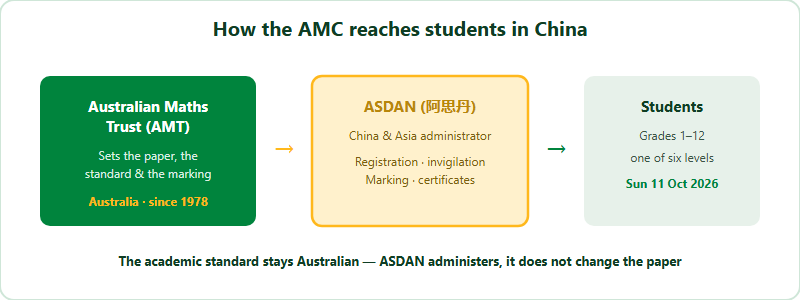
The competition — the problems, the standard, the marking scheme — comes from the Australian Maths Trust, a national not-for-profit that has run the AMC since 1978. Its design is what sets the AMC apart from a school test: a single fresh paper for each grade band every year, where marks rise as the questions get harder and nothing is ever subtracted for a wrong answer, so every student can attempt every question without fear.
For families in China and across Asia, the AMC is run by ASDAN (阿思丹), which handles registration, sitting the paper, marking to the same global standard, and issuing certificates. The crucial point for parents: the academic content and the standard stay Australian — ASDAN is the regional administrator, not a separate competition. A Distinction earned in Beijing means the same as one earned in any other AMC region, because it is the same paper and the same marking. This desk, operated by Hanlin Education, is the editorial side — we explain the competition; ASDAN runs the entry.
The six levels: Pre-A to E (Grades 1–12)
The AMC pitches a paper at each grade band, so a Grade 2 child and a Grade 11 student sit genuinely different, age-appropriate papers. You register by the grade the child is in at the time of the competition — October 2026 — not the grade they move into later, and not by how strong they are. The headline change this year is a brand-new Pre-A level for Grades 1–2, the youngest entry point the AMC has ever offered. The table below is the single reference that maps every grade to its level and its approximate time allowance.
| Level | Grade (Oct 2026) | Band | Approx. time |
| Pre-A (new 2026) | Grades 1–2 | Lower primary | ~45 min (shorter) |
| A | Grades 3–5 | Primary | ~60 min |
| B | Grades 6–7 | Upper primary / early middle | ~60 min |
| C | Grades 8–9 | Middle school | ~75 min |
| D | Grades 10–11 | Senior | ~75 min |
| E | Grade 12 | Final year | ~75 min |
A common question: “My Grade 6 child is strong — should we enter Level C to stretch them?” The honest answer is no — the level is tied to grade because the questions, the marking and the national percentile a child is compared against all belong to their own grade band. You stretch a capable student through how they prepare, not by jumping a level. For a full breakdown of what each level involves and the new Pre-A in detail, see The Six Australian AMC Levels Explained: Pre-A to E. The 45–75 minute ranges above are by level — confirm the exact minutes for your level on the official site.
Format and scoring: 30 questions, 135 marks, no penalty
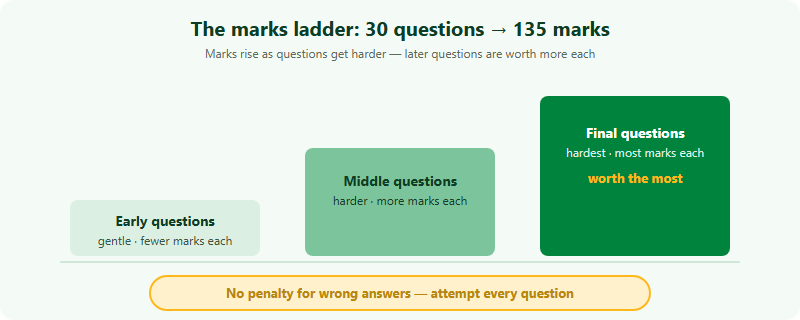
Every level sits a 30-question paper — 25 multiple-choice and 5 integer-answer questions — out of a total of 135 marks. The defining feature is that the questions climb in difficulty and the marks climb with them: the easy opening questions are worth a little, the hardest at the end are worth the most. That is how 30 questions add up to 135 rather than 30 — later questions simply carry more weight. And because there is no penalty for a wrong answer, a blank and a wrong attempt score exactly the same, so the right strategy is always to attempt every question and make a best reasoned attempt on the hard ones.
To picture the flavour of the reasoning — thinking, not recall — an early Pre-A or A question might ask, “A bead pattern goes red, blue, red, blue… what colour is the 9th bead?”, while a senior question might ask how many three-digit numbers have digits that add up to 6. These are our own illustrative examples, not real past questions: the AMT writes fresh problems each year and we do not reproduce its papers. The paper is offered in English and Chinese, and time runs from about 45 minutes at the youngest level to 75 at the senior levels.
Awards: recognition by national percentile
The experience always ends with something to keep: every entrant receives a certificate. National awards are then given by percentile, so the bar adjusts to each level and year rather than sitting at a fixed score. The top band nationally earns a Prize, followed by High Distinction, Distinction, Credit and Proficiency. A perfect paper is eligible for the Peter O'Halloran Award. Because the awards are percentile-based, a child is measured against others at their own level — a Pre-A entrant against other Grade 1–2 students, never against older children.
One honest framing worth keeping front of mind: an AMC award is a recognised, age-appropriate line on an academic record and a genuine point of pride — but it is not a guarantee of admission to any school or programme, and the exact percentile cut-offs shift slightly every year. Treat the competition as worthwhile mathematical thinking first, and a credential second. For a measured look at how much weight it really carries, read Is the Australian AMC Worth It? An Honest Look for Admissions. The exact recent cut-off scores are published on the official results pages — confirm those there rather than assume a number.
Australian AMC vs American AMC vs AMO — three different contests
This is the single most common mix-up for families, because three separate competitions share similar names. They are run by different organisations, with different papers and different entries, and a result in one does not transfer to another. On this site, “AMC” always means the Australian Mathematics Competition.
| Competition | Run by | Who it's for | This site? |
| Australian AMC | Australian Maths Trust (Australia); ASDAN (阿思丹) in China/Asia | Grades 1–12 — six levels, Pre-A to E | Yes |
| American AMC (AMC 8/10/12) | Mathematical Association of America (MAA), USA | Mainly secondary; the path toward AIME and USAMO | No — separate |
| AMO (American Mathematics Olympiad) | SIMCC, Singapore | Grades 2–12; a separate Singapore-run contest | No — separate |
The quick test: if a flyer or portal mentions the MAA, it is the American AMC; if it mentions SIMCC, it is the AMO; the Pre-A level, the six-level ladder and the 11 October China date all belong to the Australian AMC only. When in doubt about which contest a registration page is for, check the official source for that specific competition before paying anything.
Where to go next
This page is the hub; the detail lives in focused guides. If you are still deciding what the competition is, start with What Is the Australian AMC. To pin down the right level for your child — including the new Pre-A — go to The Six Australian AMC Levels Explained. And before you commit time and an entry fee, the honest cost-benefit view is in Is the Australian AMC Worth It? For the exact entry fee, the live registration steps and current cut-off scores, the official AMT and ASDAN China-region channels are always the final word.
Frequently asked questions
When is the 2026 Australian AMC in China?
The China-region exam is Sunday 11 October 2026, with registration closing 28 September 2026. Confirm the live dates on the official ASDAN channels before entering.
What grades can take part?
In China for 2026 the AMC runs six levels covering Grades 1–12: Pre-A (1–2, new this year), A (3–5), B (6–7), C (8–9), D (10–11) and E (12). You register by grade at competition time.
How is the paper scored?
Each level has 30 questions (25 multiple-choice, 5 integer) out of 135 marks; harder questions are worth more, and there is no penalty for a wrong answer.
Is the Australian AMC the same as the American AMC?
No. The Australian AMC is set by the Australian Maths Trust (ASDAN in China). The American AMC is run by the MAA in the USA, and the AMO is a separate Singapore contest.
This is the editorial desk for the Australian Mathematics Competition (AMC) China region. The competition is run by the Australian Maths Trust (AMT) and administered in China and Asia by ASDAN (阿思丹); this content desk is operated by Hanlin Education for students in China. Dates, fees, levels and rules are set by the AMT and ASDAN and can change each year — always confirm current details on the official channels (amt.edu.au and the ASDAN China-region channels). Confirmed errors are corrected within 7 working days.