
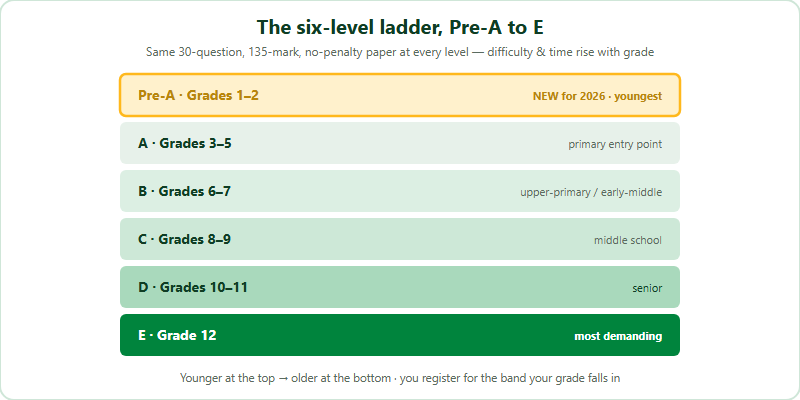
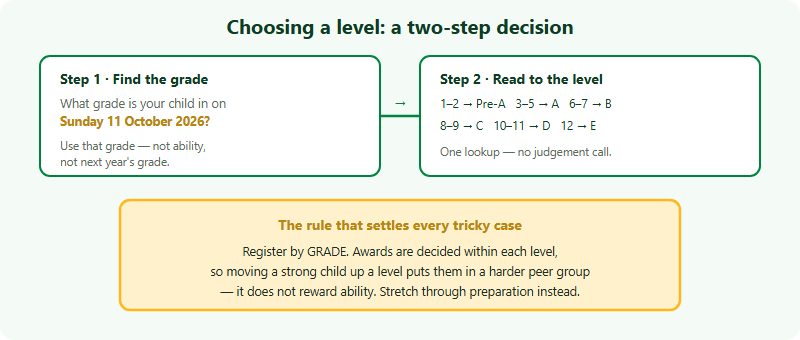
For 2026 the Australian Mathematics Competition (AMC) in China runs across six levels: Pre-A (Grades 1–2, brand-new for 2026), A (3–5), B (6–7), C (8–9), D (10–11) and E (Grade 12). You do not pick a level by ability — you pick the one that matches your child's grade on exam day, Sunday 11 October 2026. This is the definitive levels reference.
The six levels at a glance: a grade-to-level map
The first thing to settle is the rule that governs everything below: the level follows the grade, not the talent. Each of the six levels is a separate paper, written for a specific grade band, and — just as importantly — the awards are decided by comparing a child only against others sitting that same level. So the right starting move is a simple lookup: find the grade your child will be in on 11 October 2026, and read across. If the competition itself is new to you, it is worth first reading what the Australian AMC is; this page assumes you have decided to enter and want to land on the correct level with confidence.
| Level | Grade band (Oct 2026) | Stage in plain terms | Note |
| Pre-A | Grades 1–2 | Early-primary | New for 2026 — the youngest level the AMC has offered |
| A | Grades 3–5 | Primary | The long-standing entry point for most children |
| B | Grades 6–7 | Upper-primary / early middle school | Bridges primary and secondary thinking |
| C | Grades 8–9 | Middle school | Early-secondary problem solving |
| D | Grades 10–11 | Senior | Senior-secondary reasoning |
| E | Grade 12 | Final year | The most demanding level |
Two practical notes on reading this map. First, use the grade at competition time (October 2026), not the grade your child is leaving or about to enter. Second, the bands are not all the same width: Pre-A and B–D each span two grades, A spans three (3–5), and E stands alone at Grade 12. That is by design — the paper at each level is pitched to be age-appropriate for everyone in its band.
What is the same at every level — and what changes
A point that reassures most families: the structure of the paper does not change from Pre-A to E. Every level sits a 30-question paper — 25 multiple-choice questions plus 5 integer-answer questions — marked out of 135 marks, with no penalty for a wrong answer. The questions are arranged easiest-first and the marks rise as they get harder, so a child always meets gentle questions before the tough ones. The paper is offered in both English and Chinese at every level.
So what actually differs between levels? Two things. The obvious one is question difficulty: a Level E question assumes far more mathematical maturity than a Pre-A one, even though both papers have 30 questions. The less obvious one is time: the youngest levels are given less time and the senior levels more — roughly 45 minutes at the youngest end and up to about 75 minutes at the senior end. The exact minutes for each individual level are set by the Australian Maths Trust and ASDAN for the China region and can be confirmed on the official channels; the table below shows the shape families can plan around.
| Level | Questions | Marks | Penalty for wrong answers | Time band | Compared against |
| Pre-A (G1–2) | 30 (25 MC + 5 integer) | 135 | None | Shorter (~45 min end) | Other Pre-A entrants |
| A (G3–5) | 30 (25 MC + 5 integer) | 135 | None | Shorter end | Other A entrants |
| B (G6–7) | 30 (25 MC + 5 integer) | 135 | None | Middle | Other B entrants |
| C (G8–9) | 30 (25 MC + 5 integer) | 135 | None | Middle | Other C entrants |
| D (G10–11) | 30 (25 MC + 5 integer) | 135 | None | Longer end | Other D entrants |
| E (G12) | 30 (25 MC + 5 integer) | 135 | None | Longer (~75 min end) | Other E entrants |
That last column matters more than it looks. Because awards are decided on a national percentile within each level, a Pre-A child is measured against other Grade 1–2 students and never against older children. This is precisely why jumping a level to “stretch” a strong child usually backfires: it moves them into a harder peer group and a harder paper at once, rather than rewarding their ability within their own band.
Pre-A: the new 2026 level, and where it fits
The headline change for 2026 is the arrival of Pre-A for Grades 1–2 — the youngest entry point the Australian AMC has offered. Previously the ladder started at Level A (Grade 3), so families with a curious six- or seven-year-old had to wait. Pre-A removes that wait and gives early-primary children an age-appropriate first taste of competition mathematics. For the full set of 2026 updates and why they matter, see what changed for the 2026 Australian AMC.
It helps to be honest about what Pre-A is and is not. It is a gentle, low-pressure on-ramp: the same forgiving 30-question, no-penalty format, but with questions pitched for Grades 1–2 and a shorter sitting suited to younger attention spans. It is not a screening test, and a young child does not need to “be ready” in any formal sense — the no-penalty rule means there is nothing to lose by attempting a question, which is exactly what makes a first competition feel safe rather than stressful. For many families, Pre-A's real value is the experience of sitting a real, timed paper calmly — not the score.
How to choose your level — including the tricky cases
For most families the choice is a one-line lookup: read your grade off the map above. But three situations cause genuine hesitation, so here is how to think them through honestly.
- “My child is advanced — can we enter a higher level?” The level is tied to grade for a reason: the paper, the marking and the percentile peer group all belong to that grade band. The way to stretch a capable student is in how they prepare — richer problems, deeper reasoning — not by jumping into an older band where their score is compared against students one to two years ahead.
- “My child sits right on a band boundary (say Grade 5 vs Grade 6).” There is no judgement call here — use the grade on 11 October 2026. A Grade 5 child sits Level A; a Grade 6 child sits Level B. The boundary is decided by grade on exam day, full stop.
- “Is Pre-A or A right for a strong Grade 2 child?” A Grade 2 child registers for Pre-A. Strength within Grade 2 does not move them to A — it just means they are likely to enjoy Pre-A and may do well in their own percentile group.
If your child is in the final weeks before the paper, the practical next step is not re-choosing a level but preparing for the one they are in — our final-weeks revision plan walks through that calmly. To picture how difficulty climbs across levels — using our own illustrative examples, never real past questions, which the AMC writes fresh each year — a Pre-A item might ask, “A pattern goes star, moon, star, moon — what comes 6th?” A Level B item might ask how many two-digit numbers have digits that add to 7. A Level E item might ask for the number of ways to arrange letters under a stated rule. Same 30-question shell; very different demands.
Keep three look-alike contests straight before you commit
One clarification saves families from a costly mix-up: the six-level ladder, the Pre-A level and the 11 October China date all belong to the Australian AMC only. Several contests share the letters “AMC,” and a separate contest is called the AMO. They are run by different organisations, with different papers, levels and entry routes — so confirm you are looking at the Australian one before registering.
| Competition | Run by | Level structure |
| Australian AMC (this site) | Australian Maths Trust (AMT), Australia; ASDAN (阿思丹) in China/Asia | Six levels Pre-A–E across Grades 1–12; China region sits 11 Oct 2026 |
| American AMC (AMC 8/10/12) | Mathematical Association of America (MAA), USA | A different competition with its own structure — not these six levels |
| AMO | SIMCC, Singapore | A separate contest with its own paper and entry — not this one |
If a flyer or portal mentions the MAA or SIMCC, it is not the Australian AMC, and the Pre-A–E levels in this reference do not apply to it. When in doubt about which contest a page is for, check the official source for that specific competition before paying anything.
Frequently asked questions
How many levels does the 2026 Australian AMC have?
Six: Pre-A (Grades 1–2, new for 2026), A (3–5), B (6–7), C (8–9), D (10–11) and E (Grade 12). You register for the level matching your grade.
What is the new Pre-A level?
Pre-A is the new 2026 level for Grades 1–2 — the youngest entry point. Same 30-question, no-penalty format, with questions and timing pitched for early-primary children.
Do I choose the level by grade or by ability?
By grade. Use the grade your child is in on 11 October 2026. Awards are compared within each level, so a higher level just means a harder peer group, not a reward for ability.
How do the levels differ if every paper has 30 questions?
The format is shared, but question difficulty rises with the grade band and the time allowed grows — roughly 45 minutes at the youngest end up to about 75 at the senior end.
This is the editorial desk for the Australian Mathematics Competition (AMC) China region. The competition is run by the Australian Maths Trust (AMT) and administered in China and Asia by ASDAN (阿思丹); this content desk is operated by Hanlin Education for students in China. Dates, fees, levels and rules — including the exact per-level timing and entry fee — are set by the AMT and ASDAN and can change each year; always confirm current details on the official channels (amt.edu.au and the ASDAN China-region channels). Confirmed errors are corrected within 7 working days.