
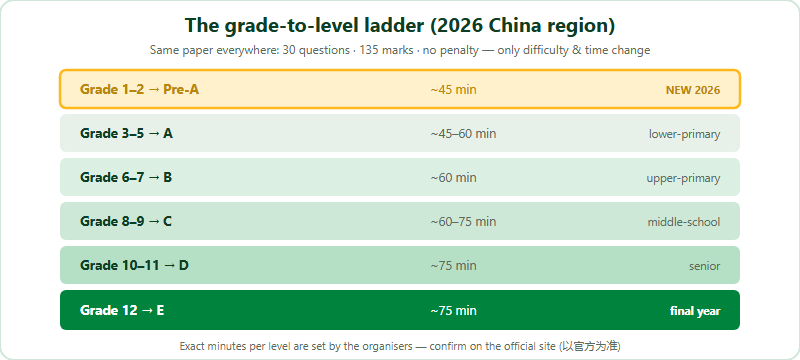
In the 2026 Australian Mathematics Competition (AMC) China region, the level your child sits is decided by grade, not ability: Grades 1–2 sit Pre-A (new for 2026), 3–5 sit A, 6–7 sit B, 8–9 sit C, 10–11 sit D and Grade 12 sits E. Every level is one paper of 30 questions worth 135 marks, running from about 45 to 75 minutes. This page is a calm grade-by-grade lookup of which level to expect and what the paper feels like.
How to read this guide in thirty seconds
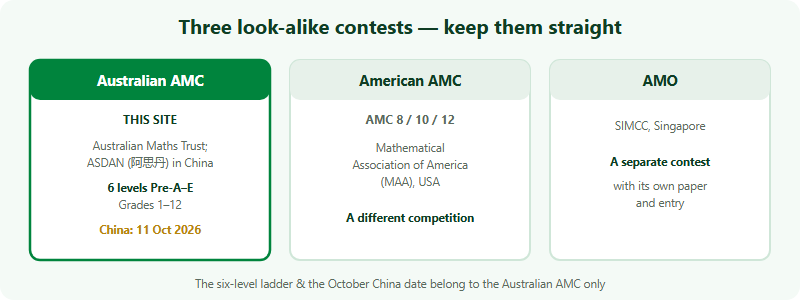
Find the grade your child is in on exam day, Sunday 11 October 2026, then read across to the matching level and what to expect. The structure is identical at every level — 30 questions, 25 multiple-choice plus 5 integer-answer, out of 135 marks, with no penalty for a wrong answer — so the only things that change from band to band are the difficulty of the questions and the time you are given. That single fact makes this an easy parent lookup: you are not choosing a harder or easier test, you are reading the one that was written for your child's grade. If you want the full reasoning behind the ladder, our companion six-levels and awards guide sets it out in depth; this page is the quick reference that sits alongside it.
| Grade on exam day (Oct 2026) | Level | Paper | Time* | Band in one line |
| Grade 1 or 2 | Pre-A (new 2026) | 30 Q · 135 marks | ~45 min | The youngest entry point — a gentle first competition |
| Grade 3, 4 or 5 | A | 30 Q · 135 marks | ~45–60 min | Lower-primary — building confidence with patterns and number |
| Grade 6 or 7 | B | 30 Q · 135 marks | ~60 min | Upper-primary / early-middle — first real multi-step problems |
| Grade 8 or 9 | C | 30 Q · 135 marks | ~60–75 min | Middle-school — early algebra and geometry reasoning |
| Grade 10 or 11 | D | 30 Q · 135 marks | ~75 min | Senior — sustained problem-solving across topics |
| Grade 12 | E | 30 Q · 135 marks | ~75 min | Final year — the most demanding band |
*The paper length rises with the level, from roughly 45 minutes for the youngest to about 75 minutes for senior students; the exact minutes for each level are set by the organisers and printed on the paper — treat the ranges above as a guide and confirm the precise time on the official site. If the competition itself is new to you, start with what the Australian AMC is and then come back here to find your band.
Grades 1–2 → Pre-A, and Grades 3–5 → A: the early years
Pre-A is brand new for 2026 and is the youngest level the AMC has ever offered, built specifically for Grades 1–2. Until this year these children had to wait, so the simplest thing to expect is a friendly first taste of competition mathematics: a short paper, roughly 45 minutes, with questions rooted in counting, simple patterns, shapes and everyday number sense. Because there is no penalty for a wrong answer, a six- or seven-year-old can attempt every question without anxiety — the worst outcome of a guess is the same as leaving it blank.
Level A covers Grades 3–5 and steps up gently. Expect more multi-step reasoning — a question may give a small pattern and ask what comes several steps later, or set a short word problem that needs two ideas combined. To picture the flavour only, an early Pre-A or A question might be: “A row goes triangle, circle, triangle, circle … what shape is 8th?” These are our own illustrative examples, not real past questions; the AMC writes fresh problems each year and we do not reproduce its papers. At both bands the goal for a young child is the same — a positive, low-pressure experience — and the certificate that every entrant receives means the day always ends with something to keep.
Grades 6–7 → B, and Grades 8–9 → C: the middle years
Level B is for Grades 6–7 and is where many students meet their first genuinely multi-step competition problems. The paper still has the same 30 questions and 135 marks, but the later questions reward students who can hold two or three steps in mind — for instance, working out a total that depends on an earlier result. The time allowed widens to around 60 minutes, giving room to think.
Level C covers Grades 8–9 and begins to draw on early secondary mathematics: light algebra, geometric reasoning and number properties. A mid-paper C question might ask, in spirit, “How many two-digit numbers have digits that add to 9?” — again, our own example, not a real past problem. By this band students benefit from knowing how the paper is built: the questions climb in difficulty and the marks climb with them, so the opening questions are approachable and the hardest carry the most marks. A sensible plan is to secure the earlier marks calmly before spending time on the steepest problems near the end. For how that translates into study, our study roadmap by level maps each band to school topics.
Grades 10–11 → D, and Grade 12 → E: the senior years
Level D (Grades 10–11) and Level E (Grade 12) are the senior bands, both running to about 75 minutes. The structure is unchanged — 30 questions, 25 multiple-choice and 5 integer-answer, 135 marks — but the questions ask for sustained problem-solving across algebra, geometry, combinatorics and number, and the final few are deliberately challenging. Level E is the most demanding band, written for students in their final year of school.
The strategy advice that matters most at these bands is, pleasantly, the same calm one as for the youngest: because nothing is subtracted for a wrong answer, you attempt everything and make a reasoned best attempt on the hardest questions rather than leaving them blank. The 5 integer-answer questions at the end carry no answer choices, so a clear, careful method matters there. A senior student treating the AMC as practice in flexible reasoning — rather than a memory test — tends to enjoy it more and perform closer to their best.
A practical lens: how much time per question by band
Here is a small piece of arithmetic that no level page gives you but that parents and students find reassuring. Since every level has the same 30 questions, dividing the time allowed by 30 shows the average breathing room per question. It is only an average — early questions take seconds and the last few take much longer — but it makes the rising difficulty concrete and shows that even the youngest band is not a race.
| Level (grades) | Approx. time | Questions | Average per question* | What that feels like |
| Pre-A (1–2) | ~45 min | 30 | ~1.5 min | Unhurried for a young child; most early questions are quick |
| A (3–5) | ~45–60 min | 30 | ~1.5–2 min | Time to re-read a word problem before answering |
| B (6–7) | ~60 min | 30 | ~2 min | Room for two- or three-step problems mid-paper |
| C (8–9) | ~60–75 min | 30 | ~2–2.5 min | Space to set up a short algebraic or geometric step |
| D (10–11) | ~75 min | 30 | ~2.5 min | Sustained thinking budgeted across the paper |
| E (12) | ~75 min | 30 | ~2.5 min | The hardest questions need most of your spare minutes |
*These averages are calculated from the verified question count (30) and the published time ranges per level; the precise minutes for each level are set by the organisers and printed on the paper — confirm the exact time on the official site rather than treat these averages as official limits. The takeaway is simply that the AMC gives genuine thinking time at every band, and that the no-penalty rule means a student should always use the final minutes to attempt the questions still open.
After the paper: certificates and awards apply the same at every band
Whichever band your child sits, the recognition works identically and fairly. Every entrant receives a certificate, so the experience always ends with a keepsake. National awards are then given by percentile within the level — the top band nationally earns a Prize, followed by High Distinction, Distinction, Credit and Proficiency, and a perfect paper is eligible for the O'Halloran Award. Crucially, because awards are percentile-based within each level, a Pre-A child is measured against other Grade 1–2 students only, never against older entrants. The exact percentile cut-off scores shift slightly each year and are published on the official results pages — confirm those there. And one honest note to keep front of mind: an AMC result is a recognised line on an academic record and a real point of pride, but it is not a guarantee of admission to any school or programme.
Frequently asked questions
Which Australian AMC level does my Grade 7 child sit in 2026?
Grade 7 sits Level B in the China region, on the grade your child is in on the 11 October 2026 exam day — not by ability.
How long is the Australian AMC paper for each grade band?
It runs from about 45 minutes for Pre-A (Grades 1–2) up to about 75 minutes for Levels D and E; confirm exact minutes on the official site.
Is the paper harder for older students or just longer?
Both. Every band sits 30 questions for 135 marks, but the questions get harder and the time allowed grows from roughly 45 to 75 minutes.
Can a strong young student enter a higher level to be challenged?
No — the level follows grade, and awards compare students within their own level. Stretch a capable child through how they prepare instead.
This is the editorial desk for the Australian Mathematics Competition (AMC) China region. The competition is run by the Australian Maths Trust (AMT), Australia's largest school mathematics competition (founded 1978), and administered in China and Asia by ASDAN (阿思丹); this content desk is operated by Hanlin Education for students in China. Dates, fees, levels and rules — including the exact time allowed per level — are set by the AMT and ASDAN and can change each year; always confirm current details on the official channels (amt.edu.au and the ASDAN China-region channels). Confirmed errors are corrected within 7 working days.