
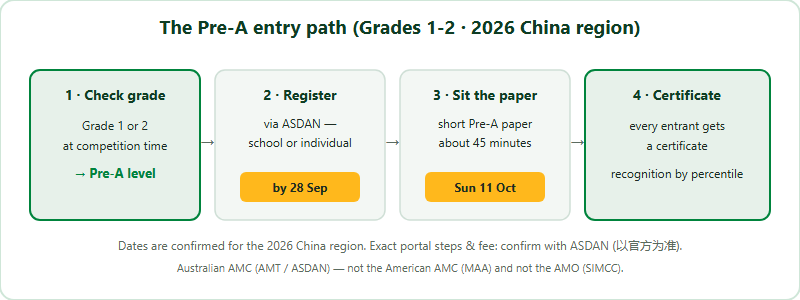
If your child is in Grade 1 or 2, the level to enter for the Australian Mathematics Competition (AMC) in China is Pre-A — a new level for 2026 built for the youngest students. You register through ASDAN (阿思丹), the China-region administrator, before the deadline of 28 September 2026, and your child sits one short paper on Sunday 11 October 2026. The Pre-A paper is gentle and age-appropriate, with no penalty for a wrong answer, so the honest goal is a happy first experience — not a score.
Pre-A in one minute: what a Grade 1-2 parent needs to know
Before any preparation, it helps to see the whole thing at a glance. Pre-A is the entry level of the Australian AMC for children in Grades 1-2, introduced for the 2026 China-region competition. The competition itself — the problems and the standard — comes from the Australian Maths Trust (AMT), the not-for-profit that has run the AMC in Australia since 1978; in China and Asia it is administered by ASDAN, who handle registration, the sitting and the certificates. This desk is operated by Hanlin Education for families in China. If the competition is new to you, our guide to what the Australian AMC is covers the six levels and format first.
| Who Pre-A is for | Grades 1-2 — the youngest level, new for 2026 |
| Register by | 28 September 2026 (through ASDAN, the China-region administrator) |
| Exam day | Sunday 11 October 2026 — one national day, all levels |
| The paper | Multiple-choice plus a few integer-answer questions; no penalty for a wrong answer; about 45 minutes for the youngest level |
| Languages | English & Chinese |
| What everyone gets | A certificate for every entrant; national recognition bands above that by percentile |
| Entry fee & portal steps | Set by ASDAN — confirm on the official site |
A quick word on names, because it trips up many families: the Australian AMC is not the American AMC (run by the MAA in the USA) and not the AMO (run by SIMCC in Singapore). Three different competitions, similar letters. On this site, “AMC” always means the Australian Mathematics Competition.
How registration works through ASDAN
For the China region, you do not enter through the Australian Maths Trust directly — you enter through ASDAN (阿思丹), the regional administrator. In practice, a Grade 1-2 entry usually reaches ASDAN by one of two routes, and which one applies to your family decides almost everything about the mechanics.
- Through your child's school. Many international and bilingual schools in China run the AMC as a group: the school's coordinator collects names, registers the cohort with ASDAN, and the children sit the paper at school on exam day. If your school already offers it, this is the simplest path — you confirm your child's grade and level (Pre-A) with the coordinator and they handle the rest.
- As an individual / through an authorised centre. If your child's school does not run it, ASDAN's China-region channels are where you confirm how an individual entrant signs up and where the paper is sat. The exact portal, the steps and the fee are set by ASDAN and can change year to year, so we point you to the official channels rather than printing steps that may be out of date.
Whichever route applies, three things stay the same and are worth fixing in your mind now: you register by your child's grade at competition time (Grade 1-2 → Pre-A); the registration deadline is 28 September 2026, comfortably ahead of the exam; and the paper is sat on Sunday 11 October 2026. For a fuller walk-through of choosing the right level by grade, see Australian AMC by Grade Band: Which Level and What to Expect.
What the youngest paper actually looks like (~45 minutes)
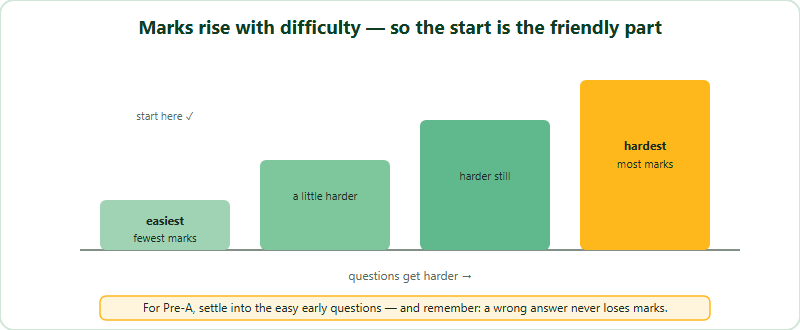
This is the part parents most want demystified, so let us be concrete and honest about what is verified and what is not. The Australian AMC is built around a single design idea at every level: a set of questions that climb in difficulty, where marks rise with the questions and there is no penalty for a wrong answer. The Pre-A paper for Grades 1-2 follows that same friendly shape, pitched for six- to eight-year-olds, and the youngest level runs for about 45 minutes.
A few things are worth setting expectations on clearly:
- It is mostly choosing, not writing. Like the other levels, the paper is largely multiple-choice with a small number of integer-answer questions. For a young child that means circling or marking an answer rather than showing long working — a format that suits short attention spans.
- It starts easy on purpose. The first questions are the gentlest in the paper and are designed to give every child a foothold. A Grade 1-2 student can expect to recognise the opening problems as “the kind of thing we do,” which is exactly the point.
- No penalty changes everything for a young child. Because a blank and a wrong answer both simply score nothing on that question, there is never a reason to feel anxious about an attempt. If a problem is too hard, the child picks their best guess and moves on — no marks are lost. This single rule is what keeps a first competition low-pressure.
- The exact Pre-A question count, mark total and minute-count: confirm with ASDAN. The Australian AMC paper across its levels is a 30-question, 135-mark format; the precise specification for the brand-new Pre-A level is set by AMT and ASDAN, so for the official Pre-A details, check the official channels rather than assuming it matches an older level exactly.
What kinds of questions appear? Without reproducing any real past problem, the flavour at the youngest end is visual and concrete rather than abstract. Picture a question that shows a row of shapes and asks which comes next; or a small word picture — “there are 4 red apples and 3 green apples, how many apples altogether?”; or a simple counting-and-comparing task with pictures of coins or animals. These are illustrative examples we have written to show the level, not items from any paper. The skill being rewarded is careful thinking — reading the picture, spotting the pattern — not speed or memorised tables.
Making a first competition a positive experience
For a six- or seven-year-old, the lasting outcome of Pre-A is not the certificate — it is how they feel about maths afterwards. A good first competition leaves a child thinking “that was interesting and I can do it again,” and a poor one can do the opposite. The encouraging news is that the AMC's design does most of the work for you; your job is mostly to keep the temperature low. Here is what genuinely helps, drawn from how young learners tend to experience a first timed paper.
| Before the day | Frame it as a puzzle morning, not a test. Let the child try two or three gentle pattern and counting puzzles so the format feels familiar — circling an answer, working alone for a short stretch. Keep practice to short, playful sessions; there is no syllabus to cram for a Grade 1-2 paper. |
| The morning of | Normal breakfast, arrive unhurried, bring a pencil they like. Remind them of the one rule that matters: if a question is tricky, pick your best guess and move on — nothing is lost. |
| During the paper | This is the child's own ~45 minutes. With no penalty, the right habit is simply to attempt every question and not get stuck. Finishing is a win in itself. |
| Afterwards | Ask “which one did you like?” before anything about score. Praise the effort and the trying, not the result. Every entrant earns a certificate — celebrate that they took part. |
Two honest framing points for parents. First, we make no admission or guaranteed-result claims: a Pre-A certificate is recognition of one paper on one day, not a ticket to any school or programme, and at this age it is best treated as encouragement rather than a credential. Second, the recognition that sits above the certificate is awarded by national percentile — so a band reflects how a child did against other Grade 1-2 entrants that year, not a fixed pass mark. For a young first-timer, the percentile band is genuinely beside the point; taking part calmly and wanting to come back is the real result.
If you are still weighing Pre-A against other young-learner contests before you commit, our honest comparison — Australian AMC vs AMO vs Math Kangaroo: Telling the Young-Learner Contests Apart — lays out how they differ so you can pick the one that fits your child, not the one with the loudest marketing.
Keeping the three look-alike “AMCs” straight
Because the letters overlap, it is worth one last check that you are entering your Grade 1-2 child in the right competition. Pre-A belongs to the Australian AMC only.
| Competition | Run by | Relevant to Grades 1-2? |
| Australian AMC (this site) | Australian Maths Trust (AMT, Australia); ASDAN in China/Asia | Yes — via the new Pre-A level for 2026 |
| American AMC (AMC 8/10/12) | Mathematical Association of America (USA) | No — aimed at secondary students |
| AMO (American Mathematics Olympiad) | SIMCC (Singapore) | A separate contest with its own grade structure |
A small but important note for families used to looking up the AMC online: the Australian Maths Trust's home Australian competition runs in August with divisions that begin at Years 3-4 — there is no Pre-A in that schedule. The China region is different: it runs in October with six levels covering Grades 1-12, and Pre-A for Grades 1-2 is part of that China-region line-up for 2026. If you read an Australian page that does not mention Pre-A, that is why — you want the China-region details, which is what this site covers.
Frequently asked questions
What level does my Grade 1 or 2 child enter?
Pre-A — the youngest Australian AMC level, new for 2026. You register by your child's grade at competition time through ASDAN, the China-region administrator.
When do we register, and when is the exam?
Register by 28 September 2026; the paper is sat on Sunday 11 October 2026. Confirm the live dates and portal steps on the official ASDAN channels.
How long is the Pre-A paper and does a wrong answer lose marks?
The youngest level runs about 45 minutes, and there is no penalty for a wrong answer — so your child can attempt every question without worry.
Does my child need to prepare a lot?
No. A few short, playful pattern-and-counting puzzles to learn the format is plenty. Every entrant receives a certificate; a happy first experience is the goal.
This is the editorial desk for the Australian Mathematics Competition (AMC) China region. The competition is run by the Australian Maths Trust (AMT) and administered in China and Asia by ASDAN (阿思丹); this content desk is operated by Hanlin Education for students in China. Dates, fees, levels and rules are set by the AMT and ASDAN and can change each year — always confirm current details on the official channels (amt.edu.au and the ASDAN China-region channels). Confirmed errors are corrected within 7 working days.