
In the final weeks before the Australian Mathematics Competition (AMC) on Sunday 11 October 2026, the most effective revision is calm and specific, not frantic. Spend this stretch doing timed past-paper practice, reviewing the question types at your registered level, rehearsing your pacing across the 30-question paper, and locking in the one habit that matters most — the no-penalty mindset, where attempting every question is always the right call.
First, why the last few weeks reward calm over cramming
The AMC is a reasoning competition, not a memory test, so the panic-cramming that works for a vocabulary quiz simply does not move the needle here. You cannot memorise your way to a higher score; you raise it by becoming faster and steadier at thinking under time. That is genuinely good news for the final weeks — it means short, focused, low-stress sessions beat long anxious ones, and a student who arrives rested and familiar with the format will outperform one who crammed late and arrived frazzled.
It helps to remember the shape of what you are preparing for. Every level sits a single 30-question paper — 25 multiple-choice and 5 integer-answer questions — out of 135 marks, with time ranging from about 45 minutes for the youngest level to 75 minutes for senior levels. Crucially, there is no penalty for a wrong answer: a blank and a wrong answer score exactly the same. The whole revision plan below is built around that one design feature. If the competition itself is still new to you, it is worth a quick read of what the Australian AMC is before you plan your weeks.
A three-week revision plan you can actually follow
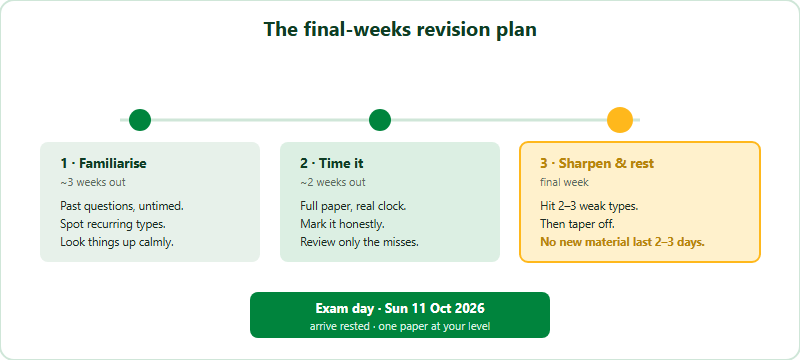
Here is a simple structure for roughly the last three weeks. It is deliberately light — three to four short sessions a week, not daily drilling — because consistency beats intensity and because a tired student makes careless mistakes. If you have more or fewer weeks, stretch or compress the same three phases; the order is what matters. Adjust freely for a young child sitting Pre-A or A, where ten focused minutes is plenty.
| Phase | Focus | What a session looks like | Roughly when |
| 1. Familiarise | Format & question types | Work through past questions untimed; notice which types recur; look up anything unfamiliar calmly | ~3 weeks out |
| 2. Time it | Pacing under the clock | Sit a full past paper at your level under real time limits; mark it; review only the ones you got wrong | ~2 weeks out |
| 3. Sharpen & rest | Weak spots, then taper | Short targeted practice on 2–3 weak question types; then ease off in the final days | Final week |
Notice the deliberate taper in Phase 3. The last two or three days before 11 October are not for new material — they are for a light review, a good night’s sleep, and arriving relaxed. Trying to learn a brand-new topic the night before tends to dent confidence more than it adds marks. The single most valuable resource throughout is genuine past papers at your own level; where to obtain official practice papers for the China region is set by ASDAN, so confirm the current source on the official ASDAN channels rather than relying on stray PDFs of uncertain provenance.
Timed past-paper practice: the heart of the plan
If you do only one thing in these weeks, make it this: sit at least one full past paper under real time conditions at your registered level. Untimed practice teaches the maths; timed practice teaches the exam — how the clock feels, when to move on, and how to stay composed when a question resists. Set a quiet table, a timer for your level’s actual limit, and no interruptions, then sit the whole paper as if it were the real thing.
Marking afterwards is where the learning happens, and the trick is to be economical about it. Do not re-do questions you already got right — that just rewards what you can already do. Instead, look only at the ones you missed or guessed, and for each ask a single diagnostic question: was this a knowledge gap, a careless slip, or a timing problem? Those three causes have three different fixes, and naming the cause is most of the cure.
| Why you missed it | What it looks like | The fix in the final weeks |
| Knowledge gap | You didn't know the method at all | Do 3–4 short practice questions of that one type; that's usually enough |
| Careless slip | You knew it but mis-read or mis-arithmetic’d | Slow down on the first read; re-check the question is asking what you think |
| Timing problem | You'd have got it with more time | Practise moving on — flag it, attempt later; the no-penalty rule makes this safe |
One full timed paper, reviewed this way, teaches more than five papers skimmed. For younger students, scale the idea down: a short timed set of the easier questions builds the same composure without overwhelm. Whether the AMC is the right level of challenge and stretch for your child is a separate, honest question worth weighing — our honest assessment of the AMC's prestige and academic value covers that without hype.
Reviewing question types by level — without learning real papers
Across a paper the questions climb in difficulty, and the marks rise with them: early questions are gentle and worth less, the hardest come last and are worth the most. Knowing this changes how you revise. Rather than grinding random problems, spend Phase 1 noticing which broad types of reasoning recur at your level, so none of them feels alien on the day. The families below are generic skills, illustrated with our own made-up examples — the AMC writes fresh problems every year, and we never reproduce its actual past questions.
| Question family | Where it shows up | Our own illustrative example (not a real AMC question) |
| Patterns & sequences | Lower levels (Pre-A / A) | “Shapes go triangle, circle, triangle, circle … what is 8th?” |
| Arithmetic & word problems | A / B | “A box holds 6 pencils; how many boxes for 50 pencils?” |
| Geometry & spatial | B / C | “A square is folded in half twice — how many smaller squares?” |
| Counting & logic | C / D | “How many three-digit numbers have digits that add to 6?” |
| Algebra & number theory | D / E | “Find the remainder when a large power is divided by 7.” |
The point of this table is not the specific problems — it is the habit of recognising a type quickly, because recognition saves the seconds that timed papers are won and lost by. The five integer-answer questions at the end deserve a special note: they are typically the toughest, so in your timed runs, decide in advance how long you’ll give them before moving on, and remember that even a reasoned guess on these costs you nothing.
Pacing and the no-penalty mindset on the day
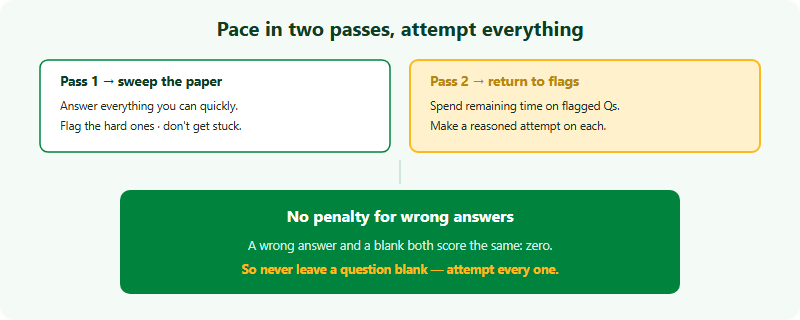
Pacing is simply applied arithmetic: with around 30 questions and (depending on level) roughly 45 to 75 minutes, a steady rhythm is to bank the early, easier questions efficiently and reserve more thinking time for the harder back half. A reliable plan is two passes — first pass: answer everything you can quickly, flagging anything that needs more thought; second pass: return to the flagged questions with your remaining time. This way you never lose an easy mark by running out of clock on a hard question you got stuck on early.
The mindset that ties it together is the no-penalty rule, and it deserves to be said plainly because it removes the single biggest source of exam anxiety. Nothing is ever subtracted for a wrong answer. A blank and a wrong answer score identically — zero — so leaving a question blank can only ever lose you the chance of a mark. The correct, calm strategy is therefore: attempt every single question, and on the ones you cannot crack, make your best reasoned attempt before time runs out. For a child sitting their first competition, internalising this one rule is often worth more than any extra hour of drilling.
A quick word: make sure you’re revising for the right “AMC”
Before you build your plan around any practice material, confirm it is for the Australian AMC. Several contests share the letters “AMC,” and a separate competition is called the AMO — they are run by different organisations, with different papers, formats and rules. The six-level ladder (Pre-A to E), the 135-mark no-penalty paper, and the 11 October China date in this plan belong to the Australian AMC only; revising from another contest’s papers would simply be practising the wrong exam.
| Competition | Run by | Does this revision plan apply? |
| Australian AMC (this site) | Australian Maths Trust (AMT), Australia; ASDAN (阿思丹) in China/Asia | Yes — six levels, no-penalty paper, China sits 11 Oct 2026 |
| American AMC (AMC 8/10/12) | Mathematical Association of America (MAA), USA | No — a different competition, different format and rules |
| AMO | SIMCC, Singapore | No — a separate contest with its own paper |
If you are preparing a Grade 1–2 child for the brand-new Pre-A level, the same calm principles apply on a smaller scale — our parent's guide to Pre-A for Grades 1–2 walks through what a first competition looks like for the youngest entrants.
Frequently asked questions
What is the single best use of the final weeks?
Sit at least one full past paper at your level under real time limits, then review only the questions you got wrong. Timed practice teaches the exam, not just the maths.
Should I learn new topics the night before?
No. The last 2–3 days are for light review and rest, not new material. Arriving relaxed and familiar with the format beats late cramming for a reasoning exam.
What should I do on a hard question I can’t solve?
Make your best reasoned attempt — never leave it blank. A wrong answer and a blank both score zero, so attempting every question can only help.
Where do I get official practice papers for the China region?
Genuine past papers at your level are the best resource. The current source is set by ASDAN — confirm it on the official ASDAN China-region channels.
This is the editorial desk for the Australian Mathematics Competition (AMC) China region. The competition is run by the Australian Maths Trust (AMT) and administered in China and Asia by ASDAN (阿思丹); this content desk is operated by Hanlin Education for students in China. Dates, fees, levels and rules — including where to obtain official practice papers and the exact entry steps — are set by the AMT and ASDAN and can change each year; always confirm current details on the official channels (amt.edu.au and the ASDAN China-region channels). Confirmed errors are corrected within 7 working days.