
You do not need to solve a single competition problem to be genuinely useful to your child's Australian AMC campaign. A parent's real jobs are logistics (registration closes 28 September 2026, exam day in China is 11 October), environment (a weekly rhythm and quiet timed practice), mindset (praising process over score), and post-exam framing. This guide walks through each job — and the well-meant habits that quietly backfire.
The Four Jobs That Actually Help
The Australian Mathematics Competition — run since 1978 by AMT, the Australian Maths Trust, and delivered in China through ASDAN — spans six levels from Pre-A to E, covering Grades 1 to 12. That range means parents of a seven-year-old and parents of a Year 11 student are supporting very different campaigns. But across every age, effective support falls into the same four jobs, and none of them involves teaching maths:
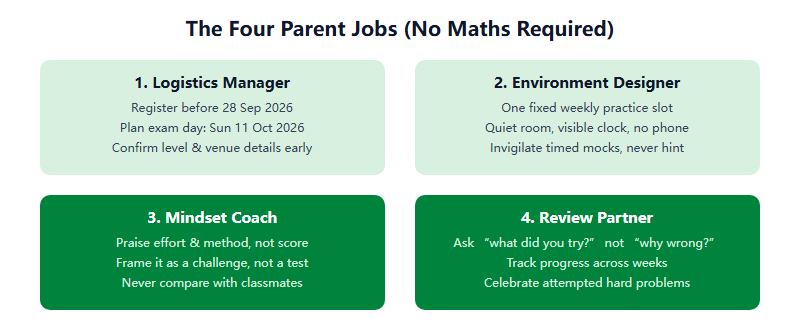
- Logistics manager — own the dates, the registration, and the exam-day plan.
- Environment designer — protect a regular, distraction-free practice slot each week.
- Mindset coach — manage what the competition means in your household.
- Review partner — help turn practice results into next steps, without judging them.
If the competition itself is new to your family, our plain-language explainer What Is the Australian AMC? covers the format, levels and awards in one read — worth ten minutes before you plan anything.
Job 1: Own the Logistics
The administrative facts for the 2026 China sitting are simple, and a parent should own all of them so the student never has to think about admin:
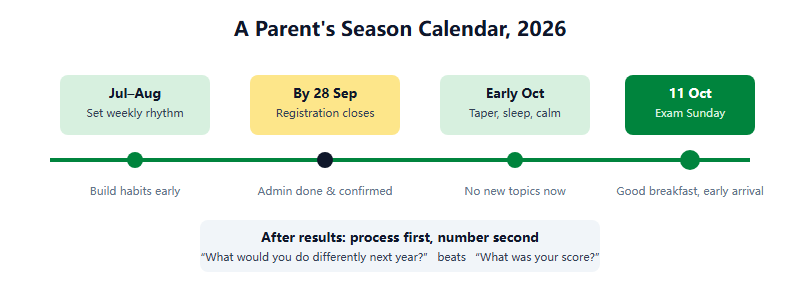
- Registration deadline: 28 September 2026. In China, entry runs through ASDAN's channels, typically via your child's school or an authorised registration route. Do not leave it to the last week of September — school approval chains and payment steps take time.
- Exam day: Sunday 11 October 2026. Note that this China-region date differs from the Australian domestic sitting earlier in the year — the October date is the one that matters for your family.
- Know your child's level. The six divisions map to grade bands: Pre-A (Grades 1–2, new for 2026), A (3–5), B (6–7), C (8–9), D (10–11), E (12). The level determines the paper and its duration (papers run roughly 45–75 minutes depending on level — confirm the exact timing for your child's division when registering).
- Confirm venue and reporting time in advance, and check current rules on permitted stationery with your test centre or amt.edu.au rather than assuming.
Job 2: Design the Environment
Between now and October, consistency beats intensity. One protected 60–90 minute slot per week — same day, same time, quiet room, visible clock, phone outside the door — will outperform sporadic three-hour weekend marathons. Your role is to defend that slot against the family calendar, not to supervise the maths inside it.
When your child sits a timed practice paper, you have one additional role: invigilator. That means managing the clock and saying nothing else. The hardest discipline for a caring parent is watching a child stare at a problem without offering a hint — but the ability to sit with a hard, unfamiliar problem is precisely the skill the competition builds. Rescuing them from that discomfort in practice removes the training effect.
Job 3: Coach the Mindset
Two structural facts about the Australian AMC make it unusually friendly territory for healthy framing, and parents should use both:
- There is no negative marking. Out of a maximum of 135, wrong answers cost nothing. That means you can honestly tell your child: attempt everything, guess bravely when stuck, and treat hard questions as free shots. Anxiety about “losing marks” has no basis on this paper.
- Recognition is percentile-based and broad. Awards are tiered by performance relative to other candidates, and every participant receives a certificate. The realistic goal for most first-time candidates is not a top award — it is a real personal benchmark and a better score next year. Framing it that way in July prevents tears in November.
The language you use matters more than you think. Compare “How many did you get right?” with “Which problem was the most interesting?” The first trains your child to see maths as a scoreboard; the second trains curiosity — and, not incidentally, curiosity is what keeps students voluntarily practising in week nine of a thirteen-week season.
What Support Looks Like at Each Age
| Level | Grades | What your child needs most | What to avoid |
|---|---|---|---|
| Pre-A | 1–2 | Short, playful sessions (15–20 min); reading questions together for stamina, celebrating the sitting itself | Any framing of the event as a high-stakes test; drilling past bedtime enthusiasm |
| A | 3–5 | A weekly rhythm; puzzle framing (“let's crack this one”); a parent invigilator for one timed run | Comparing siblings or classmates; correcting their working mid-problem |
| B | 6–7 | Ownership handover: they manage the clock, you manage the calendar; interest in their favourite problems | Hovering during practice; treating a mid-range score as failure |
| C | 8–9 | Respect for their plan plus gentle accountability (“still on for Sunday's paper?”) | Adding pressure on top of school exam load; score interrogations |
| D–E | 10–12 | Logistics fully off their plate; sleep protection in October; perspective on how one contest fits the bigger picture | Attaching university outcomes to a single Sunday morning |
The Three Traps That Backfire
Trap 1: Turning practice into performance review. If every practice paper ends with a verdict on the score, your child will start choosing easier problems to protect the number. Track scores privately across weeks if you like — trends are useful — but let individual sessions be judgment-free.
Trap 2: Outsourcing motivation to stakes. “This matters for your future” feels motivating to say and is corrosive to hear, especially for a Grade 4 student. The Australian AMC is one of the world's most established school maths competitions, sat by students across dozens of countries — participation is valuable, but no single contest deserves existential weight. Keep the stakes the size they actually are: a challenging, interesting Sunday morning.
Trap 3: Confusing your anxiety for theirs. Children calibrate their stress to the adults in the room. If exam-week conversations at dinner are relaxed, your child walks in relaxed. The single most useful thing many parents can do in the final week is visibly not worry.
One more thing worth doing before the season gets busy: read up on how the levels, marking and awards actually work, so your expectations are anchored to reality rather than hearsay. Our complete introduction to the Australian AMC is the place to start.
FAQ
Do I need to be good at maths to help my child prepare?
No. The four highest-value parent jobs — logistics, practice environment, mindset and review framing — require zero competition maths. Teaching is the one job best left to teachers or the student.
When should we register for the 2026 China sitting?
Well before the 28 September 2026 deadline. Entry in China runs through ASDAN channels, usually via your school; starting early avoids last-minute payment and approval issues.
How much weekly practice is reasonable?
One protected 60–90 minute session a week from July, plus occasional timed papers, is plenty for most levels. Consistency across thirteen weeks beats cramming in the final fortnight.
What if my child scores lower than we hoped?
Every participant receives a certificate, and awards are percentile-based. Frame the first attempt as a benchmark: review what worked, what to change, and let next year's paper be the rematch.
Published by the Australian AMC editorial desk, operated by Hanlin Education for China-based international-school students. Official rules, dates and award criteria are set by the competition organisers and can change each year — always confirm current details on amt.edu.au and with your ASDAN registration channel. If you spot an error, we correct it within 7 working days.