
Algebra on the Australian AMC rarely looks like school algebra. It looks like a pattern — a list of numbers, a growing arrangement of dots, a sequence that repeats — and it asks for the 100th term. This guide covers the three families of pattern question, the four-step route from pattern to formula, when an equation is the wrong move, and how the demand scales across the six China-region levels sitting on 11 October 2026.
What “algebra and pre-algebra” means on this paper
The Australian Maths Trust (AMT), which has set the AMC since 1978, lists algebra and pre-algebra among the topics the paper may draw on, alongside basic arithmetic, fractions and ratios, geometry, measurement, statistics and probability, and problem-solving. The wording matters: pre-algebra signals that the strand starts long before students meet the letter x. A Grade 2 student continuing a pattern of shapes and a Grade 12 student deriving an nth-term formula are doing the same mathematics at different depths.
Two structural facts shape how you should prepare. First, at Levels A to E the paper is 30 questions — 25 multiple-choice plus 5 integer-answer — worth 135 marks, with no penalty for a wrong answer; marks rise from 3 each for questions 1–10, to 4 for 11–20, 5 for 21–25, and 6, 7, 8, 9 and 10 for the final five. Pre-A (Grades 1–2) sits a shorter paper — 25 questions in 45 minutes — so those mark bands describe Levels A to E only; confirm the format for your level on our China Region page. Second, most pattern questions are answered under two minutes if you recognise the family and much longer if you don’t — so recognition, not manipulation, is the skill to train.
In China the competition is administered by ASDAN and sat on Sunday 11 October 2026, with registration closing 28 September 2026, on a bilingual paper of 45–75 minutes depending on level. If the competition itself is new to you, read What Is the Australian AMC? first. The AMT publishes the topic list but not a per-question topic weighting, so the maps in this article are an editorial planning tool, not an official specification — and rules and dates change yearly, so confirm current details on amt.edu.au or with your registration channel.
Three families of pattern question — and the give-away signal for each
Nearly every sequence question on an AMC paper belongs to one of three families. Learning to name the family in the first ten seconds is worth more than any amount of algebraic fluency.
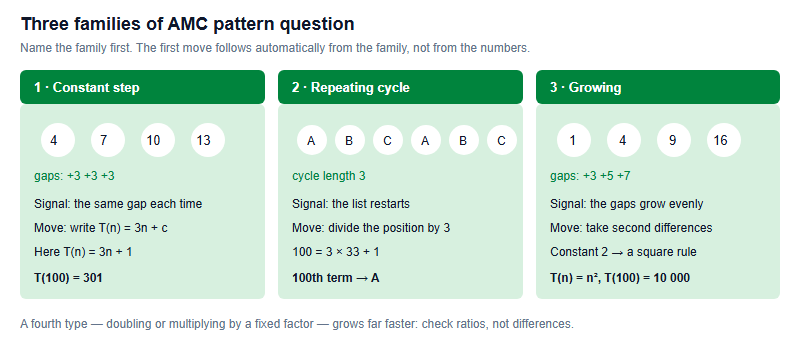
Two warnings about family recognition. First, three terms are never enough. The list 1, 2, 4 could continue 8 (doubling) or 7 (differences 1, 2, 3). Always generate a fourth term from your proposed rule and check it against the question. Second, figurate patterns — dots arranged in triangles, squares or L-shapes — are family 3 in disguise: count the objects, write the counts as a sequence, and the picture becomes numbers. Triangular numbers 1, 3, 6, 10 follow n(n + 1)/2, so the 20th is 210.
From pattern to rule: the four-step pipeline
Once the family is named, the route to a formula is mechanical. Follow the same four steps every time and the off-by-one errors that plague this topic disappear.
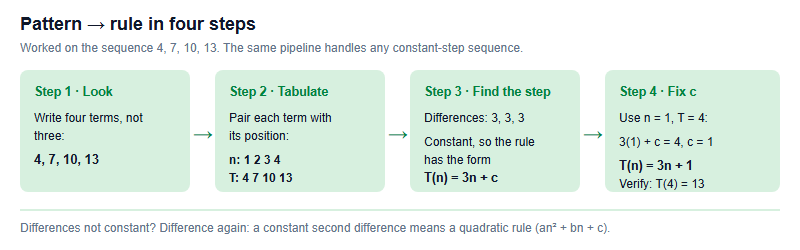
The pipeline scales. For the sequence 2, 6, 12, 20 the first differences are 4, 6, 8 and the second difference is a constant 2, which flags a quadratic rule; testing n(n + 1) gives 2, 6, 12, 20 exactly. For a doubling sequence such as 3, 6, 12, 24 the differences never settle but the ratios are all 2, giving 3 × 2(n−1).
| Family | Give-away signal | First move | The classic trap |
|---|---|---|---|
| Constant step | Equal gaps between terms | T(n) = (gap) × n + c, then fix c | Forgetting c, or counting gaps instead of terms |
| Repeating cycle | The list returns to its start | Divide the position by the cycle length; use the remainder | A remainder of 0 means the last item of the cycle, not the first |
| Growing (quadratic) | Gaps increase by a constant amount | Take second differences; test a square-based rule | Guessing the rule from three terms only |
| Growing (multiplying) | Each term is a fixed multiple of the last | Check ratios; write a × r(n−1) | Applying the exponent to the wrong position index |
| Figurate / picture | Dots or tiles in a growing arrangement | Count each picture, then treat the counts as a sequence | Counting the picture wrongly, then solving perfectly |
Equation or no equation? A decision rule
The most useful judgement in this strand is knowing when not to do algebra. On a timed paper, setting up and solving an equation is sometimes the slowest correct route.
Set up an equation when the same unknown appears in two different relationships; when the question asks for an exact value that is awkward to reach by trial; or when you need a general rule rather than one term. Take “there are three times as many red counters as blue, and 24 more red than blue”. Let blue be b; then red is 3b, and the second relationship gives 3b − b = 24, so b = 12, red = 36, and the total is 48. Two sentences, two relationships, one variable — that combination is the reliable signal that algebra is the fastest route.
Skip the equation when a bar model or a “one part is worth…” argument gets there faster; when the sequence is short enough to extend directly (finding the 8th term rarely needs a formula); or when the structure is obviously modular and a single division answers it.
Two bridging habits are worth building. The first is letting one part be the variable: in ratio-flavoured questions, writing the quantities as 3x and 5x converts a wordy problem into a one-line equation, which is why the pre-algebra and ratio strands reinforce each other. The second is substitution as verification: once you have an answer, put it back into the original sentence — not into your own equation, which may already contain the mistake.
Pre-algebra without symbols: what the lower levels are really being asked
The China region runs six levels, Pre-A to E, covering Grades 1–12, and students enter the level matching their grade at competition time. The level names used in China differ from the division names used in Australia, so confirm which paper you should sit on our China Region page or with your registration channel before 28 September. Our foundation guide sets out all six levels.
| Level | Grades | What the algebra strand looks like | What to practise |
|---|---|---|---|
| Pre-A (25 questions / 45 min) | 1–2 | Continue a picture or colour pattern; what comes next | Saying the rule out loud before answering |
| A | 3–5 | Number sequences with a constant step; missing number in a chain | Skip counting; checking a rule on a fourth term |
| B | 6–7 | Describing a rule in words; simple substitution into a formula | Position tables; the 100th-term question |
| C | 8–9 | Linear rules, cycles with remainders, forming an equation | The four-step pipeline; modular reasoning |
| D | 10–11 | Quadratic patterns, two related unknowns, manipulation | Second differences; simultaneous relationships |
| E | 12 | Rules combined with constraints; exact integer answers | Bounding an answer, then confirming it exactly |
For younger candidates the productive habit is verbal, not written: ask the child to say the rule in a sentence — “it goes up by three each time” — before touching a pencil. Students who can state the rule almost always continue the pattern correctly; students who continue by feel are guessing, and it shows in the harder questions.
A short weekly routine works better than long sessions: three mixed pattern questions from different families, timed, then one written line for each explaining which family it was and how you knew. Because there is no penalty for a wrong answer, commit to a best reasoned attempt on every question — on Levels A–E especially at questions 26–30, where 6 to 10 marks each are at stake and a partial structure often produces the right integer. The shorter Pre-A paper has no questions 26–30, but the same no-penalty logic applies there too.
Frequently asked questions
Is algebra officially on the AMC?
Yes. The AMT lists algebra and pre-algebra among the topics the paper may draw on, though it does not publish a per-strand question count.
How do I know whether a sequence is quadratic?
Take differences of the differences. A constant second difference means the rule is quadratic; then test a square-based formula on all four terms.
Do younger students need to learn formulas?
No. At Pre-A and Level A the skill is stating the rule in words and checking it on the next term, not writing algebra.
Is it faster to test the multiple-choice options instead?
Sometimes, for short sequences. For a 100th-term question, finding the rule is almost always faster than extending the list.
Published by the Australian AMC editorial desk, operated by Hanlin Education for China-based international-school students. The Australian Mathematics Competition is set by the Australian Maths Trust (AMT) and administered in the China region by ASDAN; official rules, dates and formats are set by the competition and change yearly — confirm current details on amt.edu.au. Errors reported to the editorial desk are corrected within 7 working days.