
The 2026 Australian AMC added Pre-A for years 1–2 — the first time since the competition began in 1978 that entry reaches down to lower primary. The Australian Maths Trust has announced no change to the Level A or Level B papers. Our coaches, however, report that both now feel pitched closer to the top of their year bands. This article separates what is confirmed from what is our judgement, and shows how to prepare so that it barely matters which reading is right.
First, what actually changed in 2026
One thing changed, and it is genuinely significant. The competition added a sixth level, Pre-A, for students in years 1–2. Before this, lower-primary students had no paper of their own; the competition simply started higher up. If you want the full structural picture of levels, format and marking, our guide to what the Australian AMC is lays it out.
Pre-A is worth understanding properly, because it is easy to assume it is just Level A with easier numbers. It is not. The Pre-A paper is deliberately built picture-heavy and text-light, and it comes with a read-aloud facility so that a child whose reading is still developing is not effectively sitting an English test. That combination matters: it means a six-year-old who can reason mathematically but cannot yet decode a paragraph of English can compete on the mathematics rather than on literacy. Pre-A is a purpose-built entry event, not a diluted version of the paper above it.
Almost everything else is unchanged. The paper is 30 questions for a maximum of 135 marks, there is no negative marking, papers are bilingual, the China-region sitting is on 11 October 2026, and entries close on 28 September. The level a student sits is set by the year group they are in from September 2026:
| Level | Year group (from Sept 2026) | Years spanned | Status of our coaching read |
|---|---|---|---|
| Pre-A | Years 1–2 | 2 | New in 2026 — no prior baseline to compare against |
| A | Years 3–5 | 3 | Our coaches report it feeling closer to the old year-5 standard |
| B | Years 6–7 | 2 | Our coaches report it feeling closer to old years 7–8 |
| C | Years 8–9 | 2 | Not part of this read — nothing reported |
| D | Years 10–11 | 2 | Not part of this read — nothing reported |
| E | Year 12 | 1 | Not part of this read — nothing reported |
Why a new level at the bottom can affect the levels above it
Adding a level does more than serve the students who sit it. It moves the entry point of the whole competition. Before 2026, the youngest and least experienced entrants in the system — students at the very bottom of Level A — had one option if they wanted to take part at all. With a purpose-built Pre-A paper available, that group now has somewhere designed for them.
That is the mechanism our coaches point to when they say Levels A and B feel firmer this cycle. We want to be careful here, because this is the exact point where a plausible story can quietly harden into a claimed fact. We are describing a hypothesis about why the papers feel different, not something the Australian Maths Trust has stated. The arrival of Pre-A has been announced for the China region. No announcement has been made that Level A or Level B has been made harder, and we have no basis for saying it has.
Our coaching read — stated plainly, and labelled as what it is
Here is the judgement, in one sentence: across our China-region coaching this cycle, Level A feels pitched closer to what used to feel like a year-5 standard, and Level B closer to old years 7–8. That is a read from people who see a lot of students work through a lot of papers. It is not a measurement, and you should weight it accordingly.
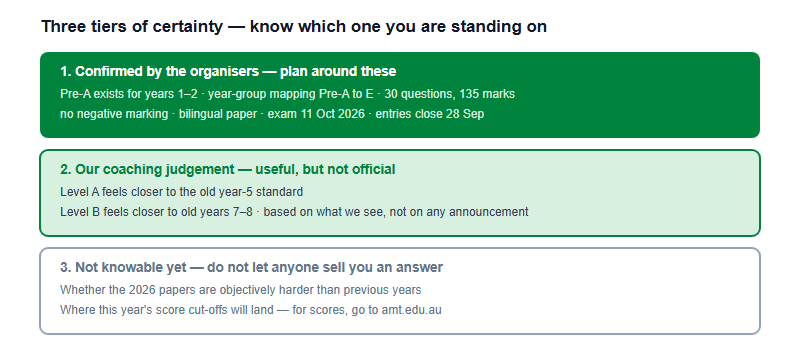
Three things this read explicitly does not mean:
- It does not mean your child is in the wrong level. Level is determined by year group, as set out in the table above. It is not a choice to be optimised.
- It does not mean fewer students will be recognised. This is the reassurance that matters most, and it follows from how the awards work. The bands are set by national percentile, not by a fixed score: Prize goes to roughly the top 0.3%, High Distinction to the top 3% at Levels A–D, Distinction to the top 20%, and Credit to the top 55%, with Proficiency below that. Because the thresholds are proportions of the cohort, a paper that feels harder does not shrink the number of Distinctions — the score needed simply moves. Your child is measured against the other students who sat it, not against last year's numbers.
- It does not mean you should hunt for last year's cut-off scores. Those numbers move every year and circulate in unreliable forms. If you want scores, take them from amt.edu.au and nowhere else.
What this means if your child sits Level A (years 3–5)
Level A spans three year groups, which is the widest band in the competition. That asymmetry exists whether or not our read is correct, and it is the thing parents most often misinterpret. A year-3 student and a year-5 student sit the same paper and are ranked in the same national cohort, having had two additional years of schooling between them.
The practical consequences for a younger Level A student:
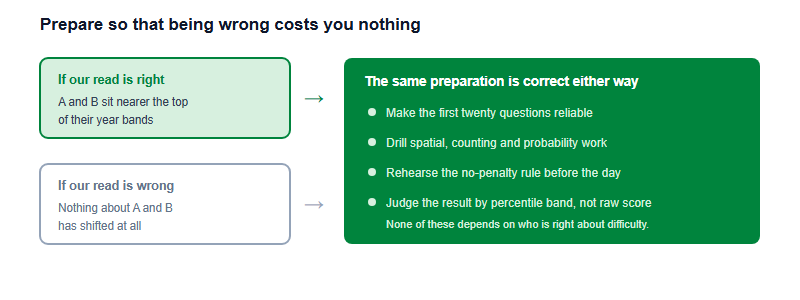
- Own the first twenty questions before touching the last ten. The opening stretch overlaps heavily with school syllabi; the back ten deliberately does not. For a year-3 or year-4 student, reliability early is worth far more than heroics late.
- Treat the back of the paper as exploration, not obligation. Attempt what looks tractable, and do not build the experience around finishing.
- Read a modest score in context. A year-3 student sitting mid-band in a three-year cohort has done something respectable. Comparing that result against a year-5 classmate's is comparing two different situations.
- Do not skip the spatial work. Nets, folding and three-view questions are where we see marks vanish at this level, precisely because school maths drills them least.
What this means if your child sits Level B (years 6–7)
Level B spans two year groups, so the internal gap is narrower than Level A's. If our read is right and the paper now sits closer to old years 7–8, the students most affected are year 6 students at the bottom of the band — who may meet material that feels a year or more ahead of their classroom.
That is not a reason for alarm, and it is emphatically not a reason to delay entry, since the level follows the year group. It is a reason to shift the emphasis of preparation:
- Prioritise reasoning over syllabus coverage. Trying to pre-learn a year of school content in eight weeks does not work. Getting comfortable with unfamiliar-looking problems does.
- Spend disproportionate time on counting and probability. These cluster in the back third of the paper, where the marks are heaviest, and they reward technique far more than prior curriculum exposure.
- Rehearse the no-penalty rule properly. With no negative marking, a blank multiple-choice answer is strictly worse than a guess. The final five questions ask you to supply an answer rather than choose one, so a blind guess there earns nothing — though a reasoned partial attempt may still land.
- Expect the difficulty ramp to feel steeper than school assessments. That is by design, not a sign of being in the wrong place.
How we would know if we are wrong — and why your prep should not depend on it
A judgement worth publishing is one you can say how to disprove. Ours would look shaky if students at the bottom of each band performed in line with previous cycles, if this year's official score cut-offs at A and B landed close to previous years once published, or if coaches outside our own cohort reported no such shift. We are working from what our teams see, which is a real but partial view.
Fortunately, you do not have to resolve the question to prepare well. The preparation that follows from our read and the preparation that follows from assuming nothing changed are very nearly the same preparation.
One final check that costs nothing: confirm you are preparing for the right competition. The Australian AMC is run by the Australian Maths Trust; the American AMC is a separate competition run by the MAA; AMO is different again, run by SIMCC. Only the Australian AMC has a Pre-A level and an 11 October China sitting. Our overview of the Australian AMC spells out the distinction, and the authoritative source for rules, dates and scores is always amt.edu.au.
Frequently asked questions
Has any change to Levels A and B been announced for 2026?
No. The announced change is the new Pre-A level. The observation that A and B feel firmer is our coaching judgement, not an official statement.
Can my year-2 child sit Level A instead of Pre-A?
Level follows the year group the student is in from September 2026, so years 1–2 sit Pre-A. Confirm arrangements with your coordinator or on amt.edu.au.
If the paper is harder, will fewer students get a Distinction?
Not by itself. Award bands are national percentiles — around the top 20% for Distinction at Levels A–D — so the score threshold moves rather than the proportion.
What score does my child need this year?
There is no fixed answer, because bands are percentile-based and cut-offs move annually. Take any score figures from amt.edu.au directly.
Published by the Australian AMC editorial desk, operated by Hanlin Education for China-based international-school students. Official rules are set by the competition and change yearly — confirm current details on amt.edu.au. Errors are corrected within 7 working days.