
On long Australian AMC word problems, most marks are lost before any calculation begins. Students who can comfortably solve the underlying equation still get the question wrong, because they built the wrong equation from the English. The fix is not more arithmetic practice and not more vocabulary — it is a repeatable routine for turning prose into a mathematical condition. Here is the one our coaches use.
The loss zone that looks like a maths problem but isn't
Across our China-region coaching, this is one of the most common places marks disappear, alongside spatial and figure work. The pattern is unmistakable once you look for it: a student gets a back-half question wrong, you sit down with them, and within thirty seconds of talking it through they solve it instantly. Nothing was wrong with their mathematics. They misread a relationship, or missed a condition entirely, and then executed flawlessly on the wrong problem.
This matters more on the Australian AMC than on a school test because of where these questions sit. The first twenty questions overlap heavily with school syllabi and tend to be short and direct. The last ten do not, and that is where the long, condition-dense wording lives — and where the marks are heaviest, since the paper is weighted so later questions carry more, up to a maximum of 135. Check the exact per-question values for your level on amt.edu.au. If you want the structural picture of the paper first, see our guide to what the Australian AMC is.
It is worth naming what this is not. It is not a vocabulary gap — students who know exactly what “consecutive” means still misread “three more than.” And it is not carelessness in the usual sense, because the student is reading carefully; they are simply reading for meaning rather than for structure. Those are different activities, and only one of them builds an equation.
What “extracting the condition” actually means
A word problem is a mathematical object wearing a costume. Somewhere in the sentences there is a quantity you are asked for, some fixed numbers, and one or more relationships that pin things down. Extraction is the deliberate act of stripping the costume off and writing down those pieces separately — on paper, before you attempt anything.
Most students skip this because it feels slow and because in school it usually is unnecessary; classroom word problems are typically one relationship long, so you can hold them in your head. Contest problems in the back third routinely carry two or three interacting conditions, which is exactly the point at which holding them in your head stops working.
The four-line routine
Four lines, always in this order, always written down. It takes about thirty seconds once it is habitual.
- ASKED — what exactly is the question asking for? Name it with a letter. Write the units.
- GIVEN — the fixed numbers, each labelled with what it counts.
- CONSTRAINT — the relationships between quantities. This is where the marks live.
- MODEL — the equation, diagram or table the first three lines force on you.
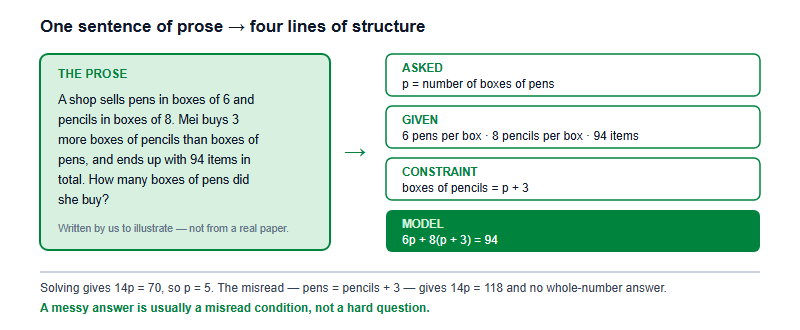
That last observation is worth internalising as a standing self-check. Contest answers are usually clean — whole numbers, tidy fractions. When your working produces something ugly on a back-half question, the most likely explanation is not that the question is unusually nasty; it is that one CONSTRAINT line is reversed. Go back and re-read that line before you burn three more minutes grinding forward.
Five phrases that reliably cost marks
Extraction errors are not random. The same handful of English constructions cause them again and again, and they cluster around comparison, boundary and counting language rather than around mathematical vocabulary.
| The phrase | What it actually says | The classic misread | Quick check |
|---|---|---|---|
| “A has 5 more than B” | A = B + 5 | B = A + 5 — the direction flips | Say aloud which one is bigger, then check your line agrees |
| “three times as many as” | The multiplier attaches to the other quantity | Multiplying the wrong side, or by the wrong factor | Substitute a small number and sanity-check the size |
| “at least” / “at most” | Inequality including the boundary value | Excluding the boundary, losing one valid case | Test the boundary value explicitly — does it qualify? |
| “from the 3rd to the 9th” | 7 items, not 6 — both ends count | Subtracting and forgetting to add one | Count a tiny version by hand: 3rd to 5th is 3 |
| “distinct” / “consecutive” | A hidden constraint that removes cases | Ignoring it and over-counting | Circle these words on first read; they are never decorative |
Notice that four of the five are about relationships and boundaries, not about knowing a technical term. This is why vocabulary drilling alone does not fix the problem: a student can define every word in the sentence and still assemble the relationship backwards.
Use the bilingual paper as a check, not as a crutch. The China-region paper is bilingual, which is a real advantage here — and one that students routinely misuse. The wrong approach is to read both versions of all thirty questions, which doubles your reading time and delivers almost nothing on the short, direct questions at the front.
The efficient approach is targeted. Read your stronger language by default. Then, on back-half questions only, use the second version to verify the CONSTRAINT line specifically — the comparison direction, the inclusive or exclusive boundary, the hidden qualifier. Those are exactly the places where a misread costs a whole question, and exactly the places where a second phrasing resolves the ambiguity in a few seconds. Cross-check the relationship, not the whole problem.
How to practise extraction without burning through papers
Extraction is a separable skill, which means you can train it without solving anything — and this is the most under-used drill in competition preparation. Past papers are a finite resource; if you solve every question you meet, you spend that resource four times faster than you need to.
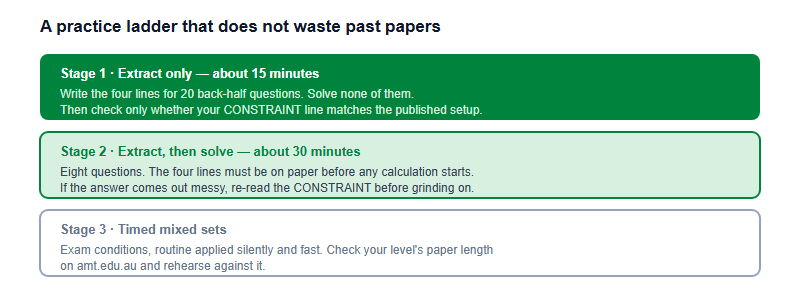
Two rules make the ladder work. Keep an extraction error log that records the misread phrase rather than the topic — “reversed a comparison” is a far more actionable entry than “got question 24 wrong,” because the phrase will reappear in a completely different topic. And never let extraction practice become answer-hunting: at stage 1 the answer is genuinely irrelevant, and looking at it defeats the drill.
What to do when extraction fails on the day
Sometimes you will read a question three times and the relationship still will not resolve. The scoring rules tell you exactly what to do, and they differ across the paper. On the multiple-choice questions there is no negative marking, so an unresolved question should never be left blank — eliminate what you can and commit to an answer, because a blank simply discards a free chance. On the final five questions you supply the answer rather than choose it, so a blind guess earns nothing there, though it costs nothing either; a partial attempt built from the conditions you did extract is worth more than a random number.
The practical move on a stuck back-half question is to write the GIVEN and CONSTRAINT lines you are confident about, mark the question, and move on. Returning with fresh eyes to a problem that is already half-decomposed on paper is dramatically faster than starting it again from prose — which is a further argument for writing the lines down in the first place.
One housekeeping note before you practise: make sure your materials belong to the right competition. The Australian AMC is run by the Australian Maths Trust and operated in China by ASDAN; the American AMC is a separate MAA competition, and AMO is different again, run by SIMCC. Their papers phrase problems differently, so practising on the wrong one trains the wrong reflexes. Our introduction to the Australian AMC makes the distinction clear, and rules and formats should always be confirmed on amt.edu.au.
Frequently asked questions
Does writing four lines waste time in a timed exam?
It costs about thirty seconds and mainly applies to back-half questions. One prevented misread pays for it many times over.
My child knows all the vocabulary but still misreads. Why?
Because the errors sit in comparison and boundary phrasing, not technical terms. Knowing what a word means does not stop a relationship being assembled backwards.
Should we read both languages on the bilingual paper?
Not for every question. Read your stronger language, then use the second version on back-half questions to verify the constraint specifically.
What if we cannot extract the condition at all on the day?
On multiple-choice, never leave it blank — there is no negative marking. On the final five you supply the answer, so make a reasoned partial attempt instead of a random guess.
Published by the Australian AMC editorial desk, operated by Hanlin Education for China-based international-school students. Official rules are set by the competition and change yearly — confirm current details on amt.edu.au. Errors are corrected within 7 working days.