
Measurement sits on the Australian Maths Trust’s published list of what the AMC assesses, and it leaks more marks than its difficulty deserves. Almost none of those losses are conceptual. They come from four repeatable places: converting units when the scale factor is squared or cubed, doing arithmetic in base 60 rather than base 10, comparing value across different quantities, and misreading a scale by one gap.
Why measurement costs marks it should not
AMT lists the assessed content as basic arithmetic, fractions and ratios, algebra and pre-algebra, geometry, measurement, statistics and probability, and problem-solving. Measurement is the only one of those that is simultaneously easy and hostile: the underlying maths is usually a single multiplication, but the question hides a unit switch, a clock rollover or a scale you have to interpret before any arithmetic starts.
That matters most at the cheap end of the paper. Questions 1 to 10 are worth 3 marks each on AMT’s published scheme, and measurement contexts turn up there often in the past papers we work through, because they are quick to state. A unit slip on Question 4 costs exactly as many marks as failing to solve it — and unlike a genuinely hard question, you were never going to get those marks back with more thinking. There is no penalty for incorrect responses, so a slip does not compound; it just quietly removes three marks you had already earned.
Students in China are not disadvantaged on the metric system itself — the units are the same ones used at school. The friction is elsewhere: the contexts are described in English on a bilingual paper, the questions switch units mid-sentence, and the answer is often demanded in a unit different from the one the question opens with. If you want the general picture of the paper before drilling a single topic, our guide to what the Australian AMC is and how it is structured sets the scene.
Family 1: conversion, and the squared and cubed trap
The single most expensive measurement error in this competition is assuming that a conversion factor for length carries unchanged into area or volume. It does not. If lengths convert by a factor of k, areas convert by k squared and volumes by k cubed.
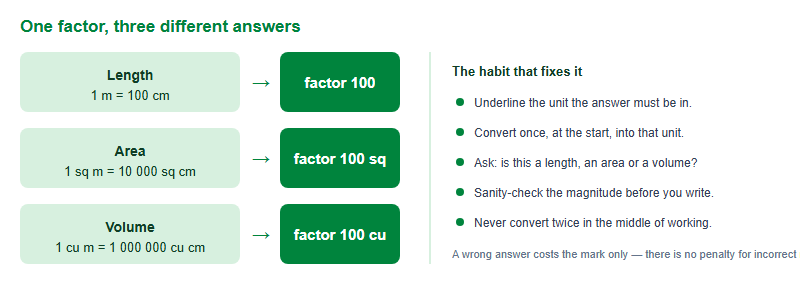
Keep a short conversion table in your head rather than a long one. The competition rewards fluency in the everyday factors, not encyclopaedic recall.
| Quantity | Conversion you should know cold | The trap |
|---|---|---|
| Length | 10 mm = 1 cm; 100 cm = 1 m; 1000 m = 1 km | Answering in cm when the question asks for m |
| Area | 1 sq m = 10 000 sq cm | Using 100 instead of 100 squared |
| Volume | 1 cu m = 1 000 000 cu cm | Using 1000 instead of 100 cubed |
| Capacity | 1 L = 1000 mL; 1 mL = 1 cu cm | Not spotting that capacity and volume are the same question |
| Mass | 1000 g = 1 kg; 1000 kg = 1 tonne | Rate questions that mix g and kg in one sentence |
| Time | 60 s = 1 min; 60 min = 1 h; 24 h = 1 day | Treating 1.5 hours as 1 h 50 min |
Family 2: time runs in base 60, and calendars run in base 7
Time questions are where confident arithmetic students lose marks, because the decimal instincts that serve them everywhere else are wrong here. Three specific failure points:
- Decimal drift. 2.25 hours is 2 hours 15 minutes, not 2 hours 25 minutes. The safe method is to work entirely in minutes, then convert back at the end — one conversion, at the point you already know the unit the answer wants.
- Rollovers. Elapsed time across an hour boundary, across midday, or across midnight. Convert both clock times into minutes-since-midnight, subtract, and add 24 hours’ worth of minutes if the result is negative. This is mechanical and it never fails; mental clock-face reasoning fails often under time pressure.
- Notation. A paper may state times in 12-hour form with am and pm, or in 24-hour form. Neither is harder, but switching between them mid-question is where a careless hour goes missing.
Calendar questions are a different mechanism again: they are remainder arithmetic in disguise. “If today is Tuesday, what day is it in 100 days?” is not a counting problem — 100 divided by 7 leaves a remainder of 2, so the answer is two days after Tuesday. Any question that asks about a day of the week a long way off is asking you to divide by 7 and keep only the remainder. It is also worth knowing the number of days in each month and the leap-year rule: a year is a leap year if it is divisible by 4, except that century years must be divisible by 400.
Family 3: money, and the “which is better value” question
Money questions on this paper are rarely about money. They are a wrapper for three underlying skills: totalling and finding change, comparing unit rates, and reasoning about combinations of denominations. Two notes specific to students sitting in China:
First, the currency symbol may not be the one you use daily, and it does not matter. The arithmetic is identical whatever the unit is called. Do not spend a second mentally converting into a familiar currency — that introduces an error and buys nothing. Treat the symbol as a label.
Second, value-comparison questions are best answered by forcing both options into the same unit rate before comparing. Price per gram, price per litre, price per item — pick one and convert both sides. Students who try to compare a “three for the price of two” offer against a “20% off” offer by intuition get it wrong at a startling rate; students who compute both as a price per item almost never do.
Denomination questions — how many ways can an amount be made, or what is the smallest number of coins — are combinatorial rather than arithmetic. Work greedily from the largest denomination downwards for “fewest coins”, and work systematically from the largest downwards when counting possibilities, so you can prove you have not missed a case.
Family 4: reading a scale, and the perimeter that is not additive
Scale-reading questions appear on rulers, thermometers, measuring jugs, dials and number lines. There is exactly one habit that fixes almost all of them: count the gaps, not the marks. Five marks on a scale create four intervals, so a scale from 0 to 20 with five labelled marks steps in fives, not fours.
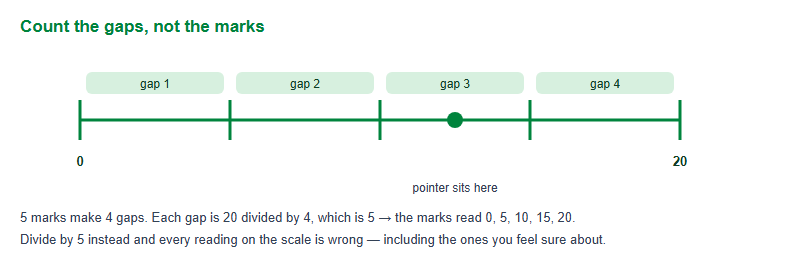
Perimeter, area and volume questions carry their own recurring confusion. Area is additive when you cut a shape into pieces; perimeter is not. Join two squares along an edge and the total area doubles, but the perimeter does not — the shared edge disappears from the outside. Composite-shape questions on this paper exploit that difference constantly. Draw the shape, mark every outside edge you will actually walk along, and only then add.
One further habit worth building: check the magnitude before you commit. A room with an area of 20,000 square metres is not a room. A journey of 4 kilometres taking 4 seconds is not a journey. In our coaches’ experience, many measurement slips would have been caught by a two-second plausibility check, and no marks are at risk from performing one.
A three-week measurement repair plan
Measurement is unusually responsive to short, targeted work, because the failures are habits rather than gaps in knowledge. If you have three weeks before the sitting on 11 October, this is a realistic shape for them. Results vary by student and starting point.
One thing to settle before you start drilling: which level you are actually sitting. The measurement contexts stretch a long way between Pre-A and Level E — a Grade 3 question about reading a jug and a Grade 11 question about compound units are the same family and nothing like the same work. Practising the wrong band wastes the whole three weeks, so check your level against the grade bands for the six levels before you choose material.
| Week | Focus | Daily drill (15 minutes) | What “done” looks like |
|---|---|---|---|
| 1 | Conversion discipline | 10 conversions, half of them area or volume | You never use a length factor on an area |
| 2 | Time and calendars | 5 elapsed-time questions, 3 day-of-week questions | You convert to minutes automatically, and divide by 7 without prompting |
| 3 | Scales, money, composites | 5 mixed past questions, marked with unit annotation | You underline the required unit before starting every question |
Two rules make the drill work. Annotate the unit the answer is asked for before you begin any calculation — physically, on the paper or on your rough working. And record every measurement slip by type, not by question number: “area factor”, “clock rollover”, “gap count”. Three weeks of typed records tells you which single habit is costing you the most, which is a far more useful output than a list of questions you got wrong.
Measurement will never be the topic that wins you an award on its own. It is the topic that stops one from slipping away three marks at a time, at the cheap end of a 135-mark paper where those marks were already yours.
Questions we get asked
Is measurement actually tested on the Australian AMC?
Yes. AMT lists measurement among the assessed topics, alongside arithmetic, fractions and ratios, algebra, geometry, statistics and probability.
What is the most common measurement mistake?
Using a length conversion factor on an area or volume. One square metre is 10,000 square centimetres, not 100.
How do I handle day-of-the-week questions?
Divide the number of days by 7 and keep only the remainder. Counting forwards day by day wastes time and invites error.
Does an unfamiliar currency symbol make money questions harder?
No. Treat the symbol as a label and do the arithmetic. Converting into a familiar currency adds risk and gains nothing.
Published by the Australian AMC editorial desk, operated by Hanlin Education for China-based international-school students. Official rules are set by the competition and change yearly — confirm current details on amt.edu.au. Errors are corrected within 7 working days.