
The jump from Credit to Distinction is almost never made on the last five questions. On AMT’s published mark scheme, Questions 11 to 25 carry 65 of the 135 marks — more than the first ten (30 marks) and more than the last five (40 marks). Students who plateau at Credit are usually secure at the front, ambitious at the back, and rushed in the middle, where half the paper’s marks actually sit.
Where the marks actually live
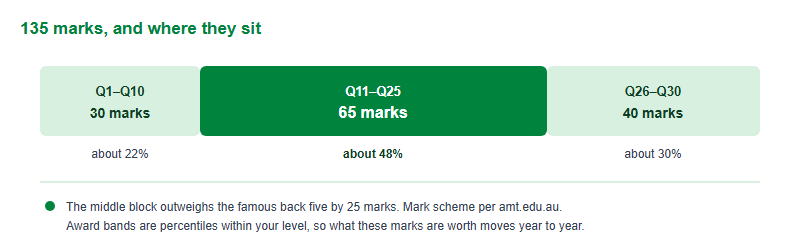
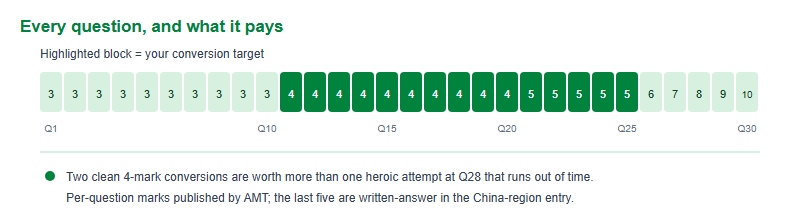
AMT publishes the weighting openly, and it is worth doing the arithmetic yourself rather than absorbing a vague sense that later questions are worth more. Questions 1 to 10 are 3 marks each. Questions 11 to 20 are 4 marks each. Questions 21 to 25 are 5 marks each. Questions 26 to 30 are worth 6, 7, 8, 9 and 10 marks respectively. Total: 135 marks across 30 questions, with no penalty for incorrect responses.
| Block | Questions | Marks each | Block total | Share of 135 |
|---|---|---|---|---|
| Front ten | Q1–Q10 | 3 | 30 | about 22% |
| Middle fifteen | Q11–Q25 | 4, then 5 | 65 | about 48% |
| Back five | Q26–Q30 | 6, 7, 8, 9, 10 | 40 | about 30% |
Read that table again, because it contradicts how most students allocate their attention. Nearly half the paper’s marks are in a block that gets talked about least. The back five are the glamorous end — they are hard, they are written-answer in the China-region entry and therefore cannot be guessed, and they are what people mean when they say the paper “gets difficult”. But all five of them together are worth less than Questions 11 to 25.
A band is a rank, not a score
Before planning anything, understand what you are aiming at. Credit, Distinction and High Distinction are percentile awards, not fixed scores. In the China-region entry, Credit covers roughly the top 55% of a level (top 60% at Level E), Distinction the top 20% (25% at E), High Distinction the top 3% (5% at E), and the Prize the top 0.3% across Levels A to E.
That has one practical consequence people miss: there is no target score. The mark that earned a Distinction in one level in one year is not the mark that earns it in another level, or in the same level next year, because the cohort moves. Anyone quoting you a fixed “Distinction cut-off” is quoting a historical artefact, not a rule. If you need the figures attached to your own level, ask ASDAN rather than inferring from a table you found online.
What you can control is coverage: how many of the paper’s marks you reliably convert. And because the bands are relative, the most efficient path upward is to convert the marks that most of your band is also leaving on the table — which is precisely the middle block, not the back five that hardly anyone finishes. If you are still orienting yourself to how the competition is structured, our introduction to the Australian AMC covers the format before you start optimising within it.
The plateau pattern
This next part is our coaching team’s reading of the students we work with in the China region, not a published finding by AMT, and results vary. But it is consistent enough to be worth naming.
A student stuck at Credit usually looks like this. They score almost everything in Questions 1 to 10, because that material is genuinely secure. Then they hit Question 12 or 14, meet something that needs two steps rather than one, and instead of settling into it they either rush it or park it. By Question 20 they are behind the clock. They arrive at the back five with fifteen minutes and real ambition, spend most of that time on Question 26, and finish having converted the cheap marks and almost none of the expensive middle ones.
The arithmetic of that is brutal. Perfect on the front ten and nothing else is 30 out of 135. Perfect on the front ten plus the ten 4-mark questions is 70 — more than double, without touching a single question anyone would call hard. The students who move up a band are rarely the ones who cracked Question 28. They are the ones who stopped losing Questions 13, 16 and 19.
The conversion protocol
If you have a few weeks before 11 October, aim the whole of it at Questions 11 to 25. Not new topics — conversion of questions you can nearly do.
- Sort your near-misses. Go through recent practice and separate three piles: got it, nearly had it, no idea. The middle pile is the entire project. The “no idea” pile is not where your next band is.
- Time-box the two-step questions. Most 4- and 5-mark questions are one insight plus one calculation. Practise at a fixed pace — set a timer per question and stop when it goes, whether or not you are finished. The skill being trained is recognising within thirty seconds whether you have the insight.
- Rehearse the abandon decision. The costly habit is not failing a question, it is failing it slowly. Decide in advance: if nothing has opened up after your time-box, mark an answer and move. There is no penalty for incorrect responses on the multiple-choice questions, so a parked question should still carry a response.
- Treat the last five differently. In the China-region entry these are written-answer and cannot be guessed, so a blank costs nothing that a wrong guess would have saved. Attempt them with whatever time genuinely remains — not with time borrowed from Question 17.
- Second-pass discipline. Budget the final few minutes to return to the middle block, not to the back. Returning to a 4-mark question you half-solved is the highest-yield minute on the paper.
One honest caveat, because the advice inverts higher up the scale. If you are already landing comfortably inside Distinction and aiming at High Distinction — the top 3% of a level, or 5% at Level E — then the middle block is presumably already converted, and the back five stop being optional. At that point the 6-, 7-, 8-, 9- and 10-mark questions are the only marks left to win, and they reward exactly the deep, unhurried practice this article told everyone else to postpone. Know which of those two students you are before you choose a plan; the answer is in your last full paper, not in your ambition. Which level you sit also sets the pitch of the whole paper, so check yours against the six level bands if there is any doubt.
Doing the clock arithmetic
Durations differ by level in the China-region entry, so confirm yours with ASDAN rather than assuming. For reference, AMT publishes 60 minutes for its Australian primary divisions and 75 minutes for its secondary divisions.
Whatever your figure is, do the division before exam day. On a 75-minute paper, giving the back five 20 minutes leaves 55 minutes for 25 questions — a shade over two minutes each. That average is the number worth internalising, because it tells you that a five-minute struggle on Question 14 is not a small overrun; it has eaten two other questions. In our coaching experience, students who have never computed their own per-question budget are often surprised by how long individual middle questions actually take them.
| Habit | What it costs | What to do instead |
|---|---|---|
| Starting at Q30 to “see the hard ones” | Clock and confidence, before any marks are banked | Work forward; the front ten are your fastest marks per minute |
| Refusing to leave a middle question | Two later questions, silently | Time-box, answer, flag, move |
| Leaving multiple-choice questions blank | Free expected marks — there is no penalty | Every multiple-choice question carries a response |
| Spending the last pass on Q26–Q30 | The highest-probability marks on the paper | Second pass belongs to Q11–Q25 |
| Chasing a remembered “cut-off score” | Planning against a number that does not exist | Plan coverage; bands are percentiles set after the event |
None of this guarantees an award — bands depend on how everyone else in your level performs, and outcomes vary. What the arithmetic does guarantee is that effort aimed at Questions 11 to 25 works on 65 marks, while effort aimed at the back five works on 40 marks that are also harder to reach. If you are choosing where to spend the weeks before the sitting, that is not a close call.
Questions we get asked
Which questions carry the most marks in total?
Questions 11 to 25, at 65 of the 135 marks. The last five carry 40 and the first ten carry 30.
Is there a score that guarantees a Distinction?
No. Distinction is a percentile band — roughly the top 20% of a level, or 25% at Level E — so the mark required moves with the cohort.
Should I guess if I run out of time?
On multiple-choice questions, yes: there is no penalty for incorrect responses. The final five are written-answer, so guessing gains nothing there.
How long is the paper?
Durations vary by level in the China region — confirm with ASDAN. AMT publishes 60 minutes for Australian primary divisions and 75 for secondary.
Published by the Australian AMC editorial desk, operated by Hanlin Education for China-based international-school students. Official rules are set by the competition and change yearly — confirm current details on amt.edu.au. Errors are corrected within 7 working days.