
The Australian Maths Trust publishes the topic scope of the AMC in seven short lines, and it is considerably narrower than most September study plans. The paper contains no written proof, no coursework, and no test of your school's scheme of work. With a month left before 11 October, knowing what the paper never asks for is worth about as much as knowing what it does.
What AMT actually publishes as the scope
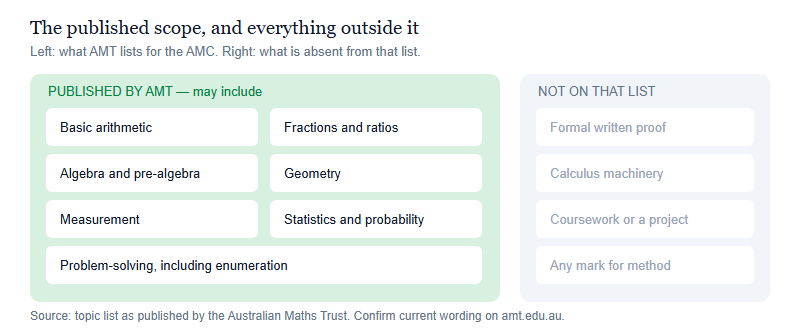
AMT lists the mathematical territory of the AMC as: basic arithmetic; fractions and ratios; algebra and pre-algebra; geometry; measurement; statistics and probability; and problem-solving, including enumeration. That is the whole published list. It fits comfortably on one line of a page and it has not been engineered to intimidate anybody.
Two honest qualifications before you build a plan on it. First, AMT frames this as a list of what the questions may include, not an exhaustive syllabus with a fence around it, so treat it as the paper's centre of gravity rather than a guarantee about any individual question. Second, the list is deliberately topic-shaped, and the AMC's difficulty has never come mainly from topics. It comes from how far a familiar idea has been bent before it reaches you. A question about the area of a rectangle sits inside “measurement” whether it takes eight seconds or eight minutes.
That second point is why the list is more useful as a subtraction tool than as a revision checklist. It tells you what is not there. And what is not there turns out to be exactly where a lot of September effort goes.
Not tested: your working
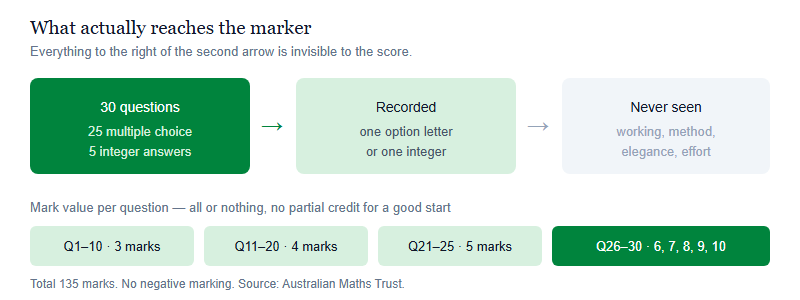
The AMC paper is 30 questions — 25 multiple choice and 5 requiring an integer answer — and AMT publishes a single mark value for each one: three marks for questions 1 to 10, four for 11 to 20, five for 21 to 25, and then 6, 7, 8, 9 and 10 marks for the last five, totalling 135. There is no written-solution component anywhere in that structure. What reaches the marker is a chosen option or a number, so a question is best treated as all-or-nothing at its band value.
Three consequences follow, and only the first is obvious.
- Elegance earns nothing. A student who finds the slick two-line argument and a student who grinds out the same answer by listing eighteen cases both score the band value. On a competition where the clock is the real opponent, the slick route is worth having — but for time, not for credit.
- There is no rescue for a good idea with a bad ending. In a school exam, most of a correct method survives an arithmetic slip. Here, none of it does. This is the single biggest adjustment for strong students, and it changes what “checking” means: you are not checking that the approach was sensible, you are checking that the final number is the one the question asked for.
- Practising written write-ups is not AMC practice. It is a genuinely valuable school skill and it makes students think more clearly. It is simply not the thing being scored on 11 October, so it should not be eating the last three weeks.
One caution, because we have seen families over-correct on this. “Working is not marked” is not the same as “do not write anything down”. In our own coaching the students who lose the most avoidable marks are usually the ones doing multi-step problems entirely in their heads. Working is a thinking tool that happens not to be a scoring tool. Keep the scratch paper; drop the presentation.
Not tested: whether your school has covered the topic yet
The AMC is not aligned to any single curriculum sequence. It is not built around the IB unit order, the British scheme of work, the mainland textbook chapter list, or the AP calendar, and it does not wait for your school to reach a topic before asking about it. That cuts in both directions, and families usually only notice one of them.
The direction most families notice: “we haven't done that yet”. It is not a reason to panic and it is rarely a reason to skip a practice question. AMC problems are built so that the mathematical machinery required stays modest — the published scope tops out at algebra, geometry, measurement and basic probability — and much of what looks unfamiliar is a familiar idea in unfamiliar clothing. A student who has never seen the phrase “arithmetic sequence” can still work out the ninetieth term by noticing the pattern.
The direction almost nobody notices: finishing a school unit is not preparation. A term of quadratics does not prepare a student for a question that hides a quadratic inside a story about a garden path, because the school unit trains recognition-by-context (“this is the quadratics chapter, so factorise”) and the AMC removes exactly that scaffold. This is the gap that surprises the strongest students in the cohort, and it is why report-card evidence and competition evidence say genuinely different things about a student rather than duplicating each other. Our overview of what the Australian AMC is sets out the structure that produces this effect.
Not tested: caution
The AMC applies no negative marking. A wrong answer scores zero; so does a blank. On the 25 multiple-choice questions this makes restraint mathematically pointless — leaving one empty is never better than putting something in the box, and one of the last things to do before time is called is to make sure no multiple-choice question has been left unanswered.
The five integer questions behave differently, and this is where a rule of thumb becomes a trap. A blind guess at a multiple-choice question has a real chance of landing. A blind guess at an integer answer, drawn from a wide range of possible values, effectively does not. So the same no-penalty rule produces two different instructions: fill in every multiple-choice box without exception, and put a number in an integer box only when you can defend it. Neither instruction costs you anything, which is precisely why neither is a strategy worth spending three weeks rehearsing.
The audit: what to keep and what to drop before 11 October
Set the published scope against what actually sits in a typical September plan. The verdict column below is ours, not AMT's — it reflects what we see change scores in the final fortnight.
| September activity | Does the paper reward it? | Verdict for the last three weeks |
|---|---|---|
| Timed past papers under real conditions | Directly — it is the same task | Keep. The highest-value hour available to you |
| Reworking questions you got wrong, without looking at the answer first | Directly | Keep. Second-highest value |
| Writing full solutions neatly | No — nothing but the final answer is recorded | Drop the neatness; keep the scratch working |
| Mental-arithmetic speed drills | Marginally | Cap it. See the timing note below |
| Working ahead in the school textbook | Indirectly at best | Drop for now — it is term work, not contest work |
| Learning proof technique or advanced formulae | Not on the published list | Drop. Genuinely valuable, wrong three weeks |
| One full rehearsal in the delivery mode you registered for | Indirectly, but heavily | Keep. Non-negotiable |
The timing note, because it is the argument against speed drilling. AMT publishes 60 minutes for its primary divisions and 75 minutes for its secondary divisions. Across 30 questions that is an average of two minutes, or two and a half at the secondary end — and averages understate it, because the early questions should take far less than their share and leave the surplus for the back five. This is not a mental-arithmetic sprint. A student who can compute quickly but cannot decide what to compute will not be saved by another fortnight of drills. (China-region sitting lengths do not map cleanly onto AMT's Australian divisions — our own records show shorter sittings at the youngest end — so confirm the duration for your level with ASDAN and set the practice timer to that number.)
Frequently asked questions
What topics does AMT say the AMC covers?
Arithmetic, fractions and ratios, algebra and pre-algebra, geometry, measurement, statistics and probability, and problem-solving including enumeration.
Do students get marks for showing their working?
No. The paper records a chosen option or an integer, and AMT publishes one mark value per question, so treat each as all-or-nothing.
Is a topic we have not covered at school a reason to skip a practice question?
Usually not. The published scope stays modest, and most unfamiliar wording is a familiar idea presented differently.
Should my child leave hard multiple-choice questions blank?
Never. There is no negative marking, so an unanswered multiple-choice question can only cost marks, never save them.
Published by the Australian AMC editorial desk, operated by Hanlin Education for China-based international-school students. The Australian Mathematics Competition is run by the Australian Maths Trust (AMT), with the China region administered by ASDAN. Official rules are set by the competition and change yearly — confirm current details on amt.edu.au. Errors are corrected within 7 working days.